Introduction
Picture this: You're driving through your Buffalo neighborhood and notice your neighbor's lawn looks thick, lush, and uniformly green. Meanwhile, your own yard has patchy areas, some sections that seem to grow faster than others, and maybe a few suspicious clumps that don't quite match the rest. The difference comes down to one thing: knowing what grass you actually have and caring for it correctly.
Identifying your grass type isn't just botanical trivia — it's the foundation of every smart lawn care decision you'll make. Mowing height, watering schedules, fertilization timing, and which weed control products are safe to use all depend on knowing what's growing in your yard.
Get it wrong, and the consequences are real. Apply the wrong herbicide to Fine Fescue and you'll end up with bleached, dying patches. Mow Kentucky Bluegrass too short, and it won't recover.
This guide covers:
- Key features to observe when identifying grass
- Common cool-season species found in Buffalo-area lawns
- A practical step-by-step identification process
- Critical mistakes that can damage your turf
Key Takeaways
- Lawns in the Buffalo, NY area are typically cool-season grasses — Kentucky Bluegrass, Tall Fescue, Perennial Ryegrass, or Fine Fescue
- Identify grass using blade shape, color, texture, growth habit, and vernation (how shoots emerge)
- Most Northern lawns are seed mixes—color and texture variation is normal
- Wrong herbicide or mowing height can cause serious damage
- Close-up blade inspection combined with regional knowledge gives reliable results
Why Identifying Your Grass Type Matters
Different grass species have wildly different care requirements. Kentucky Bluegrass thrives with frequent mowing at 2.5 to 3 inches and regular fertilization in fall. Tall Fescue, by contrast, prefers mowing at 3 to 4 inches and tolerates drought better with deep, infrequent watering. Fertilization schedules, watering needs, and safe herbicide options vary significantly between species.
The herbicide risk is real: products like mesotrione (Tenacity) or oxadiazon (Ronstar) are safe for Kentucky Bluegrass and Tall Fescue but will severely bleach or injure Fine Fescues. Applying the wrong pre-emergent herbicide can destroy sections of your lawn overnight.
Correct identification also helps troubleshoot common problems. If you notice patchiness or slow green-up in spring, knowing whether you have a bunch-type grass (Tall Fescue, Perennial Ryegrass) versus a rhizomatous spreader (Kentucky Bluegrass) changes how you approach overseeding and thatch management.
Bunch-type grasses grow in clumps and won't fill in bare spots on their own, so overseeding is the only fix. Kentucky Bluegrass spreads via underground runners and can repair itself if given proper care.
In the Buffalo area, lawns often contain a mix of cool-season grasses that respond differently to Western New York's wet springs and cold winters. Percy's Lawn Care and Son has spent over 25 years identifying these regional grass types before recommending any care plan — because the right approach depends entirely on what's actually growing.
Key Features to Look For When Identifying Your Grass
Grass identification comes down to four physical traits. Learn what each one looks like, and you can accurately name most cool-season species in a Buffalo lawn without any specialized tools.
Blade Shape and Tip
The leaf tip is one of the most reliable identifiers. There are three main shapes:
- Boat-shaped/keeled tip — The blade tip looks like the prow of a boat when viewed from above. Kentucky Bluegrass has this distinctive shape.
- Flat, pointed tip — The blade tapers to a sharp point. Tall Fescue and Perennial Ryegrass have pointed tips.
- Needle-like blades — Very narrow, almost bristle-like. Fine Fescues have this ultra-thin blade structure.
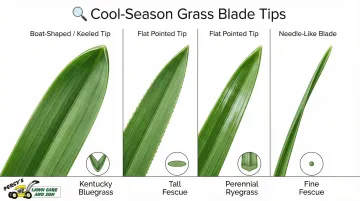
Pull a single blade and examine it against a light background. The tip shape becomes obvious once you know what to look for.
Color and Texture
Color ranges across the cool-season spectrum:
- Deep blue-green — Kentucky Bluegrass has a distinctive blue tint
- Dark green — Perennial Ryegrass and Tall Fescue tend toward darker shades
- Gray-green or dull green — Fine Fescues often look muted or grayish
Texture varies from fine and soft (Kentucky Bluegrass, Fine Fescue) to coarse and stiff (Tall Fescue). Run your hand across the blades — Tall Fescue feels rough, while Kentucky Bluegrass feels soft and pliable.
Check the underside of the blade. A glossy, shiny underside is the hallmark of Perennial Ryegrass. All other cool-season grasses have dull undersides.
Growth Habit
Grasses spread in three main ways:
- Rhizomatous — Kentucky Bluegrass spreads via underground stems (rhizomes), forming a dense, self-repairing turf
- Bunch-type — Tall Fescue, Perennial Ryegrass, and Fine Fescue clump and don't spread laterally; they appear as isolated tufts when establishing
- Stoloniferous — Spreading via above-ground runners; rare in Buffalo-area cool-season lawns
If you notice coarse clumps that stand out against the rest of your lawn, you're likely seeing Tall Fescue's bunch-type growth, not a weed.
Vernation
Vernation describes how the youngest grass shoot is arranged inside the leaf sheath. There are two types:
- Folded — Feels flat with a crease when rolled between your fingers (V-shaped cross-section). Kentucky Bluegrass and Fine Fescue both fall into this category.
- Rolled — Feels round, like a tiny straw. Tall Fescue has rolled vernation.
To check, carefully pull apart the newest shoot at the base of the plant and roll it gently. The shape becomes apparent right away.
Common Cool-Season Grass Types Found in Buffalo-Area Lawns
Buffalo sits firmly in the cool-season grass zone, where grasses peak in spring and fall and may slow down or go semi-dormant during peak summer heat. You should expect to find one or more of these four species in your lawn.
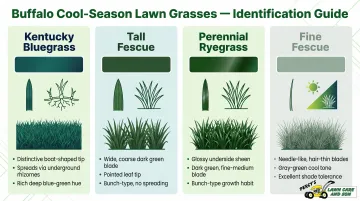
Kentucky Bluegrass
Identifying traits:
- Boat-shaped leaf tip (the key identifier)
- Prominent single mid-vein running down the center of the blade
- Deep blue-green color
- Soft, fine texture
- Spreads aggressively via underground rhizomes, forming thick, connected turf
Kentucky Bluegrass is the most popular cool-season grass in Northern U.S. residential lawns. It thrives in full sun but struggles in deep shade. It's prone to thatch buildup and requires regular aeration.
Tall Fescue
Identifying traits:
- Wide, coarse blades with many parallel veins running the full width
- Pointed (not boat-shaped) tip
- Rolled vernation
- Dark green color
- Bunch-type clumping growth
Tall Fescue is often mistaken for a grassy weed when it appears in patches. It has excellent heat and drought tolerance compared to other cool-season grasses, thanks to its deep root system. It's a common choice for Buffalo lawns that get afternoon sun and need resilience during dry spells.
Perennial Ryegrass
Identifying traits:
- Glossy, shiny underside of the blade (the key identifier—when you mow, it leaves a whitish cast)
- Fine texture
- Dark green color
- Fast germination rate (5 to 14 days)
- Bunch-type growth
Perennial Ryegrass germinates rapidly, making it a frequent component of seed mixes with Kentucky Bluegrass. The shine on its leaves is visible from a few feet away—easy to pick out once you know what to look for.
Fine Fescue
Identifying traits:
- Very narrow, almost needle-like blades (1/16 inch or less)
- Dull gray-green color
- Soft, fine texture
- Folded vernation
Fine Fescue is the most shade-tolerant of common cool-season grasses and is widely used in seed mixes for shaded Buffalo yards. It doesn't tolerate heavy foot traffic or summer heat well and may go dormant during hot, dry stretches.
Mixed Lawns
The majority of Buffalo-area residential lawns contain a blend of Kentucky Bluegrass, Perennial Ryegrass, and Fescues. These mixes are intentionally designed to balance sun tolerance, shade tolerance, and traffic resistance.
How to spot a mixed lawn:
- Subtle color and texture variation across the lawn
- Some areas show finer blades (Kentucky Bluegrass, Fine Fescue)
- Other areas show coarser blades (Tall Fescue)
- Glossy patches (Perennial Ryegrass) mixed with dull patches
Mixed lawns are standard in the Buffalo area, and the variation you see is intentional. Each species fills a role—one handles the shade, another bounces back from drought, another establishes quickly after seeding.
How to Identify Your Grass Type: A Step-by-Step Approach
Identifying your grass doesn't require special equipment: just your eyes, your hands, and a methodical approach that starts broad and narrows down.
Step 1 — Confirm Your Climate Zone
Buffalo and all of Western NY are classified as USDA Zone 6b, which is cool-season grass territory. This immediately rules out warm-season grasses like Bermudagrass, Zoysia, or St. Augustine and narrows the field to the four cool-season species described above.
Cool-season grasses green up in spring when soil temperatures reach 40–50°F and may show stress when summer temperatures climb above 85°F.
Step 2 — Do a Lawn-Wide Visual Scan
Walk your lawn and observe:
- Overall color and texture uniformity
- Patchy areas with noticeably different blade width or color
- Glossy versus dull patches (ryegrass vs. bluegrass)
- Coarser clumping areas (tall fescue)
- Very fine needle-like sections (fine fescue)
Take photos of different zones for reference. This helps you remember which areas looked different when you examine individual blades.
Step 3 — Examine Individual Blades Up Close
Pull several individual blades from different lawn areas and check:
- Blade width and tip shape — Boat-shaped, pointed, or needle-like?
- Underside of the blade — Glossy or dull?
- Number of visible veins — Single prominent vein or many parallel veins?
- Vernation of the shoot (how it's packaged in the bud) — Roll the shoot between your fingers to feel whether it's folded flat or rolled into a cylinder
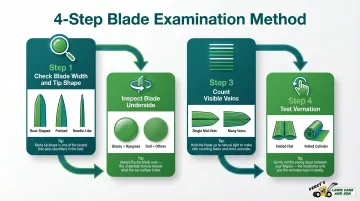
Cross-reference these observations with the identifying features of each grass type described in this guide.
Step 4 — Use Tools and Professional Resources If Needed
Plant identification apps like PictureThis or iNaturalist can provide a starting point by analyzing a photo of the grass. However, accuracy varies significantly for grasses without floral structures, dropping to around 57%.
For definitive identification, your local Cornell Cooperative Extension office in Erie County can assist with grass identification. Bringing a full sample—root to tip including any seed head—gives the best results. There's a $5 fee per specimen.
Once you've confirmed your grass type, the next step is translating that knowledge into a care plan. That's where a local professional adds real value — Percy's Lawn Care and Son has been working Buffalo lawns since 1999 and can match your grass type to the right mowing schedule, seasonal cleanup, and treatment approach for your specific yard.
Common Grass Identification Mistakes to Avoid
Treating Tall Fescue as a Weed
The most common error: assuming a clumpy, coarser-bladed patch is a weed when it's actually Tall Fescue. Tall Fescue's bunch-type growth makes it stand out against a uniform Kentucky Bluegrass lawn, leading homeowners to treat it as an invader.
Reaching for herbicides to kill it can damage surrounding turf. True grassy weeds like crabgrass grow flat to the ground and have a different blade structure. Tall Fescue is a legitimate turf grass—it just looks different.
Relying on Color Alone
Grass color is highly unreliable for identification. Any of the following can shift a grass's color well outside its normal range:
- Drought stress turns Kentucky Bluegrass pale green or gray-tinged
- Dense shade lightens most cool-season grasses noticeably
- Soil pH imbalance causes yellowing, especially in Fine Fescue
- Nutrient deficiency produces similar symptoms across all grass types
Always pair color with blade shape, texture, and vernation before drawing any conclusions.
Using Warm-Season Care Schedules
Some homeowners follow generic lawn care advice that assumes warm-season grasses and fertilize or overseed at the wrong time of year. For cool-season lawns in Buffalo, late August through September is the most critical window for overseeding and fertilization, not summer.
Fertilizing in mid-summer stresses cool-season grasses further and can set back recovery.
Frequently Asked Questions
What grass type is most common in Buffalo, NY lawns?
Buffalo lawns predominantly contain cool-season grasses, most often a blend of Kentucky Bluegrass, Perennial Ryegrass, and Fescues. Single-species lawns are less common than seed mixes in residential settings.
Why does grass type matter for weed control?
Grass type directly affects which herbicides are safe to use. Some products that work fine on Kentucky Bluegrass can damage Fine Fescue, and vice versa. Identifying your grass before any treatment prevents costly mistakes and avoids killing the turf you're trying to protect.
Can I have more than one type of grass in my lawn?
Yes. Most Buffalo-area lawns contain a mix of 2-3 cool-season grass species intentionally blended in commercial seed mixes. Visible texture or color variation across the lawn is normal and not a problem.
What's the difference between cool-season and warm-season grass?
Cool-season grasses (found in Buffalo) peak in spring and fall and tolerate cold winters. Warm-season grasses thrive in summer heat and go dormant in cold. Western NY's climate makes warm-season grasses a poor fit for year-round lawns.
How do I tell Tall Fescue apart from a grassy weed in my lawn?
Tall Fescue has wide, coarse blades that roll into a tube at the base (rather than folding flat) and a pointed leaf tip. It grows in clumps, which can look weedy, but it's a legitimate turf grass. True grassy weeds like crabgrass tend to grow flat to the ground and have a different blade structure.
When is the best time to overseed a cool-season lawn in Buffalo?
Late summer to early fall (late August through September) is optimal for Buffalo-area cool-season lawns. Soil temperatures are still warm enough for germination, but cooling air temperatures reduce competition from weeds and heat stress.