In Buffalo and across Western New York, spring lawn care comes with unique challenges. A long winter, heavy snowmelt, and clay-heavy soils that stay cold and saturated well into April create a narrow timing window for everything from mowing to fertilization. The mistakes that hurt lawns here often stem from doing too much, too soon—or missing that critical window entirely.
This article covers the six most common spring lawn care mistakes that damage Buffalo-area lawns, and more importantly, what to do instead.
What's the Short Version?
- Don't mow, fertilize, or walk on your lawn until the soil passes the crumble test
- Follow the one-third mowing rule and sharpen blades 4–6 times per season to prevent disease
- Fertilize after 2–3 mows (typically late April to May in Buffalo), not by the calendar
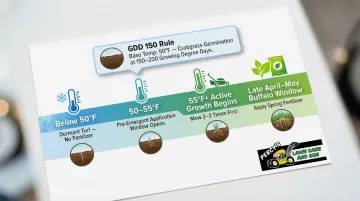
- Apply pre-emergent weed control before soil temps reach 50–55°F or crabgrass has already germinated
- In Buffalo, snowmelt saturates soil for weeks — early overwatering causes more damage than drought
Mistake #1: Working Your Lawn Before It's Ready
The first warm day hits and the temptation is overwhelming: grab the mower, fertilizer spreader, and aerator all at once. In Buffalo, where winters stretch into April and snowmelt can leave soil saturated for weeks, acting too soon is one of the most damaging mistakes a homeowner can make.
What Happens When You Work Wet Soil
When equipment and foot traffic hit cold, soggy soil, compaction happens fast. Water can't be compressed, so surface stress transfers directly to the subsoil — a phenomenon known as the "hydraulic ram" effect.
Root channels get crushed, and the grass crown (still dormant or barely waking up) can sustain physical damage before it has any chance to recover. Penn State Extension research confirms that subsoil compaction from wet-soil work isn't reversed by freeze-thaw or wetting-drying cycles — it's essentially permanent.
How to Know When Your Lawn Is Ready
Use the crumble test: Take a handful of soil and form it into a ball. If it holds together and doesn't fall apart when gently poked, it's too wet. Wait until the soil crumbles easily in your hand—not soggy or muddy—before any spring raking, mowing, or aeration begins.
Additional readiness signals:
- Walking across the lawn doesn't leave deep impressions
- Daytime temperatures consistently reach the mid-50s
- The grass is visibly greening up on its own
In Buffalo, this typically arrives later than homeowners expect—often mid-to-late April or even early May.
Jump in before these signals appear and you risk undoing months of natural recovery — damage that won't show up until midsummer, when it's too late to correct it.
Mistake #2: Mowing Too Short or With Dull Blades
Dropping the mower to its lowest setting for the first cut of the season seems efficient—but scalping the lawn exposes soil and grass crowns to direct sun, stresses the plant, and strips away the leaf area the grass needs to photosynthesize and recover from winter dormancy.
The One-Third Rule
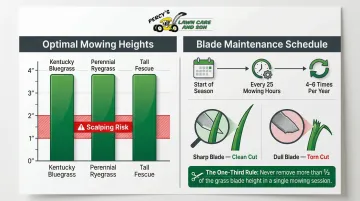
Never remove more than one-third of the grass blade in a single mowing session. Removing more causes physiological shock, halts root growth, and leads to clumping. If the lawn is overgrown after winter, bring it down gradually over two or three mows rather than cutting it all at once.
Optimal spring mowing height for cool-season grasses (common in Buffalo lawns):
- Kentucky bluegrass: 3–4 inches
- Perennial ryegrass: 3–4 inches
- Tall fescue: 3–4 inches
Maintaining a height of 3 to 4 inches shades the soil, lowers soil temperatures, and reduces crabgrass infestations by 30% to 70%.
The Dull Blade Problem
Dull blades tear and shred the tips of grass blades instead of cutting cleanly. The result is ragged, whitish-tipped grass that loses moisture faster and becomes a prime entry point for fungal disease.
The consequences are measurable:
- Water use increases by 30% when mowing with dull blades
- Mower fuel consumption rises by roughly 20–25%
- Torn leaf blades provide pathogen entry points, increasing susceptibility to brown patch and dollar spot
Visual indicator: Frayed, white-tipped grass blades signal immediate blade maintenance is needed. Sharpen mower blades at the start of the season and 4–6 times per year thereafter—or every 25 hours of mowing time.
Wait Until Active Growth
Mowing too early—before the grass is actively growing—weakens the root system and invites patchy growth. A reliable signal: wait until soil temperatures consistently reach 50°F and the lawn has visibly greened up before making the first cut.
Percy's Lawn Care and Son uses commercial-grade mowers with sharp, well-maintained blades on every visit—equipment that cuts cleanly in ways most residential mowers simply can't match, and that timing and blade quality show up directly in how the lawn looks and recovers through the season.
Mistake #3: Getting Your Fertilizer Timing Wrong
Applying fertilizer on the first warm day of spring, before the grass is actively growing, ends up feeding the weeds instead of the lawn. Nutrients released into soil where grass isn't yet metabolizing them get absorbed by opportunistic weeds or run off entirely.
The Correct Timing Signal
Wait until the lawn has completed a few genuine growth cycles—you've mowed two or three times—before applying a spring fertilizer. For cool-season grasses in the Buffalo area, this usually falls in late April to May.
Grass can only absorb fertilizer when it's actively growing. Turfgrass plants remain dormant when soil temperatures are below 55°F, so applying nitrogen to dormant or semi-dormant turf increases the risk of nutrient loss through leaching and runoff.
New York State law also prohibits lawn fertilizer applications between December 1 and April 1 to protect water quality.
The Over-Fertilizing Trap
Too much nitrogen, especially from fast-release products, can burn the grass outright. Burned patches often don't recover on their own and may require overseeding in fall.
Fast-Release vs. Slow-Release Nitrogen:
- Fast-release (water-soluble): Greens up quickly but burns easily, leaches readily, and drives boom-and-bust growth cycles
- Slow-release (water-insoluble): Feeds steadily over time with lower burn risk, longer residual color, and less nutrient runoff
Recommendation: Use fertilizers with 25–50% slow-release nitrogen to promote steady, sustained growth without rapid growth flushes.
The 150 Rule
The "150 Rule" is a method turf managers use to time pre-emergent applications by tracking Growing Degree Days (GDD). Using a base temperature of 50°F, smooth crabgrass begins to germinate when GDD accumulations reach approximately 150 to 200. It's primarily a professional tool, but it makes the point clearly: soil temperature data, not calendar dates, drives the best timing decisions.
For homeowners who find fertilizer timing confusing or easy to miss, a seasonal lawn care plan from a local professional like Percy's Lawn Care and Son keeps applications on track, timed to Buffalo's actual growing conditions rather than a generic national schedule.
Mistake #4: Overwatering When the Ground Is Already Saturated
After a heavy-snowmelt season, Buffalo soils are often already holding substantial moisture. Adding irrigation on top of that drowns grassroots, promotes shallow root systems, and creates ideal conditions for mold and fungal issues—especially in shaded or low-lying areas.
The Correct Approach
Let the lawn dry out slightly between natural rainfall events before introducing any irrigation. When watering does begin, aim for deep, infrequent sessions—roughly 1.0 to 1.5 inches of water per week, including rain—rather than light daily watering that keeps the surface perpetually wet.
Why deep, infrequent watering works:
- Encourages deep root development
- Reduces shallow rooting that makes turf vulnerable to traffic damage and pests
- Minimizes disease risk by allowing soil to dry between waterings
Timing Matters
Water in the morning (ideally between 4 AM and 8 AM). This allows the grass to absorb moisture before heat and evaporation peak, then dry off quickly once the sun is up.
Evening watering leaves grass wet overnight, which raises the risk of fungal disease. Three common culprits in Buffalo lawns:
- Brown Patch sets in when leaves stay wet for 10–12 hours or more
- Dollar Spot spreads rapidly with frequent, shallow watering cycles
- Pythium Blight thrives in saturated soils and standing moisture
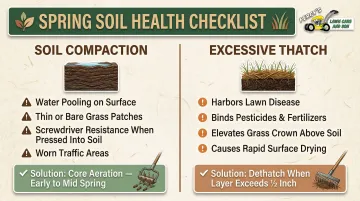
Mistake #5: Ignoring Soil Compaction and Thatch Buildup
Heavy winter traffic, frozen-thaw cycles, and clay-heavy soil (common in the Buffalo area) leave many lawns compacted by spring. Erie County soils are predominantly fine-textured, with average compositions of 50.5% silt and 17.3% clay—soil types that hold more water and compact easily when wet.
Understanding Compaction
Compacted soil doesn't absorb water well, restricts airflow to roots, and makes it harder for grass to spread and fill in thin areas.
Signs of compaction:
- Water pooling after rain
- Thin or bare patches despite regular watering and fertilizing
- Difficulty pushing a screwdriver or soil probe into the ground
- Heavy foot traffic areas showing wear
Core aeration in early-to-mid spring is the right fix for cool-season lawns. It pulls small plugs of soil to open channels for air, water, and nutrients. Never aerate when the soil is saturated — heavy equipment will cause further subsoil compaction.
Understanding Thatch
A thin layer of thatch (under half an inch) is normal and even beneficial. But excessive thatch acts as a barrier that prevents water and fertilizer from reaching roots, traps moisture against the grass crowns, and harbors pests like grubs.
When to dethatch:
- If the thatch layer exceeds half an inch
- Spring dethatching—before the peak growing season—gives the lawn time to recover
Impacts of excessive thatch:
- Harbors disease-causing organisms and insects
- Binds up pesticides, reducing their effectiveness
- Elevates grass crowns, making them susceptible to mower scalping
- Leaves the turf vulnerable to rapid drying out during dry periods
Soil pH Testing
Soil pH testing rounds out your spring soil health checklist. Buffalo soils tend toward acidity (average pH 5.9), and an imbalanced pH limits nutrient absorption regardless of how much fertilizer you apply. The optimal range for cool-season lawns is 6.0 to 7.0. If pH tests low, apply lime to correct it — but always test first, since raising pH above 7.4 triggers its own nutrient deficiencies.
Mistake #6: Missing the Window for Pre-Emergent Weed Control
Pre-emergent herbicides don't kill existing weeds—they prevent seeds from germinating in the first place. For crabgrass (the most aggressive spring lawn invader), the application window is narrow and unforgiving.
The Soil Temperature Threshold
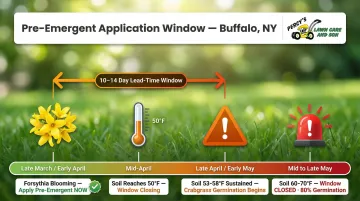
Crabgrass germinates when soil temperatures at a 2-inch depth reach 53 to 58°F and are sustained for 4 to 5 consecutive days. Eighty percent of germination occurs when soil temperatures consistently reach 60 to 70°F. Once crabgrass seeds germinate, the pre-emergent window has already closed.
The Consequence of Missing the Window
Once crabgrass takes hold, eliminating it is a losing battle. Homeowners who miss pre-emergent timing typically spend the rest of the season pulling or spot-treating reactively — far less effective and far more time-consuming than one well-timed application.
Timing Your Application
The calendar isn't your most reliable guide here — soil temperature is. Track local readings and apply pre-emergent when temps are approaching—but haven't yet reached—50°F consistently.
Practical tools for timing:
- Cornell Northeast Regional Climate Center (NRCC) GDD Tracker
- NY Mesonet (BUFF station for Buffalo)
- Weather services and university extension programs that publish soil temperature data
A useful visual cue: apply pre-emergents when forsythia is in full bloom. The flowers wither right around the time crabgrass begins to germinate, giving you a natural 10 to 14-day lead before the window closes.
Frequently Asked Questions
What is the 1/3 rule in mowing?
The 1/3 rule means never removing more than one-third of the grass blade height in a single mowing session. Cutting more than that stresses the plant, depleting root energy reserves and slowing recovery. For cool-season grasses, maintain a height of 3 to 4 inches during spring.
What is the first thing I should put on my lawn in the spring?
The first spring application is typically a pre-emergent weed control product, applied before soil temperatures reach 50–55°F. Fertilizer should wait until after the grass is actively growing and has been mowed a couple of times, usually late April to May in Buffalo.
What is the 150 rule for lawns?
The 150 rule times pre-emergent herbicide applications by tracking cumulative Growing Degree Days (GDD). When GDD reaches 150–200 using a base temperature of 50°F, crabgrass begins to germinate. That threshold is your window to apply before seeds sprout.
When should I start mowing my lawn in spring in Buffalo, NY?
Wait until the grass is actively growing, has reached 3 to 4 inches in height, and the soil has dried enough that foot traffic doesn't leave deep impressions. In Buffalo, with its late spring conditions and heavy snowmelt, this typically occurs in mid-to-late April or early May.
How do I know if my lawn needs aeration this spring?
Signs of compaction include water pooling after rain, thin or bare patches despite regular watering and fertilizing, difficulty pushing a screwdriver into the soil, and heavy foot traffic areas. Clay-heavy soil (common in Buffalo) is particularly vulnerable to compaction.
Can I fertilize and apply pre-emergent at the same time?
Combination "weed and feed" products exist, but timing conflicts make them unreliable. Pre-emergent needs to go down early (before soil temps hit 50–55°F), while fertilizer should wait until the grass is actively growing (above 55°F). Two separate applications, timed correctly, give you better control over both.