
Introduction
You mow every week, water religiously, and still your lawn looks washed-out and pale while your neighbor's grass is thick and emerald green. Frustrating, right? Many Buffalo homeowners struggle with achieving that deep, rich lawn color despite following standard advice — because most generic lawn care tips ignore Buffalo's specific conditions.
Here in Buffalo, the cool climate, short 183-day growing season, and clay-heavy soils create obstacles that national lawn care blogs never address. The Erie soil series common throughout the region features a restrictive "fragipan" layer 10–21 inches below the surface that limits root growth and nutrient uptake.
Add in 40.68 inches of annual precipitation and you've got conditions that demand a Buffalo-specific approach.
The tips below are tailored specifically to Buffalo's soil, climate, and growing season — so you can stop guessing and start seeing results.
TLDR:
- Test soil pH first — Buffalo's clay locks out nutrients even when fertilizer is applied
- Choose dark-green cultivars like Kentucky Bluegrass 'Midnight' or 'Blackstone'
- Apply 60% of annual nitrogen in early fall (late August–October), not spring
- Water deeply 1–2 times weekly rather than daily light sprinklings
- Mow at 3–4 inches and never remove more than one-third of blade height
Start With a Soil Test — Your Lawn's Green Color Begins Underground
The color of your grass is directly tied to what's happening in the soil beneath it. If pH is off or key nutrients are locked out, no amount of watering or fertilizing will produce dark green grass.
Why Soil pH Affects Grass Color
Cool-season grasses require a soil pH of 6.0 to 7.5 to properly absorb nutrients. Outside that range, nutrients become unavailable to grass roots even when they're physically present in the soil. Strongly acidic soils (pH 5.5 or below) lead to deficiencies in calcium, magnesium, and phosphorus, while also increasing aluminum and manganese to toxic levels.
Buffalo's Clay Soil Challenge
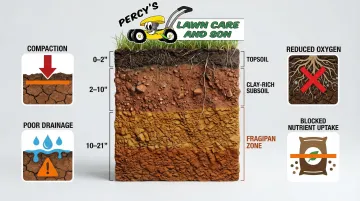
The Erie soil series is common throughout Erie County. These soils feature a "fragipan" layer 10–21 inches below the surface—a dense, restrictive zone with low hydraulic conductivity. This creates:
- Heavy compaction that restricts root penetration
- Poor drainage and waterlogged conditions
- Reduced oxygen exchange in the root zone
- Blocked nutrient uptake even when fertilizer is applied
How to Test Your Soil
Two local testing options:
- Cornell Cooperative Extension of Erie County — $3 pH test (or $5 for two samples) through their Master Gardener Volunteer Soil pH Testing Service
- Cornell Soil Health Laboratory — $100 comprehensive analysis covering pH, nitrogen, phosphorus, potassium, iron, and organic matter levels
The comprehensive test reveals exactly what your lawn needs—no guessing.
Amend Based on Results, Not Guesses
If pH is too low (acidic):
- Apply lime to raise pH
- Common in Buffalo's naturally acidic soils
- Follow lab recommendations for application rates
If pH is too high (alkaline):
- Apply sulfur to lower pH
- Less common but occasionally needed
Once pH is corrected:
- Address specific nutrient deficiencies identified in the test
- Apply targeted fertilizers rather than generic blends
Buffalo's Erie clay soils are notorious for locking out nutrients regardless of how much fertilizer you apply. A $3–$100 soil test tells you exactly what's blocking your lawn's color — and what will actually fix it.
Pick the Right Grass for Buffalo's Cool Climate
Not all grass types can achieve a deep, dark green — some species are simply genetically lighter. Buffalo's climate makes the choice straightforward: cool-season grasses are the only varieties that survive here and deliver that rich color.
Why Cool-Season Grasses Are Non-Negotiable
Buffalo sits in USDA Hardiness Zone 6b, with an average last spring frost on April 24 and first fall frost on October 26. Warm-season grasses like Bermuda will not survive Buffalo winters. The recommended species for our region are:
- Kentucky Bluegrass — Deep green potential, dense growth, moderate shade tolerance
- Turf-Type Tall Fescue — Drought-tolerant, deep roots, darker green varieties available
- Perennial Ryegrass — Fast germination, wear-tolerant, good color
Dark-Green Cultivars Worth Seeking
According to National Turfgrass Evaluation Program (NTEP) data, specific Kentucky Bluegrass cultivars rank highest for genetic dark-green color:
| Cultivar | Genetic Color Rating (1–9 scale) |
|---|---|
| Midnight | 7.0 |
| Total Eclipse | 7.0 |
| Blackstone | 6.7 |
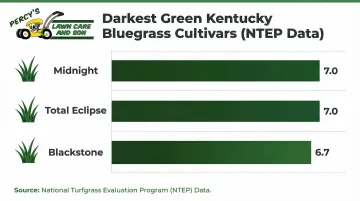
If you already have a lighter-green grass variety established, overseeding with one of these darker cultivars is an option to improve color without full lawn replacement.
Sunlight Requirements
Most cool-season grasses need at least 6 hours of direct sun daily to develop full green color. Shaded lawns require 4–8 hours and should use 100% fine fescue blends. If your lawn receives less than 4 hours of direct sun, even the best cultivars will stay thin and pale. In those spots, switching to a fine fescue blend or a shade-tolerant ground cover will produce better results than chasing dark green with the wrong grass.
Fertilize With the Right Nutrients: Nitrogen and Iron Are Your Best Friends
Dark green color comes from chlorophyll, which requires two key nutrients: nitrogen and iron. Without adequate levels of both, grass turns pale yellow or lime green instead of deep green.
Understanding the N-P-K Label
Fertilizer labels display three numbers (such as 24-0-11) representing nitrogen (N), phosphorus (P), and potassium (K). For dark green color, look for fertilizers higher in nitrogen—the first number.
Two nitrogen types:
- Quick-release — delivers visible green-up within 2–5 days, but drives rapid top growth and more frequent mowing
- Slow-release — produces steady, lasting color with lower burn risk and less mowing demand
Slow-release formulas are easier to manage and a safer bet for DIY application.
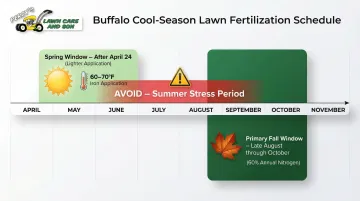
When to Fertilize in Buffalo
Cool-season grasses in Buffalo have two key feeding windows:
1. Early Fall (Late August–October) — MOST IMPORTANT
- Grass is actively growing roots heading into winter
- Apply 60% of annual nitrogen during this window
- Strengthens turf for winter survival and spring green-up
2. Light Spring Application (After Last Frost Risk)
- Apply after April 24 in Buffalo
- Lighter application than fall
- Avoid heavy spring fertilization—it causes excessive top growth and weak roots
Avoid summer fertilization during heat stress.
Annual nitrogen rate: Kentucky Bluegrass and Perennial Ryegrass need 2–4 pounds of nitrogen per 1,000 square feet annually; fine fescues need 1–2 pounds. Never apply more than 1 pound per 1,000 square feet in a single application.
Iron Supplementation for Extra Color
When nitrogen alone doesn't deliver the depth of color you're after, iron fills the gap. Look for fertilizers with 3–7% iron content or standalone chelated iron products.
Iron application tips:
- Apply in spring when temperatures are 60–70°F
- Never apply during midday heat
- Effects last 2–4 weeks before reapplication is needed
- Chelated iron is twice as efficient as iron sulfate—2 lbs/acre chelated iron = 4 lbs/acre iron sulfate
WARNING: Iron products stain concrete sidewalks and driveways. Sweep any overspray immediately.
Both nitrogen and iron work best when applied in the right amounts—more isn't better.
Don't Over-Fertilize
Too much nitrogen causes:
- Excessive top growth
- Weakened root systems
- Increased disease susceptibility
- Grass burn and brown patches
New York State law prohibits phosphorus-containing fertilizers unless a soil test proves deficiency. The law also prohibits fertilizer application on non-agricultural lawns between December 1 and April 1.
Fertilize to correct what's actually missing—soil test results are the most reliable guide for what your lawn actually needs.
Water Deeply and Infrequently
Frequent shallow watering keeps roots close to the surface, leaving grass pale and stressed. Water less often but more deeply, and roots will follow moisture down into the soil — giving them better access to nutrients, a stronger structure, and a richer green color.
The 1-Inch Weekly Rule
Lawns need about 1 to 1.5 inches of water per week for cool-season grasses, delivered in 1–2 deep sessions rather than daily light sprinklings. Deep watering encourages roots to grow 6–12 inches deep instead of staying in the top 2–3 inches.
Timing Matters: Water Early Morning
Water between 4 AM and 8 AM to:
- Reduce evaporation loss
- Allow grass blades to dry during the day
- Reduce fungal disease risk
Avoid evening watering—wet grass overnight invites disease, especially during Buffalo's humid summers.
Adjust for Buffalo's Rainfall
Buffalo receives 40.68 inches of annual precipitation throughout the growing season. During wet periods, skip supplemental watering entirely. Overwatering suffocates roots and promotes lawn diseases that turn grass yellow or brown.
How to check: Place a tuna can or rain gauge in your yard. When it collects 1 inch from rain and irrigation combined, you're done for the week.
Mow Smarter, Not Shorter
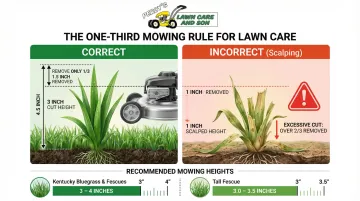
Mowing too short—called scalping—strips chlorophyll-rich leaf tissue, stresses the grass, and exposes soil to heat. Taller grass shades its own root zone, holds moisture better, and produces more chlorophyll, all of which drive that deeper green color.
The One-Third Rule
Never remove more than one-third of the blade's height in a single mow. If you maintain your lawn at 3 inches, mow when it reaches 4.5 inches. Removing more than one-third shocks the grass and diverts energy from root growth to blade recovery.
Recommended Mowing Heights for Buffalo
Cool-season grasses common in Buffalo thrive at these heights:
- Kentucky Bluegrass and Fescues: 3–4 inches
- Tall Fescue varieties: 3.0–3.5 inches
Adjust seasonally as conditions change:
- Summer heat stress: raise the cutting height toward 4 inches
- Early fall before winter: slightly lower cuts are acceptable
Sharp Blades Are Non-Negotiable
Dull blades tear grass rather than cutting it cleanly, leaving frayed tips that turn tan or brown and make the whole lawn look dull. Sharpen blades every 20–25 hours of mowing or at least 2–3 times per season.
That's part of why Percy's Lawn Care and Son uses commercial-grade mowers with freshly maintained blades on every visit — customers like Ayana R. credit it as a key reason their lawns stay vibrant green year after year.
Leave Grass Clippings
When clippings are short (from following the one-third rule), they break down quickly and return nitrogen to the soil. Research shows clippings return 46–59% of applied nitrogen back to the lawn. This is a free, easy way to maintain color between fertilizer applications.
Don't Overlook Aeration, Overseeding, and Weed Control
Even perfect mowing, watering, and fertilizing won't produce dark green color if your soil is compacted, your turf is thin, or weeds are stealing nutrients.
Why Aeration Matters in Buffalo
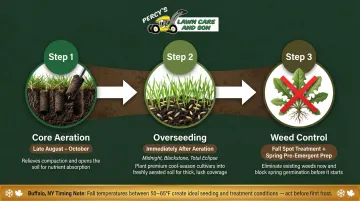
Buffalo's clay soils compact heavily over time, especially in lawns with foot traffic. Core aeration removes soil plugs to alleviate compaction and reduce thatch. It opens holes that allow oxygen, water, and nutrients to move into the soil and provides channels for root growth.
When to aerate in Buffalo: Late August–October (early fall) for cool-season grass. This is when homeowners often see the biggest jump in lawn color the following spring.
Overseed Thin or Patchy Areas
Thin or patchy lawns always look lighter green than dense, thick turf. Overseed bare or thin areas in early fall in Buffalo, ideally right after aeration so seeds make soil contact.
Overseeding tips:
- Choose dark-green cultivars (Midnight, Blackstone, Total Eclipse)
- Keep newly seeded areas consistently moist until germination
- Perennial ryegrass germinates within days; tall fescue requires warmer temperatures and should be seeded mid- to late August
Done consistently, overseeding deepens your lawn's color and fills in the thin patches that make turf look uneven.
Control Weeds to Preserve Nutrients
Weeds compete directly with grass for nitrogen, iron, water, and sunlight—the exact resources needed for dark green color. A lawn invaded by crabgrass, dandelions, or clover will always look patchy and uneven.
Weed control strategy:
- Apply pre-emergent in spring before crabgrass germinates (when soil temps hit 55–58°F)
- Spot-treat dandelions and clover in fall when they're actively growing
- Build dense, healthy turf — thick grass naturally crowds out most weeds over time
Keeping up with aeration, overseeding, and weed control on the right schedule takes some planning. Percy's Lawn Care and Son has been managing Buffalo lawns since 1999 and can handle all of it for you. Call for a professional assessment at (716) 245-5296.
Frequently Asked Questions
What makes grass turn dark green?
Dark green color in grass is driven by chlorophyll, which requires adequate nitrogen and iron. When either nutrient is deficient, or when soil pH blocks their uptake, grass turns pale or yellowish instead of deep green.
How long does it take to get a dark green lawn?
Quick-release nitrogen fertilizers show visible greening within 2–5 days, while slow-release products and holistic improvements (soil amendment, aeration, overseeding) produce lasting color over several weeks to months. For lasting results, fall fertilization in Buffalo — not a single quick fix — is what maintains color season to season.
Is iron or nitrogen better for greening up a lawn?
Nitrogen and iron both play a role, but differently: nitrogen drives overall growth and chlorophyll production, while iron targets chlorophyll synthesis directly and helps most when grass yellows despite sufficient nitrogen. A soil test identifies which is actually lacking.
What is the best grass type for dark green color in Buffalo, NY?
Cool-season grasses suited to Buffalo's climate include Kentucky Bluegrass (especially dark-green cultivars like 'Midnight' or 'Blackstone'), Turf-Type Tall Fescue, and Perennial Ryegrass. All can develop rich, deep green color in the Buffalo region.
How often should I fertilize my lawn to keep it dark green?
For cool-season grasses in Buffalo, the most important fertilization window is early fall (late August–October), with a lighter spring application after frost risk has passed. Over-fertilizing, especially in summer, can damage rather than improve color.
Can overwatering prevent dark green color?
Yes, overwatering causes shallow root systems, promotes fungal disease, and causes yellowing or pale-green grass. Deep, infrequent watering (1 inch per week in 1–2 sessions) produces stronger, deeper roots and supports richer turf color.