

Introduction
If you've spent all spring nursing your Buffalo lawn back to life only to find coarse, pale green clumps spreading across your turf by mid-July, you're not alone. That frustrating invader is crabgrass — and it follows a predictable annual cycle you can break once you know when to act.
Crabgrass thrives in the exact conditions that stress Buffalo's cool-season lawns: summer heat, thin turf, compacted soil, and bare spots where sunlight hits the ground.
This guide covers what crabgrass is, why it keeps coming back, how Buffalo's climate affects its growth, and the most effective prevention and removal strategies.
TLDR:
- Germinates when soil hits 55°F (late April–May in Buffalo); dies after first frost
- One plant drops up to 150,000 seeds that stay viable in soil for 1–3 years
- Apply pre-emergent mid-April to early May — time it with forsythia bloom drop
- Post-emergent herbicides work best on young plants (3-5 leaf stage); mature crabgrass is harder to kill
- Long-term prevention requires mowing at 3-4 inches, fall aeration, and overseeding to thicken turf density
What Is Crabgrass and How Do You Identify It?
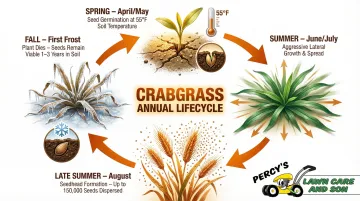
Crabgrass (Digitaria spp.) is a warm-season annual weed that completes its entire life cycle in one year. It germinates in spring when soil temperatures warm, grows aggressively through summer, produces seeds, and dies after the first frost.
This cycle works against Buffalo's cool-season grasses. Kentucky bluegrass, perennial ryegrass, and tall fescue all slow down or go semi-dormant in summer heat, giving crabgrass exactly the opening it needs to take over.
Visual Identification
Recognizing crabgrass early helps you act before it spreads:
- Color: Light to medium green, often paler than surrounding lawn grass
- Blade width: Wide, flat blades roughly ½ to ¾ inch across
- Growth pattern: Stems grow outward from a central point in a low, sprawling rosette that resembles a crab's legs (hence the name)
- Seedheads: Appear in late summer as finger-like spikes radiating from the top of the stem
Two Common Types
Smooth crabgrass (Digitaria ischaemum) is the smaller variety, with sparse hairs at the leaf base and blades measuring 0.08–0.28 inches wide. Large crabgrass (Digitaria sanguinalis), sometimes called hairy crabgrass, has hair on both leaf surfaces and sheaths, with blades up to 0.6 inches wide. Both respond to the same control methods, so telling them apart matters less than confirming it's crabgrass and not your desirable turf.
The Seed Production Problem
A single large crabgrass plant can produce up to 150,000 seeds over the course of one season. Those seeds drop into the soil and remain viable for 1–3 years according to burial studies, so failing to control crabgrass this year directly worsens next year's infestation. Even if every visible plant dies this fall, the seed bank in your soil is waiting for next spring's warmth to germinate.
Common Homeowner Mistake
Broadleaf weed killers — the products designed to target dandelions, clover, and other broadleaf weeds — do NOT work on crabgrass. These herbicides (2,4-D, dicamba, MCPP) are designed to target dicots (broadleaf plants), not monocots like grassy weeds. Using the wrong product wastes money and can stress your desirable turf without touching the crabgrass.
Why Crabgrass Keeps Coming Back Year After Year
The Germination Trigger
Crabgrass seeds begin germinating when soil temperatures at 1-3 inches depth consistently reach 55-58°F for 4-5 consecutive days. Soil doesn't warm evenly across a yard, so germination can stretch from late spring through mid-summer. That extended window is why a single treatment often falls short.
Lawn Conditions That Invite Crabgrass
Timing explains when crabgrass germinates — but lawn health explains where it takes hold. Crabgrass moves into weakened, thin lawns, not dense healthy ones. The conditions that invite it include:
- Thin or bare spots that allow sunlight to reach the soil surface
- Compacted soil that limits root growth of desirable grasses
- Low mowing heights that scald the lawn and open the canopy
- Drought stress that weakens cool-season grasses during summer heat
- Full sunlight and high temperatures where cool-season grasses struggle
The Seed Bank Problem
Even if every visible crabgrass plant dies this fall, the seeds it already dropped are sitting in the soil waiting. Research shows that approximately 55% of crabgrass seeds survive for one year in burial studies, and seeds can remain viable for up to three years at typical soil depths. Long-term control means addressing both sides of that equation: eliminating existing plants and blocking new germination each spring.
Crabgrass in Buffalo: Why Local Conditions Make It Worse
Buffalo's climate creates a specific crabgrass timing challenge that many homeowners underestimate.
A Narrow Window That Closes Fast
Buffalo experiences cold, extended winters and late springs, which means soil takes longer to warm compared to regions farther south. Once soil temperatures cross the 55°F threshold in late April or early May, crabgrass germination can accelerate quickly. Homeowners who miss the narrow pre-emergent application window often find themselves with a full infestation before they've had time to react.
Compacted Soil Gives Crabgrass a Head Start
Many Buffalo-area neighborhoods sit on clay-heavy soils that are prone to compaction, particularly after winter freeze-thaw cycles and snow removal traffic. Compacted soil is exactly the environment where crabgrass seeds thrive and desirable grasses struggle. That's why addressing soil compaction through core aeration is one of the most effective long-term defenses against recurring crabgrass — especially in Buffalo neighborhoods where clay soils are the norm.
The July–August Coverage Gap Is When Crabgrass Wins
The cool-season grasses common in Buffalo lawns — Kentucky bluegrass, perennial ryegrass, tall fescue — go semi-dormant or slow significantly in summer heat. Kentucky bluegrass, for example, is a drought "avoider" that enters summer dormancy, losing chlorophyll and wilting back to the crown.
That dormancy gap from July through August is when crabgrass moves in fast. Prevention — not reactive treatment — is the only reliable answer once your lawn thins out in the heat.
How to Prevent Crabgrass with Pre-Emergent Herbicides
Pre-emergent herbicides are your best defense against crabgrass — applied correctly, they stop the problem before it starts.
What Pre-Emergent Herbicides Do
Pre-emergents don't kill existing plants or seeds sitting dormant in the soil. Instead, they disrupt the germination process so crabgrass seedlings cannot establish roots and grow. They must be applied before soil temperatures reach 55°F — meaning timing is everything.
Buffalo-Specific Application Timing
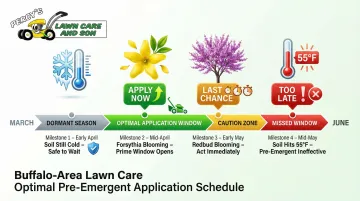
In the Buffalo and Western New York region, pre-emergent herbicide should generally be applied in mid-April to early May, before soil temperatures consistently reach 55°F. This timing varies slightly year to year depending on weather patterns, but traditional natural indicators can help:
- Forsythia blooms dropping or fading — soil temperatures are approaching the germination threshold
- Redbud trees beginning to bloom — germination is imminent
These phenological markers are more reliable than strict calendar dates, especially in a region like Buffalo where spring weather can be unpredictable.
Common Active Ingredients
Most residential pre-emergent products contain one of these active ingredients:
- Pendimethalin
- Prodiamine
- Dithiopyr
- Benefin
Many are sold combined with fertilizer in "weed and feed" formulas for convenience. Before purchasing, identify your grass type to ensure the product is compatible — some formulations can injure certain grass species if applied incorrectly.
That compatibility question becomes especially important if you're planning to seed, because most pre-emergents create a direct conflict.
The Seeding Conflict
Most pre-emergent herbicides also prevent turfgrass seed germination, meaning they cannot be applied in spring if you're planning to overseed. The exceptions are siduron (Tupersan) and mesotrione (Tenacity), which can be safely used on new seedings of cool-season turfgrasses. Fall overseeding (after pre-emergents have broken down) avoids this conflict entirely.
Split Applications for Heavy Infestations
For lawns with heavy crabgrass pressure or frequent rainfall, apply a second pre-emergent 6-8 weeks after the first for season-long control. A single application may not provide coverage through the entire germination window, which can extend into mid-summer.
Getting Rid of Crabgrass Already Growing in Your Lawn
If crabgrass has already appeared in your lawn, post-emergent herbicides can kill actively growing plants — but product selection and timing are critical.
Selective Post-Emergent Herbicides
These herbicides target crabgrass without harming most cool-season turfgrasses, provided you match the product to your grass type:
- Quinclorac (Drive XLR8) — controls both young and mature plants across multiple grass types, including Kentucky bluegrass
- Fenoxaprop-p-ethyl (Acclaim Extra) — works well on cool-season grasses, though it may injure some Kentucky bluegrass cultivars in high heat
- Mesotrione (Tenacity) — whitens then kills treated plants; best for newly emerged crabgrass, but avoid use on new fine fescue stands
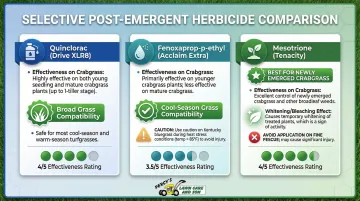
Always read labels carefully and identify your grass species first. The wrong product can damage your lawn as much as the crabgrass itself.
Timing, Effectiveness, and When to Skip Treatment
Post-emergent herbicides work best on young crabgrass at the 3-5 leaf stage. Large, well-established plants are much harder to kill, and results typically take 7-10 days to appear. A second application after 21 days may be needed for stubborn plants.
If it's late summer — August or September in Buffalo — and plants are already heading toward frost, skip the herbicide. The first freeze will handle it naturally. Use that time instead to overseed bare spots before the ground freezes, so next spring's turf is thick enough to crowd crabgrass out.
Hand-Pulling and Home Remedies
For light infestations, pulling individual plants by hand works well — pull before seedheads form to avoid worsening the seed bank in your soil. Hand-pulling won't solve a widespread problem, and it doesn't address seeds already waiting to germinate next season. Pair it with a prevention strategy for the following year.
As for home remedies — boiling water or horticultural vinegar (20% acetic acid) are non-selective contact herbicides. They damage any desirable grass they touch and don't kill the roots, so plants can partially recover. Skip them.
Lawn Care Habits That Keep Crabgrass Out Long-Term
Herbicides are temporary fixes. The real solution is building a lawn so thick and healthy that crabgrass can't establish in the first place. Three cultural practices do most of the heavy lifting.
Mowing Height: The Single Most Important Cultural Practice
Maintaining lawn height at 3-4 inches shades the soil surface, keeps it cooler, and reduces the light crabgrass seeds need to germinate. Scalping the lawn (cutting too short) is one of the fastest ways to invite a crabgrass outbreak.
Follow the one-third rule: never remove more than one-third of the blade height in a single mowing. Cutting too much at once shocks the grass, stunts root growth, and opens the canopy to weeds.
Fall Aeration and Overseeding
Fall aeration and overseeding directly combat crabgrass by thickening the turf canopy:
- Core aeration loosens compacted soil, improving root depth, oxygen flow, and water absorption for desirable grasses
- Overseeding fills the thin or bare spots crabgrass exploits
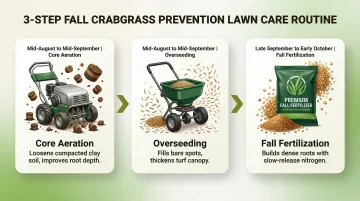
For Buffalo homeowners, mid-August through mid-September is the ideal window for fall aeration and overseeding before temperatures drop. Percy's Lawn Care and Son handles both tasks for Buffalo-area homeowners who'd rather leave the timing and execution to someone who knows the local climate.
Fertilization: Build Strong Roots
Cool-season grasses need adequate nitrogen in fall to build the dense root systems that resist weeds heading into the next season. A soil test identifies nutrient deficiencies before they create openings for crabgrass.
Fall fertilization best practices include:
- Apply a slow-release nitrogen fertilizer in late September or early October
- Avoid high-nitrogen applications in summer, which can stress cool-season grasses
- Test soil pH — Buffalo soils often run slightly acidic, and lime applications may be needed to bring it into the 6.0–7.0 range where grass roots thrive
Frequently Asked Questions
What will kill crabgrass but not my lawn?
Selective post-emergent herbicides containing quinclorac, fenoxaprop-p-ethyl, or mesotrione can kill crabgrass while leaving most cool-season grasses unharmed, as long as you match the product to your grass type and follow label instructions carefully.
Can I kill crabgrass in September?
By September in Buffalo, crabgrass is mature and heading toward frost-kill — making herbicide treatment less effective and not worth the cost. Instead, focus fall energy on overseeding bare spots so the lawn is thick enough to resist crabgrass the following spring.
When should I apply pre-emergent herbicide for crabgrass in Buffalo, NY?
In the Buffalo area, pre-emergent herbicide should generally be applied in mid-April to early May, before soil temperatures consistently reach 55°F. Local indicators like forsythia bloom drop can help homeowners time the application each year.
How do I know if I have crabgrass or just regular grass?
Crabgrass is paler and coarser than lawn grass, grows in low spreading clumps radiating from a central point, and produces finger-like seedheads in late summer — often appearing in patches rather than uniformly across the lawn.
Does mowing crabgrass spread it?
Mowing after crabgrass has produced seedheads can disperse seeds across the lawn, worsening future infestations. Mowing at the proper height before plants reach the seeding stage is far less risky and helps limit crabgrass from taking hold.
Will crabgrass go away on its own in the fall?
Crabgrass is an annual weed and will die after the first frost. The problem is that each plant has already dropped thousands of seeds into the soil, which will germinate the following spring. Skipping a prevention plan only delays the problem.