Why Buffalo Lawns Deserve a Better Approach
Homeowners across the United States spend more than $3 billion on pesticides annually, while landscape irrigation accounts for 9 billion gallons of water every single day—and up to half of it is wasted through evaporation and runoff. For Buffalo residents, that runoff doesn't just disappear; it carries nitrogen and phosphorus directly into local streams and Lake Erie tributaries, fueling harmful algal blooms that threaten our region's water quality.
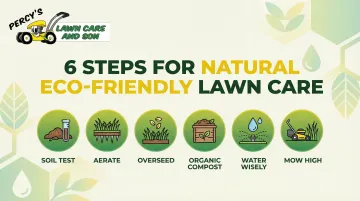
Eco-friendly lawn care works with your lawn's natural systems rather than against them. That means a healthier, more resilient landscape that holds up through Buffalo's short growing season, heavy clay soils, and brutal winters. Shift to sustainable practices and you'll spend less on fertilizers and water while protecting the environment your family depends on.
Ahead, you'll find six practical steps any Western New York homeowner can follow to transform their lawn care routine. Percy's Lawn Care and Son has been applying eco-friendly and sustainable landscaping techniques across Buffalo, Amherst, and Cheektowaga for over 25 years—these are the methods that hold up in our climate.
Quick Summary
- Test your soil to avoid over-fertilizing and nutrient runoff into local waterways
- Feed naturally with organic fertilizers timed for fall when grass roots actively grow
- Mow smarter by maintaining 3–4 inch height and leaving clippings on the lawn
- Water wisely using deep, infrequent watering early in the morning to build drought-resistant roots
- Replace synthetic pesticides with Integrated Pest Management focused on cultural practices
- Add native plants and shrink your turf footprint to reduce water, fertilizer, and maintenance needs
Step 1: Start with a Soil Test — Know What Your Lawn Actually Needs
The single biggest mistake Buffalo homeowners make is guessing at fertilizer. When you apply products your lawn doesn't need, you waste money and trigger nutrient runoff that flows directly into local streams and Lake Erie. Phosphorus-laden runoff fuels harmful algal blooms that shut down beaches and threaten drinking water across the region.
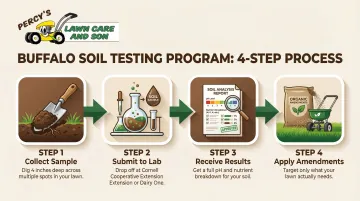
A soil test removes the guesswork. It measures pH, nitrogen, phosphorus, potassium, and organic matter levels, giving you precise guidance on what amendments your lawn actually requires. Instead of buying fertilizer blindly, you apply exactly what your soil needs.
Where to Get a Soil Test in Erie County
Cornell Cooperative Extension of Erie County (21 South Grove Street, East Aurora, NY) offers pH tests for just $3 per sample, completed by Master Gardener Volunteers. For comprehensive nutrient analysis, they refer homeowners to Dairy One Agro-One, which provides recommendations based on Cornell research tailored to New York State soils.
Testing frequency for Buffalo's heavy clay:
- Sandy soils: Every 2–3 years
- Clay soils (like the Erie series common in Western New York): Every 3–4 years
- Sample depth: 4 inches
Why Aeration Matters in Buffalo
Buffalo's heavy clay soils compact quickly, blocking oxygen and water from reaching grass roots. The Erie soil series—widespread throughout Western New York—consists of loamy till with a fragipan layer that severely limits drainage. If your soil test reveals compaction or poor drainage, aeration is usually the first corrective step.
Aerating once a year in early fall punches small holes in the soil, allowing air, water, and nutrients to penetrate deeper. Percy's Lawn Care and Son includes aeration as part of their spring cleanup services, specifically to address the compaction challenges Buffalo's clay-heavy soils create after a long winter.
Once you have your soil test results in hand, every subsequent step—fertilization, watering, overseeding—becomes a targeted decision rather than a guess. That precision is what keeps products off your lawn (and out of local waterways) in the first place.
Step 2: Feed Your Lawn Naturally
Organic fertilizers—compost, worm castings, slow-release blends—feed soil microbes and build soil structure over time, creating a living ecosystem beneath your grass. Synthetic fertilizers deliver nutrients fast but can burn grass and leach into groundwater. Notably, a 39-year global study found that organic fertilizers can leach 16% more nitrate than synthetics when nutrient release outpaces plant demand.
The fix is straightforward: timing and moderation matter more than which type you choose.
Fertilize in Fall, Not Summer
Cool-season grasses dominant in Buffalo—Kentucky bluegrass, tall fescue, fine fescue—grow roots most actively in fall. Sixty percent of your annual fertilizer should be applied in late summer or early fall (late August through October) when roots can actually use it. Fertilizing in midsummer stresses already-struggling grass and wastes product.
Key timing rules:
- Apply no more than 1 pound of nitrogen per 1,000 square feet per application
- Focus on September as your primary fertilization window
- Avoid spring applications that force excessive shoot growth at the expense of roots
Grasscycling: Free Fertilizer from Your Mower
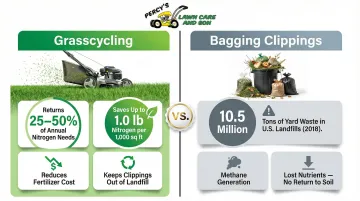
Leaving grass clippings on your lawn after mowing returns nitrogen naturally. Grasscycling can reduce your annual nitrogen fertilizer needs by 25–50%—offsetting up to 1.0 pound of nitrogen per 1,000 square feet each year.
Beyond the nitrogen benefit, clippings that stay on your lawn stay out of the landfill. In 2018, U.S. landfills received 10.5 million tons of yard trimmings—waste that decomposes into methane, a potent greenhouse gas.
Leave the Leaves
Instead of bagging Buffalo's heavy fall leaf drop, mulch leaves into small pieces with your mower. The shredded material decomposes over winter, feeding soil with organic matter and keeping yard waste out of the bin. Given how much leaf volume Buffalo properties shed each fall, this single habit can make a real dent in your fertilizer needs.
Important cautions:
- Organic fertilizers like bone meal and blood meal can attract pets—use carefully
- Source compost properly to avoid introducing invasive weed seeds
- Mulch leaves when dry to prevent matting and smothering grass
How to Make Your Own Compost
Backyard composting turns kitchen scraps and yard waste into rich organic material you can top-dress on your lawn once or twice a year. Getting started takes just a few steps:
- Combine greens (grass clippings, food scraps) with browns (leaves, twigs) in roughly equal parts
- Keep the pile moist but not waterlogged
- Turn it occasionally to speed decomposition
In 6–12 months, you'll have free, high-quality soil amendment.
Step 3: Mow Smart, Mow Green
Keep Grass at 3–4 Inches
Taller grass shades out weed seeds, keeps soil cooler, and promotes deeper root growth. Maintaining a height of 3 inches or higher creates drought-resistant turf that requires less water over time. Cutting too short (scalping) stresses grass, invites disease, and opens the door to weed invasion.
For Buffalo's cool-season grasses—Kentucky bluegrass and fescues—this 3–4 inch range is the sweet spot. That consistency also makes the one-third rule easier to follow.
Follow the One-Third Rule
Never remove more than one-third of the grass blade at once.
Removing more severely injures the plant by reducing its ability to support underground roots. If your grass reaches 4.5 inches, mow it down to 3 inches. If it hits 5.25 inches, cut to 3.5 inches.
Mowing frequency should follow growth rate, not a fixed schedule. During Buffalo's humid summers, grass grows faster and needs more attention. In spring and fall, you can step back and mow less often.
Keep Blades Sharp
Dull mower blades tear grass rather than cut it, leaving ragged edges that dry out faster and invite fungal disease — a real concern in Buffalo's humid summers. Sharp blades make a cleaner cut that heals quickly and keeps turf healthier overall.
A few simple habits keep blades in good shape:
- Sharpen blades at least once per season, or more often if you mow frequently
- Inspect the blade after hitting rocks, roots, or debris
- Look for brown, frayed tips after mowing as an early sign of dullness
Switch to Electric Equipment
Gasoline-powered lawn equipment is a major pollution source. In 2011, gas-powered lawn and garden equipment emitted 26.7 million tons of pollutants, accounting for 24–45% of all nonroad gasoline emissions nationwide. Battery-powered and electric mowers eliminate these emissions while reducing noise pollution.
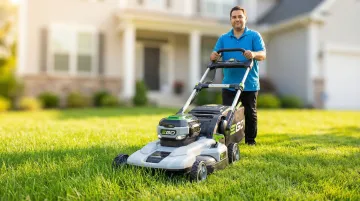
Percy's Lawn Care and Son handles mowing with commercial-grade equipment that includes clipping management — a practical option for homeowners who want eco-conscious results without the hassle of managing equipment themselves.
Step 4: Water Wisely, Waste Less
Water Deeply and Infrequently
Deep watering—targeting 6 inches of soil penetration—forces grass roots to grow downward, creating a lawn that handles dry spells far better. Shallow daily watering produces shallow roots that struggle during dry spells and require constant irrigation.
Best practice: Water 1–2 times per week, applying enough to penetrate 6 inches deep. Let the soil dry slightly between waterings to encourage deep root growth.
Water Early Morning (4 AM to 8 AM)
The best time to water is from 4 AM to 8 AM. This timing allows grass to dry in the morning sun, reducing the chance of lawn disease. Watering at night keeps grass wet for hours, creating ideal conditions for fungal growth—a serious problem in Buffalo's humid summers.
Timing matters beyond disease prevention, too. Up to 50% of outdoor water is lost to evaporation, wind, and runoff when applied at the wrong time of day—morning watering cuts that loss significantly.
Use Rain Barrels to Capture Buffalo's Rainfall
Buffalo receives an average of 40.68 inches of precipitation annually. A single inch of rain falling on 1,000 square feet of roof yields 623 gallons of water. Attach rain barrels to your downspouts to capture this free resource before it runs off into the street.
Reality check: A standard 55-gallon rain barrel will overflow during a one-inch rain if connected to just 300 square feet of roof. Installing multiple barrels or stepping up to a 250–500 gallon cistern gives you meaningful capacity for Buffalo's wetter months.
Benefits of rain barrels:
- Reduce stormwater runoff into local streams
- Lower water bills
- Provide unchlorinated water that's better for grass and plants
Step 5: Replace Synthetic Pesticides with Integrated Pest Management (IPM)
Integrated Pest Management (IPM) prevents pest problems through healthy cultural practices first—mowing correctly, aerating, overseeding—and only turns to chemical treatment if nothing else works. This approach protects pollinators, soil health, and local waterways while maintaining a healthy lawn.
A Dense, Healthy Lawn is Your Primary Defense
Thick grass crowds out weeds and pests naturally. Overseed bare or thin patches each fall with cool-season grass varieties suited to Buffalo's climate (Kentucky bluegrass, tall fescue, fine fescue). Closing gaps prevents weeds and pests from establishing in the first place. Cornell Cooperative Extension offers variety-specific recommendations for Western New York's USDA Hardiness Zones 5b–6a, recently updated to Zone 6b for Buffalo.
Aeration and Dethatching Prevent Pest Habitat
Thick thatch layers are hiding spots for grubs and fungal spores. Buffalo's clay soils are prone to thatch buildup, making annual dethatching and aeration essential. Removing thatch reduces pest habitat without any chemicals.
The 10-Grub Threshold: When Treatment is Actually Needed
Research in upstate New York shows that only 20% of home lawns require treatment for grubs. Ten or more grubs per square foot will likely cause visible damage. Fewer than five? No treatment needed.
Before treating, dig up a 1-square-foot section of turf and count the grubs. If you find fewer than 10, skip the treatment.
Organic Treatment Options When Needed
When the threshold is crossed, start with these lower-impact options before reaching for anything stronger:
Grub treatments:
- Beneficial nematodes (Heterorhabditis bacteriophora) are up to 96% effective against Japanese beetle grubs
- Apply mid to late August when grubs are actively feeding near the surface
- Water thoroughly before and after application for best results
Other pest options:
- Neem oil addresses both insects and fungal issues
- Diatomaceous earth works well for crawling insects
- Corn gluten meal works as a natural pre-emergent (note: effectiveness varies by application timing, and it adds 2 pounds of nitrogen per 1,000 square feet)
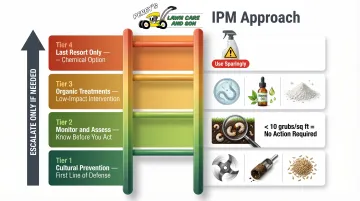
Important: Organic doesn't automatically mean safe for pets or beneficial insects. Read labels carefully and avoid broad applications near flowering plants that pollinators visit.
Step 6: Go Native and Shrink Your Turf Footprint
Replacing even a small section of traditional turf with native plants dramatically reduces water, fertilizer, and pesticide needs. Studies show that native plants use up to 60% less water than traditional turfgrass.
Native Plants for Western New York (Zones 6a–6b)
These species thrive in Buffalo's climate without fertilizers, support local pollinators, and survive harsh winters naturally:
- Wild bergamot (Monarda fistulosa) – Purple blooms, attracts bees and butterflies
- Black-eyed Susan (Rudbeckia hirta) – Bright yellow flowers, drought-tolerant
- Purple coneflower (Echinacea purpurea) – Long-blooming, supports pollinators
- Prairie dropseed (Sporobolus heterolepis) – Native grass with fine texture, low maintenance
For a lower-maintenance option that works alongside existing grass, white clover is worth adding to the mix.
White Clover: A Low-Maintenance Lawn Alternative
White clover (Trifolium repens) self-fertilizes by fixing nitrogen from the air, providing up to 2 pounds of nitrogen per 1,000 square feet to surrounding grasses. It requires less mowing, stays green through dry spells, and feeds pollinators with blooms from late May through October.
How to add clover:
- Mix white clover seed directly into grass seed
- Overseed existing lawns in early spring or fall
- Leave existing grass in place — clover integrates naturally without removal
Frequently Asked Questions
Is it possible to have a nice lawn without chemicals?
Yes. Combining soil health practices, organic fertilization, proper mowing height, and overseeding can produce a beautiful lawn without synthetic chemicals. It may take a season or two for your lawn's ecosystem to fully adjust, but the long-term payoff — healthier soil, resilient grass, and lower costs — is worth it.
What is the difference between lawn care and lawn service?
Lawn care refers to the ongoing maintenance tasks a homeowner performs — mowing, watering, fertilizing. Lawn service means hiring a professional company to handle those tasks for you. Percy's Lawn Care and Son, for example, applies eco-friendly techniques and professional-grade equipment to keep Buffalo-area properties healthy year-round, without the guesswork.