
Introduction
Buffalo-area homeowners face a frustrating reality: choose the wrong grass type, and you'll watch brown patches spread across your lawn by July — or worse, discover your turf didn't survive the winter despite all your effort and investment. With western New York's cold winters and moderate summers, your grass selection directly determines whether you'll maintain a lush, green lawn or spend seasons fighting against your own landscape.
Getting that selection right starts with understanding what your yard actually needs. Here you'll find a breakdown of cool-season, warm-season, and ornamental grasses — which ones thrive in Buffalo's Zone 6b climate, which ones to skip, and how to match each type to your property's sunlight, soil, and traffic patterns.
Key Takeaways
- Cool-season grasses like Kentucky Bluegrass and Tall Fescue are built for Buffalo's harsh winters — warm-season varieties like Bermuda and Zoysia are not
- Ornamental grasses add texture and year-round visual interest to garden beds but don't replace traditional lawn turf
- Choose grass based on your USDA hardiness zone, sunlight exposure, soil drainage, foot traffic levels, and maintenance commitment
- Kentucky Bluegrass produces a dense, lush lawn but needs consistent watering and fertilization
- Fine Fescue handles shade well and is one of the lowest-maintenance options for Buffalo yards
What Is Landscaping Grass and Why Does It Matter?
"Landscaping grass" covers any grass used intentionally in outdoor spaces — from turfgrass that forms your lawn surface to ornamental varieties planted for visual effect in beds and borders. This distinction matters because not all grasses serve the same purpose or tolerate the same conditions.
Choosing the wrong grass type creates a string of problems:
- Brown or patchy lawns that won't green up despite heavy watering
- Skyrocketing water bills from species that can't handle your climate
- Higher vulnerability to pests and disease
- A lawn that works against Buffalo's weather instead of with it
According to Michigan State University Extension, selecting turfgrass species suited to your specific region is the foundation of successful lawn establishment.
Grass species vary widely in cold hardiness, shade tolerance, water needs, and visual character. Kentucky Bluegrass self-repairs bare spots; Tall Fescue clumps and won't fill gaps without reseeding; Fine Fescue handles dense shade where most grasses give up. Understanding these categories before you plant saves years of frustration and costly do-overs.
Cool-Season Grasses for Your Landscape
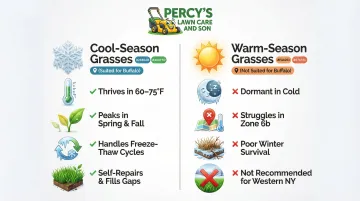
Cool-season grasses dominate northern regions like Buffalo, NY because they thrive between 60°F and 75°F, according to research from Michigan State University. They peak in spring and fall, hold their color through winter, and handle Buffalo's freeze-thaw cycles better than warm-season varieties.
Two varieties stand out for Buffalo-area lawns: Kentucky Bluegrass for homeowners who want a showcase lawn, and Tall Fescue for those who need something more forgiving.
Kentucky Bluegrass
Kentucky Bluegrass is the most widely used cool-season lawn grass in the North. Identifiable by its dark green color, fine texture, and boat-shaped blade tip, it spreads via underground rhizomes to fill bare spots — creating a dense, uniform surface that recovers quickly from damage.
Best suited for:
- High-traffic lawns where children play or pets run
- Front-yard curb appeal and formal landscapes
- Homeowners willing to invest in regular fertilization and watering
Key trade-offs:
- Struggles in deep shade (needs at least 4–6 hours of sun)
- Moderate drought tolerance; requires consistent irrigation during dry spells
- Higher maintenance than other cool-season options; needs 3–4 pounds of nitrogen per 1,000 square feet annually
Kentucky Bluegrass produces one of the best-looking lawns in the region. The catch: it earns that reputation through consistent watering, feeding, and attention. For homeowners who can commit to that schedule, few grasses come close. For those who can't, Tall Fescue is worth a look.
Tall Fescue
Tall Fescue is a coarse-bladed, clump-forming cool-season grass that tolerates heat better than most northern varieties. Its deep root system — reaching 2–3 feet down — lets it access moisture that shallower grasses can't, which matters during Buffalo's dry summer stretches.
Performance characteristics:
- Thrives in full sun to partial shade
- Tolerates clay soil common in the Buffalo area
- Handles moderate foot traffic without significant wear
- Requires less fertilizer than Kentucky Bluegrass (2–3 pounds nitrogen per 1,000 square feet annually)
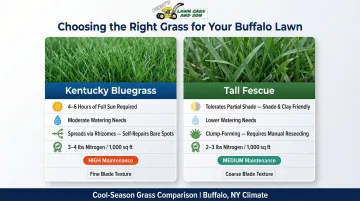
One thing to know upfront: Tall Fescue grows in clumps, not spreads. Unlike Kentucky Bluegrass, it won't fill in bare spots on its own — you'll need to reseed damaged areas manually.
Tall Fescue is ideal for backyards with mixed sun exposure, homeowners who want lower fertilizer inputs, and properties with the clay-