

Introduction
The first 4–8 weeks after planting new grass determine whether your lawn thrives or fails. Seedlings and sod lack established root systems and can't recover from neglect the way mature turf can. A single missed week of watering, one premature mowing, or an early herbicide application can undo months of planning.
According to Penn State Extension, more new lawn establishments fail due to improper follow-up care than any other factor. Buffalo homeowners face a steeper climb: cool-season grasses here must navigate variable spring and fall temperatures, occasional summer drought, and punishing winters.
Getting the early care right builds the root depth and turf density that carries your lawn through those conditions year after year.
This guide walks through the essentials for Buffalo homeowners growing Kentucky bluegrass, fescue, or ryegrass:
- Watering schedules for each growth phase
- When (and how) to mow for the first time
- Fertilizer timing to avoid burning young roots
- Weed control that won't set back new seedlings
- A phase-by-phase timeline built around Buffalo's climate
Key Takeaways
- Water 1–2 times daily during germination to keep the top inch of soil moist; once established, shift to deep, infrequent watering
- Wait until grass reaches 3–4 inches before the first mow; never cut more than one-third of the blade height
- Use starter fertilizer at planting; follow up with regular lawn fertilizer after 6–8 weeks
- Avoid all herbicides and heavy foot traffic until after 3–4 mowing sessions
- Watch for yellowing, patchy growth, or lifting sod—early intervention prevents total failure
Why Proper Care of Newly Planted Grass Matters
New grass—whether seeded or sodded—enters your yard with virtually no root system. While mature lawns can tolerate a few days of drought or a too-short mowing, new turf cannot. The first 4–8 weeks are when roots either anchor and spread or shrivel and die.
The cost of failure is steep:
- Bare or patchy lawns requiring complete re-seeding
- Wasted investment in seed, sod, and fertilizer (often $500–$1,500 for an average residential lawn)
- Extended timeline to a usable, attractive yard
- Weed invasion that becomes harder to control once established
Those risks multiply in Buffalo's climate. Kentucky bluegrass, fescue, and ryegrass all thrive here, but only if they develop deep roots before facing summer heat or winter freezing. Spring-planted lawns must establish quickly before July drought stress; fall-planted lawns need 45–75 days before the first hard frost (typically mid-October in Buffalo).
Percy's Lawn Care and Son has spent over 25 years helping Buffalo-area homeowners time their plantings, read local soil conditions, and adjust care through the region's unpredictable seasons—giving new grass the best possible start.
Essential Maintenance Tasks for Newly Planted Grass
Establishing new grass takes four coordinated practices: watering, mowing, fertilizing, and weed control. Get the timing or intensity wrong on any one of them, and the entire lawn can fail to take hold.
Watering New Grass
Watering follows a two-phase approach that changes as your grass matures.
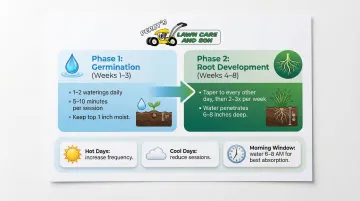
Phase 1: Germination (Weeks 1–3)
Keep the top 1 inch of soil consistently moist without saturating it. This typically requires:
- 1–2 waterings per day (sometimes 3 on hot, windy days)
- 5–10 minutes per session
- Soil should feel damp when you press your finger into it, but water should not pool on the surface
For sod specifically, water within 30 minutes of installation, ensuring moisture penetrates the sod strip and wets the underlying soil.
Phase 2: Root Development (Weeks 4–8)
As seedlings emerge and roots grow, reduce frequency but increase depth:
- Taper from once daily → every other day → 2–3 times per week
- Water should penetrate 6–8 inches into the soil (use a screwdriver test—if it pushes in easily to 6 inches, moisture is adequate)
- Encourage roots to grow downward, not stay shallow near the surface
Buffalo's weather swings require you to adjust on the fly. Here's how to adapt:
- Hot, windy days (above 80°F): Increase frequency; check soil moisture twice daily
- Cool, cloudy days (below 65°F): Reduce frequency; soil retains moisture longer
- Always water early morning (4–10 a.m.): Reduces evaporation and fungal disease risk by allowing grass blades to dry during the day
First Mowing of New Grass
Wait until grass reaches 3–4 inches tall. This typically occurs:
- Seeded lawns: 3–4 weeks after germination
- Sodded lawns: 2–3 weeks after installation (perform a tug test first—if sod lifts without resistance, roots haven't anchored; wait another week)
Stick to the one-third rule every time:
Never remove more than one-third of the grass blade in a single mowing. If your target height is 3 inches, mow when grass reaches 4 inches and cut back to 3 inches. Cutting more starves the plant of photosynthetic energy and weakens the root system.
Mower setup for new grass:
- Use sharp blades (sharpen every 10–25 hours of use)
- Set mower height higher than usual—3.5 to 4 inches for the first 3–4 mows
- Mow when grass is dry to prevent clumping and tearing
Fertilizing New Grass
Starter fertilizer (applied at or before planting):
Starter fertilizers are formulated with higher phosphorus to promote root development. Look for NPK ratios like:
- 10-10-10
- 16-8-8
- 20-10-10
- 18-24-12
Apply at 0.5–1.0 lb of nitrogen per 1,000 sq. ft. Phosphorus is immobile in soil, so placing it near the seed at planting ensures roots can access it during early growth.
Follow-up fertilizer (6–8 weeks after starter application):
Transition to a regular lawn fertilizer with higher nitrogen (e.g., 20-5-10 or similar) to promote thickening and greening. Apply 0.5–1.0 lb of nitrogen per 1,000 sq. ft.
One common mistake to avoid: over-fertilizing. Applying more than 1.5 lbs of nitrogen per 1,000 sq. ft.—or using high-urea products too close to the seed—can burn young grass and inhibit root growth.
Weed and Pest Control
No herbicides for the first 4–8 weeks. Most pre- and post-emergent weed killers prevent germination or damage immature roots. This includes "weed and feed" products.
Safe weed management during establishment:
- Hand-pull any weeds that appear in the first 4–6 weeks
- Exceptions: Mesotrione and siduron are the only pre-emergent herbicides safe to apply at seeding for cool-season grasses
- Wait until after 3–4 mowing sessions before applying any broadleaf herbicides
During this same herbicide-free window, your lawn is also most vulnerable to pest damage—so keep an eye out for early warning signs:
- Grubs: Patches of turf that roll back like carpet; birds pecking aggressively at the lawn
- Sod webworms: Small irregular brown patches; flocks of birds probing for caterpillars
- Armyworms: Ragged, chewed leaf margins or skeletonized grass blades
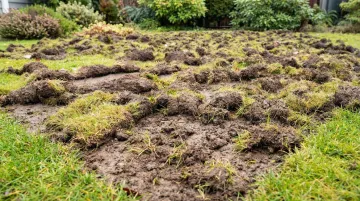
Early detection prevents damage that's difficult to reverse once the lawn is partially established.
Signs Your Newly Planted Grass Is Struggling
The first 8 weeks are the most vulnerable period for new grass. Catching these warning signs early gives you time to correct course before small setbacks turn into bare patches you'll be reseeding all over again.
Uneven or Patchy Growth
Some areas sprout vigorously while others stay bare, creating a checkerboard effect. This usually traces back to one of four causes:
- Uneven seed distribution during planting
- Inconsistent watering coverage (some spots too dry, others too wet)
- Soil compaction in certain areas preventing germination
- Seed washout from overwatering or heavy rain
To fix it: rake bare spots lightly, re-seed, and cover with a thin layer of weed-free straw mulch. Check your sprinkler pattern to make sure every section gets equal coverage.
Yellowing, Browning, or Wilting
Yellow seedlings point to one of three problems: overwatering (soil feels soggy, roots look brown and soft), underwatering (soil dry 2–3 inches down), or a nitrogen deficiency (the entire lawn looks pale, not just isolated patches).
Browning along sod edges is a separate issue. It usually means poor soil-to-sod contact — air pockets underneath — or that the edges are drying out faster than the center of each piece.
Not sure which problem you're dealing with? Do a quick screwdriver test:
- Push in easily, feels moist — moisture is fine; suspect a nutrient issue
- Hard to push, dry blade — increase watering frequency and depth
- Saturated soil, mushy roots — cut back watering and check drainage
Sod That Won't Root or Seams Lifting
By 2–3 weeks after installation, sod should be anchoring into the soil. If you're seeing curling edges, visible gaps between pieces, or sod that lifts when stepped on, rooting has stalled.
The most common culprits are light watering in the first two weeks, air pockets left at installation, or foot traffic before the roots had time to grip.
To get things back on track:
- Press sod down firmly with a light roller to close any air pockets
- Increase watering frequency, paying extra attention to edges and seams
- Keep foot traffic off completely until sod passes the tug test
New Grass Maintenance Schedule: Phase-by-Phase Guide
Maintenance intensity shifts across the first season, and timing matters as much as technique. Getting both right is what turns a patchy seeding job into a lawn that actually lasts.
Timing in Buffalo: Spring-seeded lawns follow this schedule from April–June; fall-seeded lawns (the preferred window for cool-season grasses) run August–October.
Weeks 1–2: Germination Phase
- Watering: 1–2 times daily to keep top inch moist
- Mowing: None
- Foot traffic: None
- Fertilizer: None (if starter was applied at planting)
- Monitoring: Check for seed washout, dry spots, or pooling water
Weeks 3–4: Early Sprout Phase
- Watering: Reduce to once daily or as needed based on weather
- Mowing: None until height reaches 3–4 inches
- Foot traffic: Minimal; avoid if possible
- Fertilizer: None yet
- Monitoring: Check for germination gaps; mark bare areas for re-seeding
Weeks 4–6: First Mow Phase
- Watering: Transition to deep, less-frequent watering (every other day)
- Mowing: Perform first mow at 3–4 inches using one-third rule; use sharp blades
- Foot traffic: Light traffic acceptable after first mow
- Fertilizer: None yet
- Weed control: Manual removal only
Weeks 6–8: Establishment Phase
- Watering: Continue transitioning to approximately 1 inch per week
- Mowing: Regular schedule (once per week or as needed based on growth)
- Foot traffic: Normal use acceptable
- Fertilizer: Apply regular lawn fertilizer (0.5–1.0 lb N per 1,000 sq. ft.) if 6+ weeks have passed since starter application
- Weed control: Manual removal; chemical control still not recommended
Month 3 and Beyond: Maintenance Phase
- Watering: Treat like established lawn—1 inch per week (including rainfall)
- Mowing: Regular schedule maintaining 3–3.5 inch height
- Foot traffic: Normal use
- Fertilizer: Follow seasonal fertilization schedule
- Weed control: Herbicides safe to use after 4+ mowing sessions
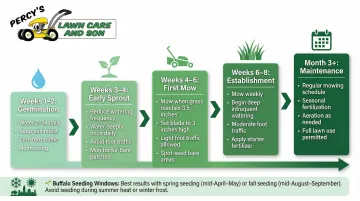
Once you've worked through these phases, timing your original seeding well pays dividends. Buffalo's fall seeding advantage: Lawns seeded in mid-August to mid-September enter winter already in the establishment or early maintenance phase, giving them two cool growing seasons (fall and spring) before facing summer heat.
Common Mistakes That Can Damage New Grass
Overwatering or Underwatering
Both extremes are equally damaging:
Overwatering consequences:
- Drowns seeds before they germinate
- Encourages fungal diseases like damping-off (seedlings turn slimy, brown, and collapse)
- Creates shallow root systems that can't survive drought
Underwatering consequences:
- Seeds dry out before germinating
- Sod detaches from soil as roots fail to anchor
- Patchy germination with large bare areas
The screwdriver test is a quick way to check moisture depth. Insert a 6-inch screwdriver into the soil after watering — it should push in easily to at least 4–6 inches with the blade feeling moist. If it only goes 1–2 inches, you're watering too shallowly.

Mowing Too Soon or Too Short
Consequences of premature mowing:
- Pulls out fragile roots that haven't anchored
- Scalps the turf, removing too much photosynthetic tissue
- Creates stress that opens the lawn to weed invasion
- Sets back establishment by 2–3 weeks
Remember: Wait until grass reaches 3–4 inches, and never remove more than one-third of the blade height in a single mowing.
Applying Weed Control Products Too Early
Consequences of applying herbicides too early:
- Pre-emergent products halt germination entirely
- Post-emergent herbicides damage fragile new roots
- "Weed and feed" products marketed for lawns can destroy a new establishment
Safe timeline: Wait until after at least 3–4 mowing sessions (approximately 4–8 weeks after emergence) before applying any chemical weed control.
Ignoring the Foot Traffic Rule
Foot traffic during the first 4–6 weeks:
- Compacts wet, newly prepared soil
- Restricts oxygen and root development
- Physically crushes fragile new growth
- Tears unanchored sod roots, leading to thinning and establishment failure
Homeowners who want to skip the guesswork can turn to Percy's Lawn Care and Son, which has been helping Buffalo-area residents establish and maintain healthy lawns since 1999.
Frequently Asked Questions
How do I take care of my new grass?
Keep soil moist with light, frequent watering (1–2 times daily during germination), avoid foot traffic and mowing until grass reaches 3–4 inches, apply starter fertilizer at planting, and hold off on weed control until after 3–4 mowing sessions.
How long before you can walk on a newly turfed lawn?
New sod generally needs 2–4 weeks before light foot traffic is acceptable. Test with a tug test—if the sod lifts easily, it hasn't rooted yet. Newly seeded lawns typically need 4–6 weeks minimum before regular traffic.
What should you do after aeration and overseeding?
Keep foot traffic off the lawn completely, avoid any weed control products until after 3–4 mowing sessions, and water consistently to maintain soil moisture. Your mowing and fertilizing routine should also stay on hold until new seedlings are visibly established.
Should I water immediately after aeration and overseeding?
Yes, water immediately after aeration and overseeding to help seeds make contact with soil and begin germination. The goal is to keep the top inch of soil consistently moist in the days that follow.
How often do I need to water after aerating and overseeding?
Start with 1–2 light waterings per day for the first 2 weeks. Once seedlings emerge and begin to establish, taper down to once daily — then shift to the standard schedule of roughly 1 inch per week.
How long should you wait after aeration and overseeding to mow?
Wait until new seedlings reach 3–4 inches in height, typically 3–5 weeks after overseeding depending on weather and grass type. Mow on a high setting and avoid removing more than one-third of the blade height.