
Introduction
Your Buffalo lawn has been through it — weeks of humid summer heat, stretches of drought, and the heavy foot traffic of backyard barbecues. Now, with August slipping away and cooler nights arriving, many homeowners assume the hard work is done. Late summer (mid-August through early September) is actually one of the most important windows for lawn health all year.
Skip it, and you're setting your yard up for a rough road ahead:
- Thin turf invites weeds to move in before fall
- Bare patches get pummeled by Buffalo's harsh winters
- Fungal diseases that started in humid August spread unchecked
The result is a weak, patchy lawn that struggles to recover when spring finally arrives.
This guide gives you what you need to avoid that outcome — the key signs your lawn needs attention now, the essential tasks to tackle before fall hits, and a practical checklist so nothing gets missed.
Key Takeaways
- Late summer gives Buffalo cool-season grasses their best chance to recover before fall
- Water deeply (1–1.5 inches weekly) early in the morning to prevent disease
- Raise mower height to 2.5–3 inches and sharpen blades
- Apply nitrogen-rich fertilizer once peak heat passes
- Aerate and overseed mid-August through mid-September for best results
Why Late Summer Is a Critical Window for Your Lawn
Late summer is the sweet spot for cool-season grasses that dominate Buffalo lawns. Soil is still warm enough for rapid seed germination and strong root development, but temperatures are beginning to drop — reducing the drought stress that made July nearly impossible to manage. According to NOAA climate data, Buffalo's average high drops from 79°F in August to 72.3°F in September, aligning with the 50–65°F soil temperature range where cool-season grass roots thrive.
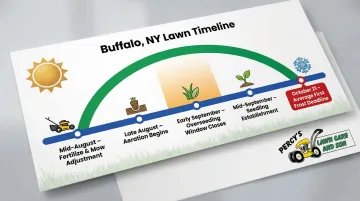
That window is narrow. Buffalo's early autumn frosts typically arrive around October 21, giving you roughly six weeks to complete all recovery work. Miss it, and your lawn heads into winter already behind.
What happens if you skip late summer care?
- Weakened root systems can't handle winter stress
- Bare patches get worse from frost heave and snow damage
- Weed seeds fill in thin areas before your grass can
- Late summer fungal diseases spread unchecked into fall
Research shows that late-season fertilization enhances spring green-up without stimulating excessive shoot growth, allowing the turf plant to maintain higher carbohydrate reserves. In practical terms, the work you do in August directly determines how quickly your lawn recovers in April — before Buffalo's spring rain season even begins.
Signs Your Lawn Is Struggling Before Summer Ends
The Footprint Test: Walk across your lawn in the morning. If your footprints stay visible because the grass blades won't spring back up, your lawn is under serious moisture stress. Catching this early prevents visible browning before it spreads.
Visible Warning Signs:
- Brown or yellowing patches that may signal drought stress or fungal disease
- Thin or bare areas where exposed soil invites weeds and winter damage
- Crabgrass and opportunistic weeds filling gaps where grass has weakened
- Heat-stressed zones along driveways and sidewalks where pavement reflects extra heat
Not every brown lawn is a dying lawn — but telling the difference matters.
Dormancy vs. Damage: Summer dormancy is intentional browning during extreme heat that recovers on its own. According to Rutgers Turfgrass Research, if the browning is evenly distributed and straw-brown in color, your lawn is likely dormant and will recover. If the browning appears in irregular spots or patches, the grass is dying or diseased and needs immediate intervention.
Late Summer Lawn Care Tasks: What to Do Now
Late summer lawn care isn't one big project — it's a series of targeted tasks done in the right order. Doing them now while soil is still warm sets up your lawn for a strong fall recovery.
Mowing: Raise Your Height and Sharpen Your Blades
Raise your mower height to 2.5–3 inches. Taller grass shades the soil, retaining moisture and suppressing weeds while encouraging deeper root growth. Cutting more than one-third of the blade length at once shocks an already-tired lawn.
Blade sharpness matters more than most homeowners realize. Dull blades tear grass instead of cutting cleanly, leaving ragged edges that increase disease susceptibility. Sharpen at least once mid-season — ideally before your late summer mowing push.
Watering: Deep and Infrequent Beats Daily Shallow Sprays
Aim for 1–1.5 inches of water per week (combined rainfall and irrigation), delivered in one or two sessions rather than daily light spraying. This encourages roots to grow deeper rather than staying shallow near the surface.
Not sure if you're watering deeply enough? Try the screwdriver test. Push a long-bladed screwdriver 6 inches into the soil — if it slides in easily, moisture has penetrated well. Resistance means roots aren't getting what they need.
Timing matters too. Water between 6:00 a.m. and 10:00 a.m. so grass blades dry in the morning sun, significantly reducing fungal disease risk. Evening watering extends leaf wetness duration, creating ideal conditions for brown patch and dollar spot.
Fertilizing: Feed for Roots, Not Just Green Color
Once daytime highs drop below peak heat — typically mid-August onward in Buffalo — apply a nitrogen-rich, slow-release fertilizer. Slow-release formulations deliver steady nutrition without shocking stressed grass.
Warning: Applying fertilizer during a heat wave can damage your lawn. Wait until temperatures moderate.
Soil pH check: Nutrient uptake depends heavily on soil pH. Most cool-season grasses prefer a pH between 6.0 and 7.0. Test kits are available at garden stores. If your soil is too acidic, apply lime according to test recommendations. If it's too alkaline, elemental sulfur can help lower the pH.
Weed and Disease Control: Catch Problems Before Fall
Perennial broadleaf weeds like dandelions and clover are more vulnerable now than at any other point in the year. As they prepare for winter, they pull energy down into their root systems — making this the best window to treat them. Fall-applied herbicides are more effective at reaching the roots for complete control than spring treatments, which only kill visible top growth.
Annual weeds like crabgrass will die with the first frost anyway — don't waste time or chemicals treating them now.
Identifying late summer lawn diseases:
- Brown Patch — circular patches a few inches to several feet in diameter, often with dark purplish "smoke rings" around the edges
- Dollar Spot — white or tan spots about the size of a silver dollar; individual leaves show tan lesions with reddish-brown borders
- Summer Patch — irregular patches, rings, and crescents; roots and crowns are severely darkened
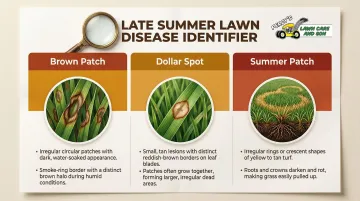
Proper watering, correct mowing height, and seasonal aeration prevent most of these diseases before they start. If you're already seeing symptoms, correcting those habits is also the first step toward recovery.
Aeration and Overseeding: The Late Summer Game-Changer
Aeration and Overseeding: Why Late Summer Is the Right Window
What Core Aeration Is and Why It Matters
Core aeration uses hollow tines to pull plugs of compacted soil, opening channels for air, water, and nutrients to reach the root zone. This is especially important in Buffalo-area lawns that have endured heavy foot traffic and equipment use through summer. Heavy clay soils (common in Western New York) benefit most from annual aeration.
Why Late Summer Is the Optimal Overseeding Window
Cornell University recommends seeding between mid-August and mid-September for Buffalo-area lawns. Soil is warm enough for rapid germination, weed competition is lower, and new seedlings have weeks to establish before winter.
Best grass types for Buffalo:
- Kentucky Bluegrass — 1–3 lbs per 1,000 sq. ft., slow to establish (30–90 days)
- Perennial Ryegrass — 4–6 lbs per 1,000 sq. ft., fast germination (14–21 days)
- Fine Fescue — 4–5 lbs per 1,000 sq. ft., medium establishment (21–50 days)
Why Aeration and Overseeding Work Best Together
The holes left by aeration provide ideal seed-to-soil contact, improving germination rates. Research shows that slit seeding delivers up to 90% germination compared to just 15–30% for standard broadcast overseeding.
Once seeded, apply a high-nitrogen starter fertilizer and keep the soil surface moist throughout germination — typically 7–21 days depending on grass variety.
Buffalo homeowners who'd rather skip the equipment rental can call on Percy's Lawn Care and Son, which has provided aeration and overseeding services across Western New York since 1999, with local knowledge of the region's cool-season grass conditions and clay-heavy soils.
Late Summer Lawn Care Checklist for Buffalo Homeowners
Buffalo's window between mid-August and late September is short — use this checklist to stay on track before cooler temps close the door on overseeding and fertilizing:
Early August:
- Conduct footprint test and soil moisture check
- Raise mower height to 2.5–3 inches
- Sharpen mower blades
- Begin deep watering schedule (1–1.5 inches weekly)
Mid-August:
- Apply slow-release nitrogen fertilizer once daytime highs consistently drop
- Spot-treat visible broadleaf weeds
- Check for signs of lawn disease (brown patch, dollar spot, summer patch)
Late August–Early September:
- Schedule or complete core aeration
- Overseed thin or bare areas
- Apply starter fertilizer
- Keep soil surface consistently moist until seedlings establish
Ongoing Through September:
- Continue weekly deep watering unless rainfall covers 1–1.5 inches
- Mow at correct height as grass resumes growth
- Avoid heavy foot traffic on newly seeded areas
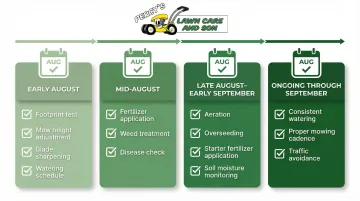
Work through these steps consistently and your lawn will head into winter with the root depth and density it needs to bounce back strong in spring. If you'd rather hand it off, Percy's Lawn Care and Son has been handling late-season lawn maintenance and cleanup for Buffalo homeowners since 1999 — contact them at hello@percyslawncare.com or (716) 245-5296.
Frequently Asked Questions
What should I put on my lawn in late summer?
A nitrogen-rich, slow-release fertilizer is the top priority once peak heat has passed. Overseeding with cool-season grass seed (after aeration) is also highly effective. Broadleaf weed herbicide works best when applied in late summer through early fall.
Can I stop mowing my lawn in October?
Keep mowing until the grass stops actively growing — after the first hard frost in the Buffalo area, usually mid-to-late October. The final mow of the season should leave grass at about 2–2.5 inches to reduce snow mold risk over winter.
What is the "150 rule" for lawns?
The 150 rule refers to adding together the daytime high and low temperature. When that combined figure drops below 150°F, grass growth slows significantly. That's your cue to switch from active feeding and seeding to winterization prep.
When is the best time to aerate and overseed my lawn?
Late August through mid-September is the ideal window in the Buffalo area. Soil is still warm enough for germination, weed competition is reduced, and there's enough time for new grass to establish before the first frost.
How do I know if my lawn needs watering in late summer?
Use the footprint test: grass that doesn't spring back after being walked on is dehydrated. Another visual cue is a blue-green tint rather than bright green color. Both are signs to water before visible browning begins.
Is it too late to treat weeds in late summer?
Late summer is the best window for treating perennial broadleaf weeds like dandelions — they're moving energy to their roots before winter, which makes herbicides more effective now than in spring. Annual weeds like crabgrass will die with the first frost regardless.