

Introduction
Nitrogen is the single most important nutrient for lawn health — it's the reason some lawns stay deep green and dense all season while others fade, thin out, and struggle. While nitrogen is available in fertilizers and naturally in the environment, it rarely reaches grass in adequate amounts on its own — especially after Buffalo's harsh winters deplete soil reserves.
Applying nitrogen sounds simple, but results vary widely based on timing, fertilizer type, grass variety, and soil conditions. Buffalo-area homeowners managing cool-season turf through short growing seasons and clay-heavy soils face challenges that make getting those variables right especially critical.
Get any of it wrong and you risk burned turf, wasted product, or a lawn that never quite recovers. This guide walks through the practical decisions that actually move the needle.
Key Takeaways
- Nitrogen drives grass color, blade growth, and root strength — without it, lawns yellow, thin, and become weed-prone
- Apply nitrogen in early spring, late spring, and early fall — avoid peak summer heat and late fall
- Always conduct a soil test before applying to determine actual nitrogen need
- Limit annual nitrogen to 1–4 lbs per 1,000 sq ft, split across multiple applications
- Slow-release fertilizers are safer and more effective than fast-release options
What Nitrogen Does for Your Lawn and Why It Matters
Nitrogen is a core component of chlorophyll — the compound that enables photosynthesis. Without it, grass cannot convert sunlight into energy, which is why nitrogen-deficient lawns turn pale green or yellow rather than staying vibrant. It's often called the "green-up" nutrient for good reason — it directly controls the intensity of your lawn's color.
Beyond color, nitrogen plays additional critical roles:
- Produces amino acids and proteins that support blade structure and root development
- Strengthens disease resistance by enabling the plant to manufacture defensive compounds
- Increases turf density by promoting tillering (the production of new shoots from the base of the plant)
- Accelerates recovery from foot traffic, mowing stress, and environmental damage
When nitrogen runs low, the effects show up fast. Grass can't sustain the growth and density those functions require, and the decline is hard to miss:
- Yellowing or light-green grass, typically starting in older leaves
- Slow or stunted growth with weak, thin blades
- Thinning turf with bare patches where weeds invade
- Increased weed pressure, especially clover (which fixes its own nitrogen and thrives in nitrogen-poor soils)
- Reduced bounce-back from traffic or stress
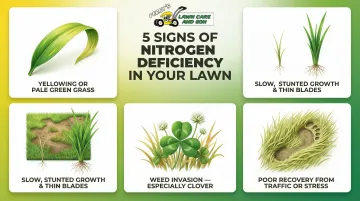
For Buffalo homeowners, these symptoms tend to peak in early spring. Cold winters suppress the microbial activity that releases organic nitrogen back into the soil, leaving lawns nitrogen-starved right as the growing season begins.
How to Apply Nitrogen Fertilizer to Your Lawn
Successful nitrogen application takes more than scattering fertilizer and hoping for the best. Preparation, the right product, and correct technique all matter — get any one wrong and you risk burning turf or wasting money on nutrients that never reach the roots.
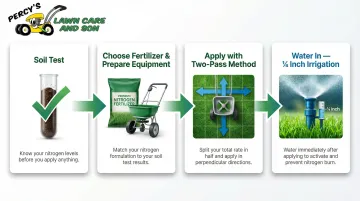
Step 1: Test Your Soil Before You Buy Anything
A soil test is the essential first step. Cornell Cooperative Extension of Erie County provides soil pH testing for $3–$5 per sample and facilitates comprehensive nutrient analysis through Dairy One Agro-One. This reveals your current nitrogen level, pH, and soil composition so you know exactly how much nitrogen to add rather than guessing.
Buffalo-area soils are often clay-heavy. Clay soils have high cation exchange capacity (CEC), meaning they retain nutrients well but are prone to compaction. Slow-release fertilizers tend to outperform fast-release options in these conditions because they prevent nitrogen from washing out of the root zone before roots can absorb it.
Step 2: Choose the Right Nitrogen Fertilizer Type
That soil behavior directly shapes which fertilizer type works best. Here's how the two main categories compare:
Slow-Release vs. Fast-Release Nitrogen:
| Feature | Fast-Release Nitrogen | Slow-Release Nitrogen |
|---|---|---|
| Examples | Urea, Ammonium Sulfate, Ammonium Nitrate | Polymer-Coated Urea, Sulfur-Coated Urea, Blood Meal, Feather Meal |
| Release Mechanism | Dissolves immediately in water | Coating breakdown or microbial degradation |
| Visible Response | Rapid green-up (7–10 days) | Gradual green-up (3–4 weeks) |
| Feeding Duration | Short (2–6 weeks) | Long (8–12+ weeks) |
| Burn Risk | High | Low |
Slow-release fertilizers provide steadier growth, are more forgiving for DIY applicators, and are less likely to leach into groundwater. Fast-release options deliver quick visible results but require precise application and immediate watering.
Reading the N-P-K Label:
The three numbers on every fertilizer bag represent the percentage by weight of Nitrogen (N), Phosphorus (P₂O₅), and Potassium (K₂O). To apply 1.0 lb of actual nitrogen per 1,000 sq ft using a 20-0-10 fertilizer (20% N):
- 1.0 ÷ 0.20 = 5.0 lbs of fertilizer product per 1,000 sq ft
- For a 5,000 sq ft lawn, multiply by 5 = 25 lbs total product needed
Step 3: Prepare Your Lawn and Equipment
Before spreading:
- Mow the lawn a few days in advance to the proper height
- Ensure grass is dry (not wet from rain or morning dew)
- Measure your lawn area accurately
- Calibrate your spreader according to the product label
- Put on gloves and a dust mask for safety
Equipment options:
- Broadcast spreaders cover large areas quickly but lose precision at lawn edges
- Drop spreaders give you tight control for edges and small areas — overlap passes carefully to avoid missed strips
- Hose-end sprayers work for liquid fertilizers; keep a consistent walking pace and spray height throughout
Step 4: Apply the Fertilizer and Water In
Application technique:
- Start at the perimeter, then make parallel passes across the lawn
- Avoid overlapping passes to prevent double-dosing (which causes striping and burn)
- For even coverage, consider the two-pass method: apply half the product in one direction, then the other half perpendicular to the first pass
Water immediately after application:
Apply about ¼ inch of water to move nutrients into the soil and rinse fertilizer off grass blades, which prevents burn. Keep it light — heavy watering flushes nitrogen past the root zone before grass can use it.
When to Apply Nitrogen to Your Lawn
Nitrogen timing directly determines whether your lawn thrives or struggles. Applying at the wrong time can stress the grass, waste fertilizer, or even burn it.
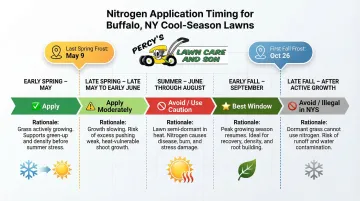
Optimal application windows for Buffalo cool-season lawns:
Early Spring (May): Apply when soil temperatures consistently reach 55°F and grass actively resumes growth. Buffalo's last spring frost averages May 9, with the last hard frost around April 27. Don't apply too early — grass only absorbs fertilizer when actively growing.
Late Spring (Late May to early June): Provides a growth boost before summer stress begins. Keep rates moderate (0.5–1 lb actual nitrogen per 1,000 sq ft) to avoid forcing excessive shoot growth.
Early Fall (September): The most impactful window for cool-season turf. As temperatures cool, grasses shift from foliar growth to manufacturing and storing carbohydrates for root and rhizome growth, disease tolerance, and winter survival. Buffalo's first fall frost averages October 26, with the first hard frost around November 6.
Two windows to avoid:
- Summer: High heat pushes cool-season grass toward dormancy. Nitrogen-stimulated growth depletes carbohydrate reserves and increases burn risk. Apply only if irrigating consistently, and cap rates at 0.5 lb actual nitrogen per 1,000 sq ft.
- Late fall (after active growth stops): Absorption rates drop to 15–60%, and unabsorbed nitrogen leaches into groundwater over winter. New York State law also prohibits lawn fertilizer applications between December 1 and April 1.
Percy's Lawn Care and Son has over 25 years of experience managing Buffalo lawns through every season. If you're unsure which window fits your lawn's current condition, they can assess the right fertilization schedule for your specific property and grass type.
Key Variables That Affect Nitrogen Application Results
Even homeowners who follow directions get inconsistent results because nitrogen outcomes depend heavily on four controllable variables most guides skip over.
Nitrogen Release Rate
The speed at which nitrogen becomes available to grass roots determines both the burn risk and how long the feeding window lasts. Fast-release products deliver results in days but require careful rate management.
Slow-release fertilizers maintain steadier growth and are more forgiving for DIY applicators. Fast-release products are best reserved for experienced applicators or emergency green-up situations where quick results are needed.
Application Rate (Pounds of Actual Nitrogen per 1,000 sq ft)
University extension guidelines recommend 1–4 lbs of actual nitrogen per 1,000 sq ft per growing season, depending on grass type. Exceeding this — especially in a single application — causes fertilizer burn and pushes excessive shoot growth at the expense of root health.
Spread applications across the season rather than loading it all at once. Per-application guidelines:
- Keep each application in the ½–1 lb range of actual nitrogen per 1,000 sq ft
- Never exceed 1.0 lb in a single application
- Drop to 0.25–0.5 lbs when using fast-release soluble sources
Grass Type and Local Climate
Cool-season grasses common in Buffalo have different nitrogen needs and peak uptake windows:
| Grass Type | Annual Nitrogen Requirement (lbs per 1,000 sq ft) |
|---|---|
| Kentucky Bluegrass | 2.0–4.0 lbs |
| Perennial Ryegrass | 2.0–4.0 lbs |
| Tall Fescue | 1.0–3.0 lbs |
| Fine Fescue | 1.0–2.0 lbs |
Applying nitrogen during active growth cycles — spring and fall, not summer — maximizes uptake efficiency. Applications during dormancy waste product and stress roots. Fine Fescue is particularly sensitive: applying high rates (3–4 lbs) increases its susceptibility to drought, heat stress, and disease.
Soil Type and Moisture Conditions
Clay-heavy soils — common across the Buffalo area — hold nutrients longer but compact easily, slowing nitrogen penetration to roots. Sandy soils drain nitrogen quickly and may need more frequent, lower-dose applications.
Core aeration before a fall nitrogen application significantly improves uptake in compacted clay soils. Removing soil cores alleviates compaction, improves water infiltration, and opens air space so roots can grow deeper and absorb nitrogen more efficiently.
Common Mistakes When Applying Lawn Nitrogen Fertilizer
Over-Applying or Skipping the Soil Test
Over-application — especially with fast-release products — leads to:
- Fertilizer burn (brown streaks and dead patches)
- Excessive thatch buildup
- Weakened root systems
Skipping the soil test means applying nitrogen lawns don't actually need, wasting money and potentially damaging soil chemistry.
Applying at the Wrong Time — or Without Proper Watering
Nitrogen applied during peak summer heat pushes already-stressed cool-season grass toward damage. Applications made after the lawn stops growing in late fall do nothing for the current season and increase runoff risk.
Watering habits matter just as much. Skipping water after application or overwatering immediately after are both common errors — the first limits absorption, the second washes nutrients into storm drains.
Ignoring Signs of Uneven Coverage
Striping — alternating dark and light green lines — signals overlapping passes or missed strips during spreading. A properly calibrated spreader corrects this on the next application.
More nitrogen is not always better. Consistent, correctly timed applications build a healthier lawn over seasons far more effectively than heavy single doses.
Frequently Asked Questions
Is it good to put nitrogen on your lawn?
Yes, nitrogen is beneficial and essential for healthy grass — it supports color, growth, and disease resistance. However, the benefit depends on applying the right amount at the right time, not indiscriminate application. Too much or poorly timed nitrogen causes more harm than good.
How to tell if a lawn needs nitrogen?
Key signs of nitrogen deficiency include pale green or yellowing grass (starting in older leaves), slow growth, thinning turf with weed invasion (especially clover), and poor recovery from foot traffic. A soil test is the most reliable way to confirm nitrogen deficiency before you fertilize.
How much nitrogen should I apply per 1,000 square feet?
University guidelines recommend 1–4 lbs of nitrogen (measured by elemental weight, not product weight) per 1,000 sq ft per year across multiple applications. Individual applications should stay in the ½–1 lb range to avoid burn, with fast-release products limited to 0.25–0.5 lbs per application.
Can too much nitrogen burn my lawn?
Yes, excessive nitrogen — especially fast-release types applied without watering — causes fertilizer burn, visible as brown or yellow scorched patches. Over-application also leads to thatch buildup, weakened roots, and increased disease susceptibility.
What type of nitrogen fertilizer is best for cool-season grass?
Slow-release granular fertilizers are the better choice for cool-season grasses like Kentucky Bluegrass and Tall Fescue — they deliver steady nutrition without triggering surge growth. Organic options like blood meal or feather meal work well if you want to avoid synthetic inputs.
How long after applying nitrogen will I see results?
Fast-release nitrogen can produce visible greening within 7–10 days, while slow-release products may take 2–4 weeks to show noticeable results. Soil temperature, moisture, and grass type all influence how quickly the lawn responds.