Introduction
It's late March in Buffalo. The last stubborn snowbank along your driveway has finally melted, and the lawn underneath looks brown, matted, and rough around the edges. If you're a Buffalo homeowner, this scene is familiar — and completely normal after months of lake-effect snow, freeze-thaw cycles, and road salt exposure.
What you do in the next few weeks determines whether your lawn thrives or limps through the season. Skipping post-thaw care invites real problems: soil compaction, salt damage along driveways and sidewalks, snow mold patches, and bare spots that turn into weed havens by June.
Buffalo's winters average 95.4 inches of snow annually — those conditions hit lawns harder than almost anywhere else in the region.
This guide covers how to assess winter damage, the essential spring lawn care techniques, a realistic timeline for Buffalo conditions, and common mistakes that cost homeowners time and money.
Key Takeaways
- Wait until soil is firm before walking on your lawn — foot traffic on saturated ground crushes the air channels roots need to recover
- Work in order: assess damage → rake when dry → aerate → treat salt → overseed bare patches → fertilize once grass is actively growing
- Buffalo's freeze-thaw cycles, road salt, and snow mold each need specific treatment — generic spring care won't cut it
- Most active work starts mid-to-late April when soil temps consistently exceed 50°F
- If the same problems keep coming back each spring, that's a sign of an underlying issue worth addressing with professional help
Why Spring Thaw Lawn Care Matters for Buffalo Lawns
Buffalo sits in one of the most demanding lawn climates in the Northeast. Heavy lake-effect snow, repeated freeze-thaw cycles through February and March, and aggressive road salting combine to stress turf far more than a typical mild winter elsewhere.
The Freeze-Thaw Damage Cycle
During a Buffalo winter, soil and grass endure relentless freeze-thaw cycling. As soil water freezes and expands, it creates ice lenses that physically push grass roots upward — a process called frost heaving. Freeze-thaw cycles can alleviate surface compaction to a depth of 12 inches, but they also sever lateral roots and elevate grass crowns, leaving turf vulnerable to moisture loss and temperature extremes.
Fine-textured soils common in Erie County — including Niagara and Canandaigua silt loams — are especially prone to ice lens formation because they hold more water. The result: lumpy, uneven turf with exposed roots near the surface.
Left unaddressed, these conditions compound over time. Lawns that skip proper spring recovery lose soil structure, develop persistent thin spots, and grow increasingly vulnerable to weeds and summer drought stress — eventually requiring costly re-sodding or repair.
Buffalo's Salt Damage Problem
Road crews and homeowners apply massive amounts of salt each winter. NYSDOT applies salt across thousands of lane-miles each season, and Erie County procures thousands of tons of salt annually to keep roads clear.
Excess sodium damages grass through three mechanisms:
- Osmotic stress — salt ions hold water tightly in soil, creating "physiological drought" that prevents roots from absorbing moisture
- Chloride toxicity — chloride accumulates in grass tissue, causing leaf burn and browning (typically when leaf concentrations exceed 1.0% chloride or 0.5% sodium)
- Soil dispersion — sodium displaces calcium and magnesium on soil particles, causing clay to expand, which increases compaction and reduces drainage
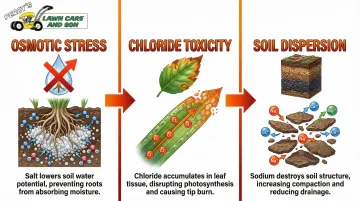
The brown or yellow border patches you see along driveways and curbs each spring are direct evidence of sodium buildup disrupting water uptake.
The Spring Opportunity
Spring thaw, handled correctly, is the best window of the year to reset soil health, fill bare patches, and set the lawn up for a resilient summer. For Buffalo homeowners dealing with Erie County clay soils and heavy salt exposure, acting early in the season makes the difference between a lawn that recovers quickly and one that struggles into July.
How to Assess Your Lawn After the Winter Thaw
Spring thaw in Buffalo doesn't mean your lawn is ready for action. Before raking, aerating, or applying anything, a proper walkthrough tells you exactly what you're dealing with.
Start by waiting until the surface is firm enough that footsteps don't leave deep impressions. Walking on saturated soil crushes the air channels roots depend on; stepping on partially frozen turf tears fragile grass crowns. A day or two of patience can save weeks of recovery time.
Identifying Salt Damage
Salt damage appears as straw-colored or tan patches running along driveways, sidewalks, curb lines, or wherever snow was piled during shoveling. These areas are typically confined to the lawn's edges and are caused by sodium buildup disrupting water uptake in grass roots.
Photograph and map affected zones now — once conditions allow treatment, you'll know exactly where to focus. Snow mold is the next thing to look for as you work toward the middle of the lawn.
Spotting Snow Mold and Fungal Issues
Snow mold shows up as circular grayish-white or pinkish patches that become visible as snow recedes — it develops when fungal growth takes hold under snow cover at temperatures just above freezing.
Buffalo lawns can be hit by two distinct types, and knowing which one you have determines how aggressively you need to respond:
| Feature | Gray Snow Mold (Typhula spp.) | Pink Snow Mold (Microdochium nivale) |
|---|---|---|
| Snow Requirement | Requires 45-60 days of snow cover over unfrozen soil | Does not require snow; thrives in cool (35-55°F), wet conditions |
| Visual Markers | White/gray mycelium with tiny reddish-brown or black sclerotia (hard structures) on leaves | White/pink mycelium; no sclerotia; produces pink spore masses |
| Damage Level | Usually only kills leaf blades; crowns and roots survive | Can severely damage or kill the grass crown and plant |
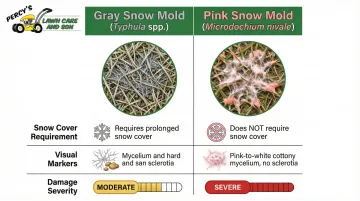
Gray snow mold often resolves on its own as the lawn dries, while pink snow mold is more damaging and may require fungicide treatment. Check matted, flat areas of grass closely — if blades peel apart to reveal a web-like or powdery coating, fungal activity is likely present.
Signs of Frost Heaving and Drainage Problems
Frost heaving signs include lumpy, uneven turf where soil has been pushed upward, exposed roots near the surface, and a spongy feel underfoot even after the surface appears dry. Low-lying areas and high-clay soils (common in parts of the Buffalo area) are especially prone to frost heaving.
Identify drainage problem spots by watching where water pools or flows during the thaw — note these areas for aeration or grading later in the season.
Essential Spring Lawn Care Techniques
Spring lawn care is a sequence, not a single event. Rushing any step before the lawn is ready causes more harm than good. Apply each technique below in roughly the order listed.
Gentle Raking and Debris Removal
Once the surface is firm and dry enough to walk on without sinking, a light rake-through removes leaves, matted grass blades, and debris trapped under snow. This allows sunlight and airflow to reach grass crowns and speeds drying.
If the rake is pulling up clumps of turf, the ground isn't ready yet. Matted patches from snow mold can be gently raked to break up compressed areas and restore airflow — but hold off on dethatching or power-raking until the grass is actively growing.
Aeration
Core aeration pulls small plugs of soil from the lawn, opening pathways for air, water, and nutrients to reach grass roots. While fall is the preferred time for aerating cool-season lawns, spring aeration is acceptable if soil is severely compacted.
After a Buffalo winter, freeze-thaw cycles and heavy snow loads compress the soil until water pools on the surface rather than filtering down to root zones. Aeration reopens those pathways. Lawns showing persistent pooling, slow green-up, or hard-packed soil benefit most.
For best results:
- Aerate when soil is slightly moist — not waterlogged
- Soil too dry prevents tines from penetrating; soil too wet lets equipment destroy soil structure
- Target mid-spring once the ground has fully thawed and dried
Treating Salt Damage
Salt-damaged border areas respond well to gypsum (calcium sulfate), which displaces sodium in the soil and restores conditions for grass growth. The process is straightforward:
- Apply gypsum at 40 lbs per 1,000 sq ft to affected areas
- Water thoroughly after application to flush displaced sodium through the soil
- Six inches of water leaches out roughly 50% of the salt
In severe cases where grass is fully dead along borders, overseeding or spot-sodding after treatment may be necessary.
Overseeding Bare and Thin Patches
Overseeding fills bare patches and thickens thin areas damaged by winter stress.
Process for bare patches:
- Loosen the existing soil with a rake
- Spread a thin layer of compost or topsoil
- Broadcast seed at the recommended rate for your grass type
- Lightly rake seed into the soil
- Keep the area consistently moist in the mornings until germination
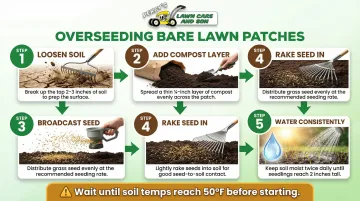
Wait until soil temperatures hit 50°F before seeding — in the Buffalo area, that usually falls in late April to early May, though the date shifts depending on how late winter holds on.
For grass selection, stick with a cool-season blend suited to Western New York: Kentucky bluegrass, fine fescue, and perennial ryegrass all perform reliably in Buffalo's climate.
Spring Fertilization
Once aeration and overseeding are done and the lawn is actively growing, fertilization can begin. Applying it too early pushes leafy top growth before roots are strong enough to support it — leaving the plant more vulnerable through summer.
For spring applications, follow these guidelines:
- Use a balanced or slightly nitrogen-forward formula
- Cap spring nitrogen at 1 lb per 1,000 sq ft
- Choose fertilizer with at least 30% slow-release nitrogen on non-sandy soils
Hold off until soil temperatures reach 55°F and the grass is visibly growing. Heavy nitrogen before that point forces shoot growth the root system can't yet support, increasing susceptibility to summer drought and disease.
One more consideration for Buffalo homeowners: New York State prohibits applying lawn fertilizer between December 1 and April 1. New York law also requires zero-phosphorus fertilizers unless you're establishing a new lawn or a soil test shows a deficiency.
Your Spring Lawn Care Timeline for Buffalo
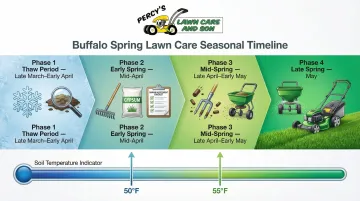
Buffalo's spring thaw doesn't follow a strict schedule. Some years winter releases its grip in late March; others, it holds on well into April. What stays consistent is the sequence of recovery work. Plan for the thaw period to run late March through mid-April, with active lawn care starting in April and early May — and use soil conditions, not calendar dates, as your true guide.
Thaw Period (Late March–Early April)
Ice pack on Lake Erie typically doesn't disappear until mid-April, keeping Buffalo cooler than inland locations and delaying the growing season. For now:
- Stay off the lawn entirely
- Observe and photograph damage
- Spread any remaining snow piles to aid even melting
- Wait for soil to firm up
Early Spring (Mid-April)
The average last frost in the Buffalo metro area falls near the end of April. Soil is starting to dry out, but may still be too wet for heavy equipment. Once the surface firms up:
- Gentle raking and debris removal once surface is firm
- Assess for salt damage, snow mold, and frost heaving
- Apply gypsum to salt-damaged areas
- Begin planning aeration and overseeding
Mid-Spring (Late April–Early May)
Soil temperatures are approaching 50°F, and grass roots are beginning active growth before blades visibly green up. This is when real recovery work starts:
- Core aeration of compacted areas (when soil is slightly moist, not saturated)
- Overseed bare patches once soil temps hit 50°F
- Begin watering schedule as needed (only if soil has dried sufficiently)
Late Spring (May)
Grass is actively growing and soil temperatures are holding consistently above 55°F. Focus on getting the lawn established for the season:
- Spring fertilization once the lawn is actively growing
- First mow at a height of at least 3 inches
- Edge beds and walkways
- Schedule a fall aeration pass if the lawn sees heavy use — commercial properties, households with pets or children, or areas compacted by snow removal equipment often need it to fully recover
Common Mistakes to Avoid — and When to Call a Pro
Three Most Common Errors Buffalo Homeowners Make
1. Starting spring cleanup before the lawn is firm Walking on saturated soil compacts it severely, crushing air channels and tearing grass crowns. Wait until footsteps don't leave deep impressions.
2. Watering too soon after snowmelt The soil is already saturated from melting snow. Adding more water worsens drainage problems and can promote fungal diseases.
3. Applying fertilizer in early spring before grass is actively growing This feeds weeds before turf recovers, and pushes top growth before roots are strong enough to support it.
When to Call a Professional
If the same spots wash out, compact, or die back every year, it's a sign of an underlying drainage or grading issue that topical fixes won't solve long-term. Signs it's time for a professional assessment include:
- Chronic pooling that persists days after rain or snowmelt
- Erosion channels forming in the same areas each spring
- Lawn sections that never fully green up despite consistent care
For Buffalo homeowners dealing with persistent post-winter damage, Percy's Lawn Care and Son brings over 25 years of local experience to problems that DIY fixes can't fully address. The team understands Buffalo's soil conditions and salt exposure patterns firsthand — and can assess, aerate, and overseed lawns back to health.
Frequently Asked Questions
What month do you put winterizer on your lawn?
Winterizer fertilizer is typically applied in late October to early November in the Buffalo area — after the lawn stops growing actively but before the ground freezes. The goal is to strengthen root reserves heading into winter, not to promote leafy growth.
When is it safe to walk on my lawn after the spring thaw?
The lawn is ready for foot traffic once the soil no longer moves or compresses underfoot with normal walking pressure. In Buffalo, this usually means waiting until mid-to-late April depending on winter severity, and avoiding the lawn during any late refreezes.
How do I fix salt damage on my lawn in spring?
Start with a thorough watering to flush sodium from the root zone, then apply gypsum to help restore soil structure. Severely dead patches may need overseeding or spot-sodding once conditions improve.
When should I apply spring fertilizer to my lawn?
Wait until the lawn is actively growing — typically late April to mid-May in Buffalo — before applying spring fertilizer. Going too early drives top growth before roots are ready, leaving the lawn vulnerable to stress and disease.
What is snow mold and how do I treat it?
Snow mold is a fungal disease that appears as circular gray or pink patches once snow melts. Gray snow mold typically resolves on its own — raking the area speeds drying — while pink snow mold is more aggressive and may need a fungicide treatment.
When should I start mowing my lawn in spring?
Start mowing once grass is actively growing and the soil is firm enough to support mower weight without rutting — typically late April or early May in Buffalo. Keep the blade at 3 inches or higher for those first cuts to avoid stressing a lawn still recovering from winter.