
Introduction
Aeration opens the door — what you do in the next two to three weeks determines whether your lawn actually recovers. Skip the follow-through and the investment stalls: seeds won't germinate, soil re-compacts within weeks, and you're back to square one by spring.
This is especially critical in Buffalo's short growing window. Our cool-season grasses have a narrow fall window for establishment, and skipping post-aeration care in September or October means waiting an entire year for another opportunity.
What follows is a practical, week-by-week breakdown of post-aeration care — watering schedules, common mistakes, and timing specifics built around Buffalo's climate.
Key Takeaways
- Leave soil plugs on the lawn — they break down naturally and return nutrients to the soil
- Overseed and fertilize within 48 hours to fill open soil channels
- Water lightly 2–3 times daily for the first 2–3 weeks to keep the seedbed moist
- For the first 2–4 weeks, skip mowing, heavy foot traffic, and herbicide applications
- Fall aeration (late August–October) is the best timing for Buffalo lawns — cool-season grasses recover well before first frost
Why Post-Aeration Care Matters
Aeration opens up your soil — breaking compaction and giving roots direct access to oxygen, water, and nutrients. But those benefits only materialize if you act quickly. Without follow-through, the holes close back up before delivering any lasting change.
Research shows that aeration holes lose their physical benefits within two weeks under warm, moist soil conditions before soil gases return to pre-aeration levels. Solid-tine holes can lose 50% of their diameter almost immediately. That's a tight window — and it's one worth planning around.
Long-Term Impact
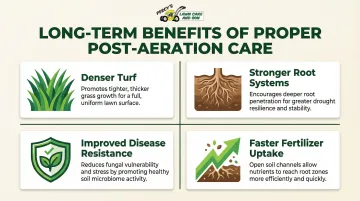
Post-aeration is the single best window to introduce seed and fertilizer directly into the root zone. Done right, the results compound over seasons. The open channels increase available soil surface area, delivering direct benefits to grass health:
- Denser turf growth that crowds out weeds naturally
- Stronger root systems better equipped to handle drought
- Improved disease resistance from better airflow and drainage
- Faster fertilizer uptake directly at the root zone
Buffalo-Specific Context
That window gets even tighter here in Buffalo. Cool-season grasses like Kentucky bluegrass and tall fescue — the most common varieties in the area — need enough warm soil days to germinate before temperatures drop. According to NOAA climate normals, Buffalo's median first frost hits October 13, with a hard freeze following by October 26.
Skipping or delaying post-aeration steps in September or October can mean waiting an entire year for another opportunity. The optimum time to seed cool-season grasses in this region is late summer to early fall (mid-August to mid-September). Seeding later than mid-October is not recommended.
Essential Steps to Take After Aerating Your Lawn
Step 1 — Leave the Soil Plugs Where They Are
The cores pulled up during aeration contain microorganisms and organic matter that break down naturally over 10–14 days. These plugs feed the soil as they decompose.
Raking or removing them wastes this free nutrient cycle. Soil cores generally take several days to a few weeks to decompose, depending on rainfall, mowing, and traffic. Leaving plugs on the surface returns valuable nutrients to the soil and improves its structure.
Step 2 — Overseed Immediately
Aeration holes act as a seedbed, giving new grass seed direct soil contact and a significantly higher germination rate. Seed broadcast onto a lawn without proper cultivation will generally not survive.
Timing matters: Seed should be applied the same day or within 24 hours of aeration. Authoritative sources recommend overseeding "right after aerifying" to take advantage of the open seedbed.
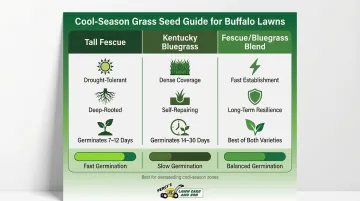
Buffalo recommendations: Choose cool-season grass blends suited to the region's climate:
- Tall fescue: drought-tolerant and deep-rooted, germinates in 7–12 days
- Kentucky bluegrass: dense and self-repairing, germinates in 14–30 days
- Fescue/bluegrass blends: a reliable mix that balances fast establishment with long-term resilience
Step 3 — Topdress with Compost or Topsoil
Applying a thin layer (¼ to ½ inch) of compost over the seeded area helps protect seeds, retain moisture, and add organic matter. Topdressing should consist of a thin layer of soil or compost, usually no more than ¼ to ½ inch.
This step is especially valuable for Buffalo lawns. Erie County's clay-heavy soils compact easily, and organic matter helps loosen that structure while accelerating grass establishment.
Application tip: When using compost, apply a thin layer (about ¼ inch) and work it into the soil via aeration to prevent building up an organic layer that restricts rooting.
Step 4 — Apply Fertilizer Within 48 Hours
Aeration holes allow fertilizer nutrients to reach the root zone much faster than on a non-aerated lawn. Apply a balanced slow-release starter fertilizer within 48 hours to maximize nutrient absorption.
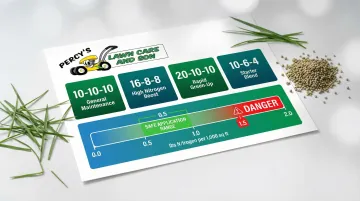
Recommended fertilizer analyses (nitrogen-phosphorus-potassium ratios):
- 10-10-10 (balanced all-purpose, good for new seed)
- 16-8-8 or 20-10-10 (higher nitrogen for faster green-up)
- 10-6-4 (lower-nitrogen option for sensitive or recently stressed turf)
Application rate: Apply at a rate of 0.5 to 1 lb of nitrogen per 1,000 square feet. Exceeding 1.5 lbs per 1,000 sq ft risks burning young grass before it has a chance to root.
Soil test recommendation: A soil test beforehand helps determine what your lawn actually needs, preventing over-application and wasted resources.
Step 5 — Consider Lime if Soil pH is Off
Not all lawns need lime, but if a soil test shows acidic conditions, post-aeration is an ideal time to apply it. The aeration holes allow lime to reach the root zone more effectively.
Cool-season turfgrasses grow best in slightly acidic to neutral soils ranging from 6.0 to 7.2 pH. Ground limestone is most effective when applied in the fall, as winter rain, snow, and freeze-thaw cycles help work it into the soil.
For cool-season grasses in Buffalo, fall is also the recommended time for liming, which makes it a natural pairing with fall aeration.
Percy's Lawn Care Can Help
Percy's Lawn Care and Son has served Buffalo homeowners for over 25 years, with deep familiarity with local soil conditions and seasonal timing. The team handles aeration, fertilization, overseeding, and seasonal lawn care — so you don't have to coordinate each step yourself. Reach out at (716) 245-5296 or hello@percyslawncare.com to talk through what your lawn needs this season.
How to Water Your Lawn After Aeration
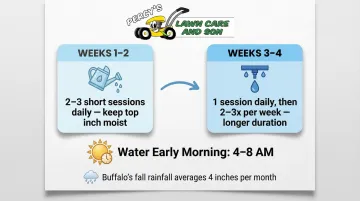
The overall watering goal post-aeration is to keep the top inch of soil consistently moist — not soaked — to support seed germination. Overwatering can wash away seeds and promote rot, while underwatering allows the seedbed to dry out and kills germinating seeds.
First Two Weeks: Light and Frequent
Water lightly and frequently — short sessions 2–3 times daily to maintain surface moisture throughout germination and early establishment.
Timing guidance: Water early in the day (e.g., 4 AM to 8 AM). Late afternoon or evening irrigation prolongs leaf wetness, which promotes fungal infection and disease development.
Weeks 3–4: Transition to Deeper Watering
Once seedlings begin to establish, shift to deeper, less frequent watering — fewer sessions per week but for longer durations. This encourages roots to grow downward and develop drought resilience.
Prior to the first mowing, watering once daily in the early morning is sufficient. Once the lawn is fully established, mature cool-season turf needs deep irrigation just 2–3 times per week.
Buffalo Rainfall Note
Buffalo receives meaningful rainfall in fall — averaging 4.10 inches in September and 4.03 inches in October. Monitor soil moisture and reduce irrigation after rain events to avoid oversaturation. Heavy or prolonged rainfall shortly after aeration is generally fine for established grass but can displace seeds in bare areas.
What to Avoid After Lawn Aeration
Avoid Foot Traffic for 3–4 Weeks
The newly created holes and germinating seeds are easily disrupted. Both pet and human traffic can compact the loosened soil and uproot fragile seedlings before they establish.
Traffic must be strictly limited during the establishment phase, as turfgrass wear tolerance is extremely poor. Seedlings can take 4 to 8 weeks to establish firmly enough to handle regular foot traffic. Consider temporary fencing or signage if needed.
Avoid Mowing Too Soon
Beyond protecting the soil from foot traffic, mowing timing matters just as much. Cutting too early can pull up seedlings or disturb seeds still germinating.
General guideline: Wait until new growth reaches 3–4 inches before the first mow. Begin mowing when seedlings reach a height about ⅓ higher than the desired lawn height (e.g., mow at 3 inches when grass reaches 4 inches). Never remove more than one-third of the leaf tissue in a single mowing. Mowing too soon also compacts aeration holes before they've delivered their full benefit to the soil.
Avoid Applying Herbicides or Weed Killers
Post-aeration weed control chemicals can kill germinating grass seed. Pre-emergent herbicides inhibit root and shoot growth, making them unsafe for any newly seeded area.
Instead, hand-pull weeds during the recovery period. Wait until new grass has been mowed at least twice — usually 6 to 8 weeks after seeding — before applying any weed treatments.
Post-Aeration Lawn Care Timeline for Buffalo Homeowners
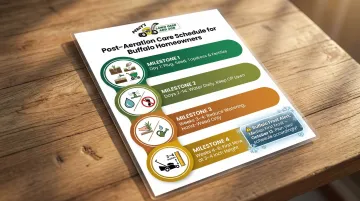
This week-by-week framework gives Buffalo homeowners a clear sequence to follow after aeration, especially important when working around the fall growing season and approaching frost dates.
Timeline Overview
| Timeline | Action Steps | What to Monitor |
|---|---|---|
| Day 1 | Leave plugs, overseed, topdress, apply fertilizer/lime, water first time | Proper seed distribution, even coverage |
| Days 2–14 | Water 2–3 times daily (short sessions), avoid foot traffic | Germination begins (expect 7–21 days depending on seed type) |
| Weeks 3–4 | Reduce watering frequency, hand-pull any weeds, continue avoiding heavy traffic | Seedling establishment, root development |
| Weeks 4–6 | First mow once new grass reaches established height, resume normal mowing schedule | Grass density, lawn uniformity |
Buffalo-Specific Timing Note
Fall aeration in Buffalo should ideally happen by early-to-mid October, giving seeds enough time to germinate before the first frost typically arrives in late October. That narrow window makes it essential to apply overseed and fertilizer immediately after aeration — not days later.
Aerating too late in the season often slows or stalls germination entirely, pushing recovery into spring and leaving the lawn more exposed to winter damage and weed encroachment in the meantime.
Frequently Asked Questions
How long does it take for a lawn to recover after aeration?
Most lawns show visible improvement within 3–4 weeks after aeration, with new seed germinating in 7–21 days depending on grass type and conditions. Full recovery and a noticeably thicker lawn typically takes 6–8 weeks.
What happens if I mow after aeration?
Mowing too soon risks pulling up germinating seedlings and collapsing aeration holes before they've done their job. Wait at least 2–4 weeks, or until new growth reaches 3–4 inches tall.
Should I leave the soil plugs on my lawn after aeration?
Yes, soil plugs should be left in place. They break down naturally within 10–14 days and return nutrients and microorganisms directly into the soil — so leave them where they fall.
When should I fertilize after aeration?
Apply fertilizer within 48 hours of aeration to take advantage of the open soil channels. Always follow up with watering to move the fertilizer down into the root zone and prevent burning the grass blades.
Can I apply weed killer after aeration?
Avoid herbicides — especially pre-emergent weed killers — if you've overseeded, since they'll kill germinating grass seed along with weeds. Wait until new grass has been mowed at least twice before applying any weed control.
How soon after aeration can I water my lawn?
Start watering the same day as aeration, ideally right after overseeding and fertilizing. For the first two weeks, keep the top inch of soil moist with short, frequent sessions — not long, deep soaks.