
Introduction
Buffalo winters rank among the harshest in the country. Heavy snowfall averaging 95.4 inches annually, relentless road salt, freeze-thaw cycles, and prolonged snow cover leave lawns stressed and damaged by the time spring arrives. With the right spring cleanup routine, that same struggling turf can recover fully and hold strong through the growing season.
Skip spring cleanup and the consequences compound fast. Thatch buildup blocks sunlight and moisture from reaching new grass shoots. Lingering debris creates shelter for pests and fungal diseases like snow mold.
Salt-damaged turf near driveways never fully recovers without intervention, leaving bare patches that demand costly repairs. What starts as deferred maintenance becomes a problem that weakens your lawn through the entire growing season.
This guide covers why spring cleanup matters specifically for Buffalo-area properties, the key tasks involved and their proper sequence, how to read your lawn's condition after winter damage, and a realistic timeline for getting the work done right.
TLDR:
- Spring cleanup removes winter debris, thatch, and damage so Buffalo lawns recover strong
- Core tasks follow a specific sequence — from debris removal through mulching — and order matters
- The ideal window is mid-April through early May, once soil temps exceed 50°F and frost risk passes
- Skipping cleanup leads to compacted soil, weed pressure, fungal issues, and struggling turf all season
Why Spring Cleanup Matters for Buffalo Lawns
Buffalo's winters inflict specific, measurable damage that requires targeted spring intervention. Months of snow cover, repeated freeze-thaw cycles, and heavy road salt application leave turf stressed, compacted, and vulnerable heading into the growing season.
Snow Mold: Buffalo's Hidden Lawn Disease
Snow mold is a common fungal disease in Upstate New York that appears as gray or pink circular patches once snow melts. According to Cornell Cooperative Extension, Buffalo's prolonged snow cover and temperatures just above freezing (32°F–45°F) create ideal conditions for two primary pathogens:
- Gray Snow Mold (Typhula incarnata) produces white or tan crusted patches and reddish-brown sclerotia
- Pink Snow Mold (Microdochium nivale) produces pinkish mycelium and can develop even without snow cover during cold, wet periods
Spring cleanup is the primary treatment. Light raking breaks up crusted, matted grass, improves airflow, and allows natural recovery without immediate chemical intervention.
Winter Debris and Thatch Buildup
Layers of matted dead grass, leaves, and organic buildup left from fall and winter block sunlight, air, and moisture from reaching the soil. This suffocates root development and stunts new grass growth. When combined with snow mold damage, the effect is severe: turf that should green up in April remains brown and patchy well into May.
Road Salt Damage
Road salt triggers physiological drought and ion toxicity in turf. According to Rutgers Plant & Pest Advisory, high sodium and chloride levels disrupt normal cellular functions and make it difficult for roots to absorb water. Kentucky bluegrass—common in Buffalo lawns—is highly sensitive to salt damage, whereas perennial ryegrass and fine fescues are more tolerant.
Beyond turf health, there's a financial case for staying on top of spring cleanup. The 2023 National Association of REALTORS® Remodeling Impact Report found that standard lawn care yields an estimated 217% cost recovery at resale—the highest ROI of all outdoor projects evaluated. Well-maintained lawns boost curb appeal, reduce pest harborage, and prevent the kind of turf deterioration that requires expensive regrading or sod replacement.
Percy's Lawn Care and Son has served Buffalo-area properties for over 25 years. The team understands how local climate conditions—from Cheektowaga to Orchard Park—affect turf recovery in spring, and tailors cleanup approaches accordingly.
What Does Spring Lawn Cleanup Include?
Spring cleanup is a sequence of tasks performed in a specific order. Each step prepares the lawn for the next, setting the foundation for strong summer growth.
Debris Removal and Dethatching
Start by clearing the property of winter debris—fallen branches, leaf litter, dead perennial stems, and scattered mulch. This exposes the lawn surface and reveals damage patterns that winter cover masked.
Dethatching comes next. Thatch — the layer of dead grass stems and roots between soil and live blades — builds up significantly over Buffalo winters and should be addressed before any seeding or fertilizing.
How to test if dethatching is needed:
Remove a 2-inch deep, pie-shaped wedge from your lawn. Measure the brown layer between the soil and green vegetation. If it exceeds 0.5 to 1 inch, dethatching is warranted.
Equipment options:
- Manual dethatching rake: Low turf injury risk, best for small lawns and light thatch under 0.5 inches
- Power rake (vertical mower): Steel knife-like tines rotating perpendicular to the ground; highly aggressive, best for severe thatch over 1 inch
- Core aerator: Removes hollow soil plugs; moderate injury risk, effective for gradual thatch reduction and compaction relief

Power rakes are highly effective but can severely thin winter-weakened turf if used improperly. For most Buffalo residential lawns, a combination of manual raking for snow mold patches and core aeration for thatch control delivers the best results.
Once thatch and debris are cleared, attention shifts to the planting beds and ornamentals.
Pruning, Trimming, and Bed Cleanup
Remove dead or broken branches on shrubs and ornamentals, browned perennial stems, and frost-killed foliage. Cut above a live node to encourage healthy regrowth. Over-pruning is a common mistake—remove only what's clearly dead or damaged.
Bed edging follows pruning. Redefine the border between lawn and planting beds, pull winter weeds that germinated during warm spells, and rake debris from mulched areas. Fresh beds are far easier to mulch — and weeds are much harder to establish once mulch goes down.
With beds and ornamentals in order, the lawn itself is ready for its spring treatment.
Lawn Care: Aeration, Seeding, and Fertilizing
Core aeration is essential after a Buffalo winter. Snow weight and freeze-thaw cycles compact the soil, blocking air, water, and nutrients from reaching roots. The process pulls plugs 0.5 to 0.75 inches in diameter and 2 to 3 inches deep — aim for 20 to 40 holes per square foot. It's especially valuable on lawns with thin or bare patches left behind by snow mold.
Overseeding fills in bare patches caused by salt damage, snow mold, or winter wear:
- Lightly rake bare areas to expose soil
- Apply seed at the recommended rate for your grass type
- Keep the area moist until germination (7-14 days)
- Wait at least 60 days before applying pre-emergent herbicides to newly seeded areas
Cool-season grasses common in Buffalo — Kentucky bluegrass, fine fescue, perennial ryegrass, and tall fescue — benefit from a light spring feeding once soil temps reach 55°F. According to the Rutgers Center for Turfgrass Science, nitrogen uptake remains very slow until soil temperatures consistently exceed that threshold. Don't over-apply: heavy spring fertilizing pushes top growth at the expense of roots and raises disease risk.
Weed Control and Mulching
Pre-emergent herbicides prevent crabgrass and other annuals before they germinate. Crabgrass seeds begin sprouting when soil temperatures in the upper inch reach 55°F to 58°F at daybreak for 4 to 5 consecutive days. Watch your forsythia — when it hits full bloom, soil temps are approaching that threshold.
Pre-emergent vs. post-emergent:
- Pre-emergent: Applied before weed seeds germinate; prevents crabgrass, not effective on existing weeds
- Post-emergent: Applied to actively growing weeds; kills existing broadleaf weeds but doesn't prevent new germination
Fresh mulch applied after cleanup retains soil moisture, regulates temperature during late cold snaps, suppresses weeds, and sharpens the overall look of any property.
Best practices:
- Apply 2–3 inches of mulch (1–2 inches for finely shredded mulch)
- Pull mulch 3–5 inches away from young tree trunks (8–10 inches for mature trees) to expose the root flare
- Never pile mulch against plant stems or tree trunks—this causes inner bark death, fungal diseases, and stem-girdling roots
The International Society of Arboriculture calls improper mulching "mulch volcanos" and warns that piling mulch against trunks can eventually strangle trees.
Signs Your Lawn Needs Spring Cleanup
Lawns that look fine in March can surprise you by May — winter damage often hides beneath the surface and only shows up once the growing season kicks in and weak patches refuse to green up.
Visual indicators:
- Gray or pink circular patches — snow mold that needs light raking to restore airflow
- Matted grass that doesn't spring back, pointing to thatch buildup or mold
- A spongy feel underfoot, a sign of excessive thatch (over 0.5 inches)
- Dead zones near driveways or sidewalks from winter de-icing salt
Beyond what you see on the surface, soil compaction is another common issue after Buffalo's freeze-thaw winters. Look for these signs:
Signs of soil compaction:
- Water pooling on the surface after rain rather than absorbing
- Sparse grass growth despite adequate watering
- Lawn feels hard when walked on
- Soil resists penetration when you push a screwdriver into it
Spot two or more of these signs? Your lawn needs attention now — before weak areas fall further behind during the growing season.
Buffalo Spring Cleanup Timeline
Timing is critical in Buffalo. Starting too early—when soil is still frozen or waterlogged—can compact turf and damage root zones. The general rule: wait until the last frost has passed, soil temperatures are consistently above 50°F, and the lawn can support foot traffic without leaving deep impressions.
In Buffalo, this window typically opens mid-April to early May. The National Weather Service Buffalo notes that the average last spring frost occurs near the end of April in the metro area, but extends into mid-May for inland locations. Lake Erie's ice pack often persists until mid-April, keeping the region chilly through May.
Phased Task Timeline
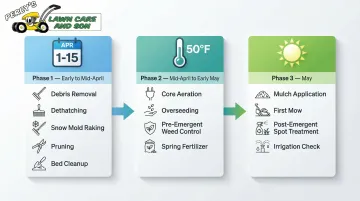
Early to Mid-April (soil temps rising, last frost approaching):
- Debris removal
- Dethatching and snow mold raking
- Pruning damaged plants
- Bed cleanup and edging
Mid-April to Early May (soil temps 50°F+, frost risk low):
- Core aeration
- Overseeding bare patches
- Pre-emergent weed control
- Spring fertilizer application
May (growing season underway):
- Fresh mulch application
- First mow of the season at proper height (3–3.5 inches for cool-season grasses)
- Post-emergent weed spot treatment as needed
- Irrigation system check
Special consideration for salt damage: Buffalo properties with heavy salt exposure near roads or driveways may need additional lawn repair steps. Cornell Cooperative Extension recommends flushing salt-saturated soil with water before seeding if drainage is adequate. A local pro familiar with Buffalo's road salt patterns — like the team at Percy's Lawn Care and Son, who've been assessing post-winter damage across the area since 1999 — can help you identify how much repair your lawn actually needs before deciding on next steps.
Conclusion
Buffalo winters are hard on lawns. The damage left behind — snow mold, compacted soil, thatch buildup — compounds through the growing season if you don't address it early. Getting ahead of it in spring sets the tone for everything that follows.
Sequence and timing matter. Work through the steps in order:
- Wait for soil temps to reach 50°F before starting
- Address snow mold and thatch first
- Aerate and overseed bare or thin areas
- Fertilize and apply pre-emergent herbicides last
Each step prepares the ground for the next.
Percy's Lawn Care and Son has served Buffalo-area homeowners and commercial properties since 1999. Percy and David Eldridge know exactly what Upstate New York winters do to turf, and they've spent over 25 years helping local properties recover and thrive each spring. For a consultation or to schedule spring cleanup, call (716) 245-5296 or email hello@percyslawncare.com.
Frequently Asked Questions
What is a spring cleanup in landscaping?
Spring cleanup is a set of tasks performed after winter to clear debris, remove damaged plant material, dethatch and aerate soil, and prepare the lawn and landscape for healthy growth through the growing season.
When should you do spring yard cleanup?
In Buffalo, NY, spring cleanup should be performed mid-April to early May, once the last frost has passed and soil temperatures are consistently above 50°F and no longer waterlogged.
How much does a landscaper charge for spring cleanup?
Spring cleanup costs vary based on property size and damage extent. According to recent industry data, general yard cleanup ranges from $190–$1,000 (average $360), with spring cleanups typically costing $100–$300. Bundled services like aeration ($75–$206) and dethatching ($160–$225) affect total pricing.
What are the signs my lawn needs spring cleanup?
Key indicators include:
- Snow mold patches (gray or pink circles)
- Matted or spongy turf that doesn't spring back
- Salt-damaged dead zones near pavement
- Surface water pooling from compaction
- Debris coverage blocking sunlight from reaching soil
Should I aerate my lawn in spring or fall in Buffalo, NY?
For cool-season grasses common in Buffalo, fall (September) is generally preferred for core aeration. However, spring aeration is beneficial for lawns with heavy compaction or snow mold damage, especially when followed by overseeding.
Can I do spring cleanup myself or should I hire a professional?
Basic debris removal and light pruning are DIY-friendly. However, tasks like core aeration, dethatching, overseeding, and fertilizer application benefit from professional equipment and local expertise—especially in Buffalo, where freeze-thaw cycles and lake-effect snow affect each property differently.