
Key Takeaways
- Wait until soil is dry and consistently above freezing (late March to mid-April in Buffalo) before starting any lawn work
- Rake out thatch, remove debris, and assess salt damage along edges and curb strips
- Test soil pH and nutrients, then core aerate to relieve compaction in Buffalo's heavy clay soils
- Hold off on heavy fertilizing until late May — early applications waste money and encourage weak growth that won't survive Buffalo's late frosts
- Apply pre-emergent herbicide once soil temps hit 50°F, which typically falls in late April in Buffalo
- Overseed damaged or bare areas with perennial ryegrass after pre-emergent timing has passed
What Early Spring Looks Like for Buffalo, NY Lawns
Zone 6b and Cool-Season Grass Behavior
Buffalo sits in USDA Hardiness Zone 6b, where the average last frost arrives near the end of April—sometimes stretching into mid-May for inland areas. March and early April are unpredictable: one week brings 50°F sunshine and rapid snowmelt, the next dumps six inches of fresh snow.
Your lawn is dominated by cool-season grasses: Kentucky bluegrass, perennial ryegrass, fine fescue, and tall fescue. These grasses behave very differently from the warm-season varieties found in southern climates.
Cool-season grasses break winter dormancy and begin actively absorbing nutrients only when soil temperatures consistently rise above 55°F. Air temperature means nothing; a sunny 60°F day in late March does not wake your lawn if the soil two inches down is still 40°F. This is why Buffalo's spring lawn care is dictated by soil conditions and temperatures, not calendar dates or your neighbor's schedule.
Specific Winter Damage Patterns
Buffalo lawns face a predictable set of damage issues after winter:
- Thatch accumulation — dormant grass leaves a matted layer of dead organic material that smothers new shoots
- Soil compaction — heavy snowpack and foot traffic compress Buffalo's clay-heavy soils, blocking water, air, and nutrient movement
- Salt and sand residue — road treatments and plow activity leave sodium chloride deposits and gravel along curbs, driveways, and sidewalks, creating brown, straw-colored damage strips
- Snow mold — prolonged snow cover (40–60+ days) creates ideal conditions for gray snow mold (Typhula species) and pink snow mold (Microdochium nivale), leaving circular tan or white matted patches
Timing Framework for Buffalo Spring Lawn Care
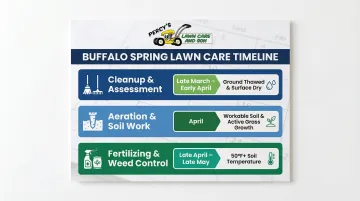
| Task | Timing Window | Soil/Weather Condition |
|---|---|---|
| Cleanup & assessment | Late March to early April | Ground thawed, soil surface dry enough to walk without sinking |
| Aeration & soil work | April | Soil workable, grass entering active growth |
| Fertilizing & weed control | Late April to late May | Soil temps 50°F+ for pre-emergent; late May for nitrogen fertilizer |
Rushing any step before the ground is ready will cost you. Aerating saturated soil smears clay and deepens compaction. Fertilizing dormant grass wastes product and invites disease. Let soil conditions, not the calendar, set your pace.
Spring Cleanup: Clearing Winter Damage First
Thatch Removal and Raking
Your first task is removing the matted dead grass and thatch that built up over winter. Thatch is the layer of dead organic material—stems, roots, and crowns—that sits between the soil surface and the green grass blades. A thin layer (under ½ inch) provides insulation and wear tolerance.
Once thatch exceeds that threshold, it becomes a barrier that blocks water, air, and nutrients from reaching roots.
Research shows that thatch layers over ½ inch harbor disease and insects, increase drought susceptibility, and tie up fertilizer and pesticide products before they reach the soil. Measure thatch depth by removing a 2-inch-deep wedge of turf and examining the layer between green vegetation and soil.
For most Buffalo lawns after winter:
- A simple spring raking with a fan rake or leaf rake breaks up matted grass and pulls out loose thatch
- Power dethatching (vertical mowing) is warranted only when thatch exceeds ½ inch or the lawn was previously neglected
- Rake when the ground is dry enough to support foot traffic without creating ruts
Debris Removal
Pick up sticks, leaves, gravel, and sand deposited by snowplows and spring winds. Leaving this material blocks sunlight and air circulation, contributing to disease and slow green-up. Pay special attention to curb edges and driveway borders where plow activity deposits the heaviest debris.
Salt Damage Assessment and Remediation
Road salt and ice melt products damage grass along driveways, curbs, and sidewalks. Visual signs include brown, straw-colored strips where sodium chloride concentration burned grass crowns and roots.
Remediation steps:
- Flush affected areas with water once the ground thaws to leach salt deeper into the soil
- Rake away dead material
- Overseed with perennial ryegrass or topdress with compost once the ground has dried
Cornell research notes that flushing works well when drainage supports it — skip this step if your soil is already waterlogged from spring thaw.
Snow Mold Recovery
Check for gray snow mold (circular tan or white matted patches, sometimes with hard BB-like sclerotia) or pink snow mold (smaller patches under 1 foot with pinkish margins). Both are common in Buffalo after extended snow cover.
Recovery approach:
- Lightly rake matted patches to promote air circulation and dry the canopy
- Most turf recovers naturally as temperatures warm and new growth emerges
- Fungicides are rarely warranted in spring — by the time you spot the damage, the fungus has already done its work and is no longer active
If tackling all of this feels like a lot before the season even starts, Percy's Lawn Care and Son has handled spring cleanups across Buffalo, Amherst, Cheektowaga, and surrounding neighborhoods since 1999 — the kind of local familiarity that means they know what Buffalo winters actually do to a lawn.
Soil Testing and Aeration: Building the Right Foundation
Why Soil Testing Comes First
Soil testing is the smartest first investment before buying any fertilizer or amendment. A test reveals:
- pH level (Buffalo's clay soils often trend slightly alkaline)
- Nutrient levels (nitrogen, phosphorus, potassium)
- Organic matter content
Local testing resources:
- Cornell Cooperative Extension Erie County offers Master Gardener volunteer soil pH testing for $3 per sample
- For comprehensive nutrient analysis, CCE refers homeowners to Dairy-One/Agro-One, which provides recommendations based on Cornell research
Understanding Soil Compaction in Buffalo Lawns
Buffalo's heavy clay soils — combined with winter snowpack and foot traffic — create dense layers that block water, oxygen, and nutrients from reaching roots. Buffalo's heavy clay soils — combined with winter snowpack and foot traffic — create dense layers that block water, oxygen, and nutrients from reaching roots. Research confirms that compaction causes measurable damage to soil structure. The effects compound quickly:
- Reduces air pockets that roots need to breathe
- Slows water infiltration, leading to runoff and pooling
- Cuts off nutrient pathways before they reach the root zone
- Pushes roots shallow, leaving grass vulnerable to drought
Core Aeration: The Fix
Core aeration removes small plugs of soil (typically ½–¾ inch in diameter, 2–3 inches deep) to relieve compaction and improve air, water, and nutrient infiltration.
Timing for Buffalo:
- Late March to mid-April is optimal for cool-season lawns in Western New York
- Aerate when grass is entering active growth and can recover quickly
- Soil should be moist but not saturated (if water squeezes out when you grab a handful, wait a few days)
Equipment choice matters:
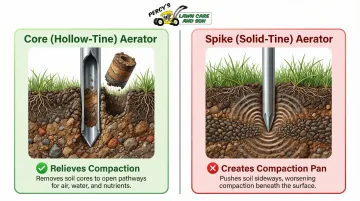
- Core (hollow-tine) aerators physically remove soil plugs and effectively relieve compaction
- Spike or solid-tine aerators do not remove soil and can create compacted "aerification pans" at the bottom of each tine stroke, particularly in fine-textured clay soils like Buffalo's
DIY vs. Professional:
- Core aerators are available to rent, though machines are heavy, require a truck or trailer to transport, and can be difficult to maneuver on uneven ground
- Professional services ensure proper equipment, technique, and coverage—especially valuable in Buffalo's challenging clay soils
New York State Phosphorus Law
New York Environmental Conservation Law §17-2103 strictly regulates lawn fertilizers:
- Phosphorus prohibition: You cannot apply phosphorus-containing fertilizer on established lawns unless a soil test confirms deficiency
- Blackout period: No fertilizer of any kind may be applied between December 1 and April 1
- Water setbacks: No application within 20 feet of surface water unless there's a 10-foot natural vegetative buffer or you use a spreader guard (allowing application up to 3 feet from water)
Getting your soil tested before that April 1 window opens puts you in a position to act quickly — and stay on the right side of state law when you do.
Fertilizing, Weed Control, and Overseeding
The Early Spring Fertilizing Myth
Applying nitrogen-heavy fertilizer before late May pushes rapid top growth at the expense of root development. Cornell Cooperative Extension explicitly advises to "allow grass to come out of winter dormancy before applying fertilizer" and notes that grass only absorbs fertilizer when actively growing above 55°F soil temperature.
Why wait until late May:
- Early applications encourage lush top growth that makes lawns more susceptible to summer drought and disease
- Cool-season grasses naturally green up on their own as soil warms
- Late May or fall applications deliver better results with lower disease and thatch risk
If you're on a multi-application schedule: First application should be late May. If you fertilize once a year, wait until September for best results.
Choosing the Right Fertilizer for Buffalo Lawns
Look for:
- Slow-release nitrogen formula with no phosphorus (such as 20-0-10 or 24-0-4 N-P-K) — required under NY law unless a soil test shows a deficiency
- Organic options like compost topdressing, grass clippings, or slow-release natural fertilizers carry lower risk for early-season application
Pre-Emergent Herbicide Timing
Pre-emergent herbicides prevent weed seeds from germinating—they do nothing to weeds that are already growing. Timing is dictated by soil temperature: apply when soil temperatures at 0–2 inch depth consistently reach 50–55°F, typically late April to early May in Western New York.
Crabgrass germination: 80% occurs at 60–70°F soil temps. Forsythia bloom is a supporting phenological indicator that soil temps are approaching the application window.
Apply too early and you waste the herbicide's active window; apply too late and weeds are already established. Aim for that late April sweet spot and track soil temps, not calendar dates.
Post-Emergent Weed Treatments
Pre-emergents handle what hasn't sprouted yet — post-emergents tackle what's already there. For established broadleaf weeds like dandelion, clover, and chickweed:
- Most effective in spring when weeds are actively growing but still small
- Use selective herbicides labeled safe for cool-season grasses
- Timing aligns with late April to May in Western New York
Overseeding Bare or Thin Spots
Common causes in Buffalo:
- Heavy shade
- Salt damage along edges
- Grub activity from previous season
- Disease patches (snow mold recovery)
Best practices:
- Use perennial ryegrass for spring spot repairs — it germinates in 5 to 10 days under optimal conditions
- Combine overseeding with aeration and light topdressing with compost for good seed-to-soil contact
- Keep seeded areas consistently moist (not saturated) until germination
First Mows and Watering: Getting the Timing Right
The First Spring Mow
Wait until:
- Grass has reached 3–4 inches height
- Soil is dry enough to support foot traffic and mower weight without creating ruts or compaction
- Ground is no longer soft or waterlogged
Mowing guidelines:
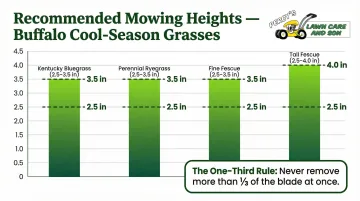
- Never remove more than one-third of the grass blade at once — cutting more causes physiological shock, reduces root mass, and opens the door to weed invasion.
- Recommended mowing heights for Buffalo's cool-season grasses: 2.5–3.5 inches for Kentucky bluegrass, perennial ryegrass, and fine fescues; 2.5–4.0 inches for tall fescue
Sharpen mower blades before the first cut: Dull blades shred grass instead of cutting cleanly, increasing disease vulnerability. Research in the Agronomy Journal demonstrated that mowing with dull blades resulted in a 22% increase in gasoline consumption compared to sharp blades, while also reducing turf quality and increasing leaf spot disease susceptibility.
Spring Watering Needs in Buffalo
Buffalo receives an average of 3.37 inches of precipitation in both April and May, according to NOAA 30-year climate normals. Supplemental irrigation is rarely needed until late May or June.
Monitor for stress signs instead of fixed schedules:
- Bluish-gray or dark blue hue to the lawn
- Footprinting — footprints remain visible long after being made because grass blades lack turgor pressure (the internal water pressure that keeps blades upright) to spring back
- Slow recovery when you walk across the lawn
Once those signs appear, timing and technique matter as much as volume.
Watering best practices:
- Water deeply but infrequently to encourage deeper root growth rather than shallow surface roots
- Apply 1–1.5 inches per week (including rainfall) when irrigation is needed
- Water early morning to minimize disease risk
Pest Awareness: Grubs
While you're keeping an eye on moisture, it's also worth watching what's happening just below the surface. As soil warms in spring, white grubs — larvae of Japanese beetles and European chafer beetles, both common in Western New York — move toward the surface to feed on grass roots.
Spring monitoring:
- Note any signs of turf lifting or spongy patches that may indicate grub damage from the previous year
- Treatment thresholds: 5–10 grubs per square foot for European chafer; >10 per square foot for Japanese beetle
- Skip preventative treatments unless you've confirmed populations exceed these thresholds by physically inspecting the soil
If grub counts are high, mid-summer (late June through July) is the most effective window for targeted insecticide application, when larvae are young and close to the surface.
Frequently Asked Questions
When should I start lawn care in the spring in Buffalo, NY?
Wait until the ground is dry and no longer frozen — typically late March to early April in Buffalo. Starting on saturated or still-frozen ground compacts the soil and can damage new grass growth before the season even begins.