
Introduction
After a long, harsh Western New York winter, Buffalo homeowners face a familiar challenge: weeds often emerge before grass fully recovers, creating a narrow but critical window to act. In Buffalo's compressed spring season, soil temperatures warm later than in southern regions, giving you just a few weeks to prevent annual weeds like crabgrass from germinating and perennial invaders like dandelions from establishing deep root systems. Miss it, and you'll spend the entire season on the defensive.
Timing and method choice determine whether your lawn thrives or struggles all season. This guide covers:
- How to identify common spring weeds in the Buffalo area
- The difference between annual and perennial weed types
- When and how to use pre-emergent and post-emergent herbicides
- Cultural prevention strategies that strengthen turf naturally
- A simple action plan to reclaim your lawn this spring
Key Takeaways
- Pre-emergent herbicides must go down before soil temperatures consistently reach 50–55°F — for Buffalo lawns, that window is typically late April to early May
- Weed type matters: knowing whether it's broadleaf or grassy, annual or perennial, determines which herbicide actually works
- Common Buffalo-area spring weeds include dandelions, crabgrass, chickweed, creeping charlie, and clover
- Mowing at the right height and watering deeply are the most reliable long-term weed prevention tactics
- Professional weed control is the most effective solution for recurring infestations
Why Spring Is the Most Critical Window for Weed Control
Spring is when annual weed seeds begin germinating and perennial weeds resume aggressive growth after winter dormancy. Once weeds establish, they compete directly with grass for water, nutrients, and sunlight — weakening turf and making it more vulnerable to drought and disease later in summer.
Buffalo's Compressed Application Window
Buffalo's colder climate means soil temperatures warm later than in southern regions, compressing the pre-emergent application window significantly. According to the Midwestern Regional Climate Center's soil temperature data, soil temperatures at 2-4 inch depth in Western New York typically cross the critical 50–55°F threshold in late April to early May.
Key timing benchmarks for Buffalo-area lawns:
- 50–55°F soil temperature (2–4 inch depth): the germination trigger for crabgrass
- 4–5 consecutive days at that threshold: when seeds actively begin sprouting
- 130–200 Growing Degree Days (base 50°F): the approximate GDD range for germination onset
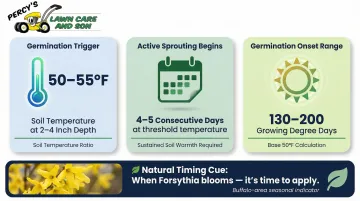
Natural indicator to watch: When Forsythia shrubs are in full bloom or flowers begin to drop, soil temperatures have reached the 50–55°F threshold — your signal to apply pre-emergent immediately.
The Cost of Missing the Window
Miss that window and you're locked into a reactive, post-emergent-only approach: harder, more expensive, and less effective than prevention.
Pre-emergent herbicides create a chemical barrier that stops weed seeds before they emerge. Once weeds are visible, you're limited to post-emergent treatments that require multiple applications and perfect timing to achieve only partial control.
Common Spring Weeds in Western New York
Dandelions (Taraxacum officinale)
Dandelions are broadleaf perennials with deep taproots extending 6-18 inches into soil and bright yellow flowers that quickly turn to wind-dispersed seed heads. Each plant produces 50-150 seed heads per year, each containing approximately 250 seeds that can lie dormant in soil for years.
Root removal is non-negotiable: Partial root removal leads to regrowth — you must extract the full taproot or use systemic herbicide that travels down to kill the entire root system.
Crabgrass (Digitaria spp.)
Crabgrass is a summer annual grassy weed that germinates when soil reaches 55°F. Once established, a single plant produces up to 150,000 seeds by fall, creating massive infestations the following year. It spreads by rooting at stem nodes, forming dense mats that crowd out desirable grass.
Get ahead of it with pre-emergent: Once crabgrass is visible and spreading in June, it becomes significantly harder to control. Pre-emergent application before germination is your best defense.
Chickweed (Stellaria media)
Chickweed is a winter annual broadleaf weed with shallow fibrous roots and a preference for cool, moist soil — exactly the conditions of early Buffalo springs. It produces 500 to 3,000 seeds per plant and establishes quickly by rooting at stem nodes.
Control strategy: Hand-pulling while young is effective for small patches; larger infestations require selective post-emergent broadleaf herbicide.
Creeping Charlie / Ground Ivy (Glechoma hederacea)
Creeping charlie is a persistent perennial broadleaf weed from the mint family that spreads rapidly via creeping stolons in shaded, poorly drained areas — common in Buffalo's older residential neighborhoods and wooded lots. Its stolons can extend several feet in a single season, forming dense ground cover that chokes out grass.
Plan for repeat treatments: Creeping charlie typically needs two herbicide applications. Expect to treat a second time several weeks after the first to achieve full control.
Clover and Other Broadleaf Perennials
White clover is a sign of nitrogen-deficient soil. This perennial spreads via creeping stolons and fixes atmospheric nitrogen, thriving where grass struggles due to low fertility. Henbit and broadleaf plantain are also common spring broadleaf weeds in Buffalo.
Long-term control: Improving soil nutrition through proper fertilization and increasing lawn density addresses the root cause that allows these weeds to take hold.
Understanding Weed Types: Why Classification Matters Before You Treat
Why Classification Determines Success
Most herbicide products are formulated to target either broadleaf weeds or grassy weeds, not both. Misidentifying the weed type and applying the wrong herbicide costs you time and product — and can stress desirable turf without killing the target weed.
Annual vs. Perennial: Different Control Strategies
Annual weeds — crabgrass and chickweed being common examples — complete their life cycle in one growing season and reproduce entirely from seed. Pre-emergent herbicides that prevent germination are your best defense here.
Perennial weeds like dandelions and creeping charlie work differently. They regrow from roots or rhizomes each year, so they require systemic post-emergent herbicides that travel down to the root system. Pre-emergent alone won't touch them.
Quick Visual Identification Tool
You don't need to identify every weed by name — just two visual cues cover most cases:
- Grassy weeds (monocots): Narrow leaves with parallel veins — crabgrass and goosegrass are the most common in Buffalo lawns
- Broadleaf weeds (dicots): Wide leaves with net-like vein patterns — dandelions, clover, creeping charlie, and chickweed all fall here
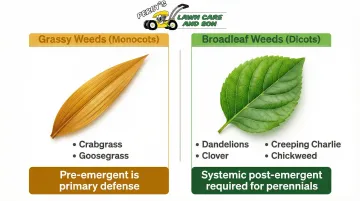
Once you know which type you're dealing with, you can match it to the right herbicide and timing — which is where the real control happens.
Pre-Emergent Herbicide: Your First Line of Defense
How Pre-Emergent Works
Pre-emergent herbicides do not kill weed seeds directly. Instead, they form a chemical barrier in the soil that disrupts germination by killing the weed seedling before it can break the soil surface. Once a weed is visible, pre-emergent has no effect on it.
Timing Is Everything: Soil Temperature Triggers
Apply when soil temperatures at 2–4 inch depth have been consistently 50–55°F for several days. For Buffalo, NY homeowners, this typically falls in late April to early May. Use a soil thermometer rather than air temperature as your guide, since air temperature fluctuates more and doesn't reflect what's actually happening underground.
Natural cue: Apply when Forsythia is in full bloom or flowers are dropping.
Miss this window and you lose the season. If crabgrass or other annuals have already germinated by the time you apply, pre-emergent won't touch them. Post-emergent treatment is your only recourse at that point: more labor-intensive, less comprehensive, and more expensive.
Application Logistics
Pre-emergent must be watered into the soil with ¼ to ½ inch of water after application to activate the chemical barrier. Granular and liquid formulations are both effective when applied according to label directions — always read the label for product-specific instructions.
Activation window: Most products require activation within 5 to 14 days following application.
The Seeding Conflict
Pre-emergent herbicides will also inhibit grass seed germination. This creates a timing conflict for homeowners who plan to overseed in spring. Your two options:
- Apply pre-emergent now and wait until fall to seed
- Seed first and delay pre-emergent until after the new grass has been mowed at least twice
Most pre-emergent products require waiting 60 days after seeding before application, or until after the second mowing — whichever is longer. Check your product label, as intervals vary.
Post-Emergent Herbicide: Tackling Weeds Already Growing
Selective vs. Non-Selective Herbicides
| Type | What It Does | Best Used For |
|---|---|---|
| Selective | Kills target weeds without harming desirable grass | Broadleaf weeds or grassy weeds in established lawns |
| Non-selective (e.g., glyphosate) | Kills all green plant material — grass included | Bare ground, sidewalk edges, full vegetation removal |
Selective Post-Emergent for Broadleaf Weeds
These are the go-to for spring control of dandelions, clover, creeping charlie, and chickweed. Common active ingredients include 2,4-D, MCPP (mecoprop), dicamba, and triclopyr, often combined in 3-way mixtures for broad-spectrum control.
Application best practices:
- Apply to young, actively growing weeds while they're small
- Avoid application before rain or in extreme heat (above 80-85°F)
- Perennial broadleaf weeds like creeping charlie may need a second application several weeks later
Selective Post-Emergent for Grassy Weeds
Crabgrass killers work best during early leaf stages (1-2 tillers) — effectiveness drops sharply once the plant matures. The most useful window is during early leaf stages (1-2 tillers). Severe infestations may require non-selective spot treatment followed by lawn repair.
Responsible Application Practices
- Follow label directions exactly — herbicide labels are legal documents
- Wear protective gear
- Avoid application on windy days to prevent drift onto shrubs, flower beds, and other desirable plants
- Do not apply when soil moisture is low — effectiveness is reduced and turf damage can occur
- Overuse or off-target application risks damaging surrounding plants and harming the environment
Cultural Weed Control: Natural Prevention Methods That Strengthen Your Lawn
Mowing Height and Frequency
Raising mower height to 3–4 inches encourages grass to grow thicker and taller, shading the soil surface and depriving weed seeds of the sunlight needed to germinate. Regular mowing also cuts down any weeds that break through, interrupting their seed production cycle before they can spread.
Why it works: Taller grass creates a dense canopy that blocks sunlight from reaching the soil, reducing weed seed germination. It also encourages deeper root systems, which improves drought tolerance over time.
Deep, Infrequent Watering
Shallow, frequent watering encourages shallow root systems and promotes conditions favorable to many weeds. Deep watering — less often but more thoroughly — drives grass roots deeper and creates a denser, more competitive turf that crowds out weeds naturally.
Guideline for cool-season lawns in Buffalo: Apply approximately 1 inch of water per week (including rainfall), delivered in one or two deep applications rather than daily light sprinklings.
Soil Health and pH
Certain weeds thrive in compacted, nutrient-poor, or pH-imbalanced soil:
- White clover indicates low nitrogen
- Moss indicates high acidity and poor drainage
- Broadleaf plantain indicates severe compaction
Conducting a soil test and correcting deficiencies with appropriate fertilization and, if needed, lime application removes the underlying conditions that allow many weeds to take hold. Pairing those corrections with core aeration reduces compaction further, giving grass the competitive edge it needs to crowd out weeds.
Your Spring Weed Control Action Plan
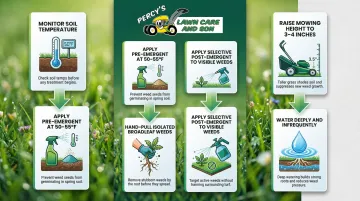
Simple Sequential Checklist
- Monitor soil temperature in late April — use a soil thermometer at 2-4 inch depth or watch for Forsythia full bloom
- Apply pre-emergent at the 50–55°F threshold — water in with ¼ to ½ inch of irrigation if rain isn't expected within 5-14 days
- Hand-pull isolated broadleaf weeds while soil is moist — remove the full taproot to prevent regrowth
- Apply selective post-emergent herbicide to visible broadleaf weeds in late April through early June while weeds are young and actively growing
- Raise mowing height to 3-4 inches and begin regular weekly mowing — taller grass shades soil and prevents weed germination
- Water deeply and infrequently — 1 inch per week in one or two applications to support grass over weeds
When Professional Help Makes Sense
Some situations call for a professional assessment rather than another round of trial and error:
- Recurring weeds that return despite consistent DIY treatment
- Widespread infestations covering large portions of the lawn
- Uncertainty about weed identification or which products to use safely
Percy's Lawn Care and Son has served Buffalo-area homeowners for over 25 years, with deep familiarity with Western New York soil conditions, seasonal timing, and common regional weed pressures. Their team knows Buffalo's compressed spring window well and can apply pre-emergent and post-emergent treatments at precisely the right time for maximum effectiveness.
Year-Round Strategy
Weed control works best as part of a year-round lawn health strategy, not a single spring sprint. Consistent turf density is your most effective long-term barrier — and the habits you build in spring, from mowing height to watering depth, carry through the rest of the season.
Frequently Asked Questions
When to apply spring weed control?
Timing depends on the method: pre-emergent should be applied when soil temperatures consistently reach 50–55°F (in Buffalo, typically late April to early May), while post-emergent herbicides should be applied once weeds are actively growing and visible, ideally while they are still young.
What is the difference between pre-emergent and post-emergent herbicide?
Pre-emergent prevents weed seeds from germinating and must be applied before weeds appear, forming a chemical barrier in the soil. Post-emergent kills weeds that are already visible and actively growing above the soil surface.
Can I apply pre-emergent herbicide if I plan to seed my lawn in spring?
Pre-emergent will also inhibit grass seed germination, so homeowners must choose: apply pre-emergent now and wait until fall to overseed, or seed first and delay pre-emergent until the new grass has been mowed at least twice.
What are the most common spring weeds in Buffalo, NY?
Dandelions, crabgrass, chickweed, creeping charlie (ground ivy), and white clover are the most prevalent spring weeds in Buffalo and Western New York. Chickweed and dandelions tend to emerge first, often appearing before crabgrass season begins in late spring.
Is it too late to apply pre-emergent herbicide once weeds have appeared?
Pre-emergent is no longer effective once weeds have germinated and broken the soil surface. At that stage, post-emergent herbicide is the appropriate treatment, and plan to apply pre-emergent the following spring.
How do I get rid of dandelions without killing my grass?
Use selective post-emergent broadleaf herbicides, which target dandelions without harming lawn grasses. Hand-pulling is effective for small infestations if the full taproot is removed, as partial removal leads to regrowth.