For Buffalo-area homeowners working with cool-season grasses like Kentucky Bluegrass and Tall Fescue, achieving that dark green color comes down to three things: the right nutrients, the right release rate, and the right timing. In this guide, we'll break down the fertilizer types that actually work in Western New York's climate, explain why nitrogen and iron are your lawn's best friends, and show you how to apply them correctly without burning your grass or wasting money.
TLDR
- Nitrogen drives chlorophyll production—look for fertilizers with a high first number (e.g., 30-0-4)
- Iron supplements deepen color to rich blue-green without excessive growth
- Slow-release nitrogen delivers lasting color and reduces burn risk
- Fall is the single most important fertilization window for cool-season grasses in Buffalo
- Soil testing prevents guesswork and identifies actual deficiencies
What Makes Grass Dark Green?
Grass color isn't magic—it's biochemistry. The deep green hue you're chasing is driven by chlorophyll, the molecule that powers photosynthesis. Without adequate nitrogen and iron, chlorophyll production stalls, leaving you with pale, yellow, or dull turf.
Nitrogen is the primary driver. It's a structural building block of chlorophyll itself, as well as the amino acids and proteins that fuel plant growth. When your lawn has adequate nitrogen, it produces more chlorophyll — and more chlorophyll means more photosynthesis, stronger roots, thicker blades, and faster recovery from stress. The relationship is direct: nitrogen → chlorophyll → healthier turf.
Iron plays a supporting but critical role. It's not part of the chlorophyll molecule itself, but it's an essential cofactor for the enzymes that synthesize it. Without enough iron, your lawn can't manufacture chlorophyll efficiently — even if nitrogen is plentiful. Iron deficiencies show up as chlorosis, a yellowing of the youngest leaves, because iron doesn't move freely within the plant.
Applying iron deepens grass color from basic green to a richer blue-green without pushing excessive top growth — a meaningful advantage for homeowners who want dense color without constant mowing.
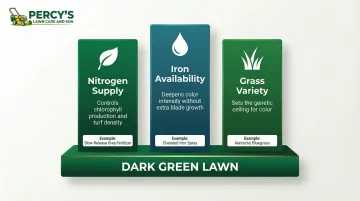
Three factors ultimately determine how dark your lawn can get:
- Nitrogen supply — directly controls chlorophyll production and overall turf density
- Iron availability — deepens color intensity without spurring extra blade growth
- Grass variety — sets the genetic ceiling for color
Cool-season grasses common in Buffalo — Kentucky Bluegrass, Tall Fescue, Fine Fescues, and Perennial Ryegrass — naturally hit deeper blue-green tones than warm-season varieties. Kentucky Bluegrass in particular is prized for its dense growth and dark genetic color, though individual cultivars vary.
Best Types of Fertilizer for a Dark Green Lawn
Not all fertilizers deliver the same results. The right choice depends on the specific nutrient, release rate, and your lawn's current condition.
High-Nitrogen Fertilizers
High-nitrogen fertilizers are the fastest, most direct route to green color. Look for products with a high first number in the N-P-K analysis—such as 30-0-4 or 46-0-0 urea. These formulations flood the soil with nitrogen, triggering rapid chlorophyll production and visible green-up within 7 to 10 days.
Best for: Lawns that are clearly nitrogen-deficient (pale, slow-growing) or need a quick spring green-up after winter dormancy.
Caution: Fast-acting nitrogen can burn your lawn if over-applied or applied to dry soil. Always follow label rates, apply evenly with a broadcast spreader, and water in immediately after application to dissolve the salts and move them into the soil.
High-Iron Fertilizers
Iron supplements are the specialist tool for homeowners who want deeper color without stimulating excessive top growth. Granular or liquid iron products can be applied between nitrogen feedings to maintain that blue-green hue.
Liquid iron works fast—results often appear within 24 to 48 hours and last 2 to 4 weeks. This makes it ideal before special events or for spot-treating dull areas that look lackluster despite adequate nitrogen.
Important: While iron is generally safe for all grass types, excessive application can cause permanent rust-colored stains on concrete driveways, sidewalks, and hardscaping. Sweep granules off pavement immediately and avoid spraying near hard surfaces.
Slow-Release Nitrogen Fertilizers
Slow-release fertilizers—such as polymer-coated urea (PCU) or sulfur-coated urea—deliver nitrogen gradually over 6 to 12 weeks. Instead of a spike-and-fade pattern, you get steady, sustained green color.
Key benefits:
- Dramatically reduced risk of fertilizer burn
- Safer during warm weather
- Lower environmental impact—nitrate leaching can be reduced by up to 43% compared to fast-release urea
- Less frequent reapplication needed
For Buffalo homeowners near waterways or drainage areas, slow-release formulas are the smarter default—runoff from fast-release nitrogen is a direct contributor to algae blooms in local creeks and water bodies.
Organic Fertilizers
Organic fertilizers—made from composted materials, feather meal, biosolids, or other natural sources—work more slowly than synthetics but build long-term soil health. They feed soil microbes, improve soil structure, and release nutrients steadily as the soil warms.
They're also safer for children, pets, and the environment, with lower burn risk and minimal runoff.
The trade-off is timing. Soil microbes must first mineralize the nitrogen before grass can absorb it, so visible color results take longer to appear than with synthetics. For homeowners focused on long-term soil health over quick green-up, organics are a sound investment.
Balanced NPK Fertilizers
Balanced fertilizers (e.g., 10-10-10 or 12-12-12) supply nitrogen, phosphorus, and potassium in equal or similar proportions. They're a decent starting point for lawns that haven't been soil-tested, but they're less targeted than high-nitrogen or high-iron products.
One important restriction for New York homeowners: state law prohibits applying phosphorus-containing fertilizers to established lawns unless a soil test confirms a deficiency. That rules out most balanced formulas for routine color improvement. Stick to zero-phosphorus options like 30-0-4 unless your test results say otherwise.
Think of balanced fertilizers as a starting point, not a long-term strategy. Once you know your lawn's specific deficiencies, targeted nitrogen or iron products will get you to dark green faster and more efficiently.
Organic vs. Synthetic: Which Is Better for Dark Green Grass?
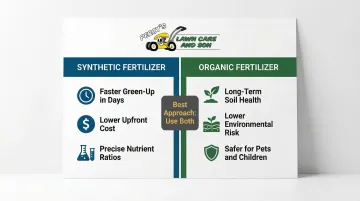
The short answer: both can achieve dark green lawns—the choice depends on your priorities.
Synthetic fertilizers deliver:
- Faster, more visible green-up results (often within days)
- Lower upfront cost per application
- Precise nutrient ratios for targeted deficiencies
Organic fertilizers deliver:
- Long-term soil health improvements (increased organic matter, better water retention)
- Lower environmental risk (reduced leaching and runoff)
- Safer for household use (children, pets)
Neither is universally superior. A hybrid approach works well in practice: use a slow-release synthetic as your base and supplement with organic matter or iron for soil health. This gives you the quick green-up of synthetic feeding without depleting the soil over time.
How and When to Apply Fertilizer for Maximum Green Color
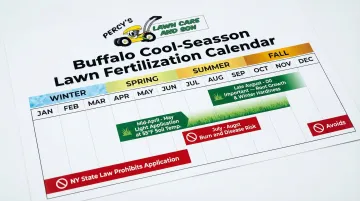
Buffalo's cool-season grasses respond strongly to well-timed fertilization — get the windows right, and the color difference is dramatic. Miss them, and you're wasting money or risking damage.
| Timing Window | When | What to Know |
|---|---|---|
| Early Fall (most important) | Late August – October | Soils stay warm while air cools; nitrogen fuels root growth, winter hardiness, and early spring green-up |
| Early Spring | Mid-April – May | Apply 0.5–1.0 lb nitrogen per 1,000 sq. ft. once soil temps hit 55°F; go light to avoid weak top-heavy growth |
| Avoid: Midsummer | July – mid-August | Heat and drought stress make nitrogen applications a burn risk and disease trigger |
| Avoid: Winter | December 1 – April 1 | New York State law prohibits lawn fertilizer applications during this period to prevent runoff into waterways |
Application Best Practices
- Use a broadcast spreader for even distribution
- Follow label rates exactly—never double-up
- Water in granular fertilizers with about ¼ inch of water to dissolve salts off grass blades and activate nutrient release
- Avoid common mistakes: fertilizing drought-stressed or dormant grass, applying before heavy rain (runoff risk), or skipping a soil test and guessing
How to Choose the Right Fertilizer for Your Lawn
Start with a soil test—it's the most important first step. A soil test reveals current N-P-K levels, pH, and iron content, so you can choose a fertilizer that targets actual deficiencies rather than guessing.
Why this matters in Buffalo: Erie County soils typically average a moderately acidic pH of 5.9, though urban and disturbed residential soils can show alkaline pH levels between 7.1 and 8.1. Soil pH heavily dictates nutrient availability.
At pH 7.0 or higher, iron precipitates into insoluble forms that grass roots can't absorb. If your soil pH exceeds 7.5, standard iron sulfate won't work; you'll need chelated iron (such as EDDHA) to keep iron soluble.
Where to Get a Soil Test in Buffalo
Cornell Cooperative Extension of Erie County offers pH testing services through their Master Gardener hotline and facilitates comprehensive nutrient testing via the Dairy One Agro-One laboratory. Turnaround times are typically 1 to 3 weeks.
Key Selection Factors
- Grass type: Cool-season grasses (Kentucky Bluegrass, Tall Fescue) dominate Buffalo lawns
- Desired speed of results: Fast green-up vs. sustained color
- Budget: Synthetics cost less upfront; organics build long-term soil value
- Safety concerns: Pets, children, proximity to storm drains
For homeowners who want professional results without the guesswork, Percy's Lawn Care and Son has served Buffalo, Amherst, Cheektowaga, and surrounding communities for over 25 years. Their local expertise with Buffalo's soil conditions means fertilization is handled as part of a broader lawn care plan — no guesswork required.
Conclusion
A dark green lawn in Buffalo depends on pairing the right nutrients with the right timing. Nitrogen drives growth and density; iron adds that deep green color; slow-release formulas keep both working through the season. And for cool-season turf in Western New York, fall fertilization does more heavy lifting than any other application.
Homeowners in Buffalo and surrounding areas who want professional results without trial-and-error can reach out to Percy's Lawn Care and Son—a family-owned business with over 25 years of local expertise—to get a lawn that stays green and healthy year-round.
Frequently Asked Questions
What fertilizer makes your grass really green?
Nitrogen-rich fertilizers with a high first number in the N-P-K ratio (e.g., 30-0-4 or 46-0-0) are the primary driver of green color. Pairing them with an iron supplement pushes grass from ordinary green to a deeper, richer blue-green.
Is 20-20-20 fertilizer good for lawns?
20-20-20 is a balanced, general-purpose fertilizer — not optimized for green color. For dark green results, a higher nitrogen-to-phosphorus ratio works better on established lawns, and New York law restricts phosphorus use on established turf.
How often should I fertilize for dark green grass?
Cool-season grasses in Buffalo typically benefit from 3-4 fertilizer applications per year, with fall (late August through October) being the most critical window for color and root development.
What is the difference between slow-release and fast-release fertilizer for lawns?
Fast-release fertilizers green up the lawn quickly but can burn grass and fade faster. Slow-release products provide steady color over 6-12 weeks with lower burn risk and reduced environmental impact.
Is iron fertilizer safe to use on all grass types?
Iron supplements are safe for all common lawn grass types when applied at label rates. However, excessive iron can cause permanent rust-colored stains on concrete, sidewalks, and hardscaping surfaces.
Should I do a soil test before fertilizing?
Yes—a soil test identifies nutrient deficiencies and pH imbalances that affect how well fertilizer is absorbed. This prevents wasted product, potential lawn damage, and helps you choose the right fertilizer.