Introduction
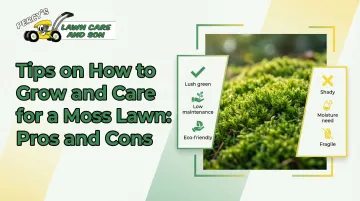
Many Buffalo homeowners know this frustration: patchy grass that won't thrive under mature tree canopy, acidic soil that keeps turf thin, and shady yards where even premium seed mixes fail year after year. Instead of fighting these conditions with endless reseeding and fertilizer, more homeowners are working with their landscape—treating moss as an intentional ground cover rather than a weed to pull.
Moss thrives in the exact conditions where grass struggles most—no mowing, no fertilizing, and minimal watering once established. This guide walks through what a moss lawn actually involves, its real pros and cons, and how to grow and maintain one through Buffalo's seasons.
Key Takeaways
- Moss lawns excel in shady, acidic, moist areas where grass consistently fails—ideal for many Buffalo yards
- Zero mowing, zero fertilizing, and minimal watering after establishment
- Cons include foot traffic sensitivity, limited sun tolerance, and ongoing leaf debris removal
- Getting started requires pH testing, site prep, species selection, and consistent watering until established
- Ongoing care means removing leaves, hand-weeding, and watering during dry spells
What Is a Moss Lawn?
A moss lawn is a dense, low-growing ground cover made entirely of moss plants. Unlike grass, mosses reproduce via spores rather than seeds, absorb water and nutrients directly through their leaves (not roots), and stay green and soft year-round without ever needing to be mowed. Mosses are non-vascular plants that lack true roots, xylem, and phloem. Instead of roots, they use tiny hair-like structures called rhizoids to anchor themselves to surfaces.
One common misconception is that moss is always a lawn problem. In reality, when moss appears naturally in your yard, it's a signal that conditions already favor it over grass. Common triggers include:
- Heavy shade that limits grass growth
- Acidic soil that moss tolerates better than turf
- Soil compaction that chokes grass roots
- Poor drainage that moss thrives in
Rather than fighting these conditions with chemicals and constant reseeding, Buffalo homeowners are increasingly embracing the moss—transforming struggling turf into a lush, low-maintenance carpet.
The Pros of a Moss Lawn
No Mowing, No Fertilizing, No Pesticides
Moss grows no taller than 4 inches (and most species stay much shorter) and thrives in nutrient-poor, compacted soil. This makes it one of the lowest-maintenance ground covers available. You'll save hundreds of hours and dollars annually by eliminating mowing, fertilizer applications, and chemical treatments.
Gasoline-powered lawn equipment accounts for 24-45% of all U.S. nonroad gasoline emissions, emitting 26.7 million tons of pollutants annually. A moss lawn eliminates your household's landscaping carbon footprint entirely.
Environmentally Friendly and Sustainable
Traditional lawns consume nearly 9 billion gallons of water daily across the U.S., with the average American family using about 30% of its 320 gallons per day on outdoor watering. Once established, moss naturally enters dormancy during drought and rehydrates when rain returns — no supplemental summer irrigation needed.
Suburban lawns receive more pesticide applications per acre (3.2-9.8 lbs.) than agricultural land (2.7 lbs. per acre on average) — a chemical load moss lawns sidestep altogether.
Excellent for Problem Areas
Moss outperforms grass on shady slopes, under dense tree canopy, and in areas with poor drainage — where traditional turf consistently fails or erodes. Turfgrass failure is commonly caused by competition for water, nutrients, and light under trees, as well as poor soil drainage.
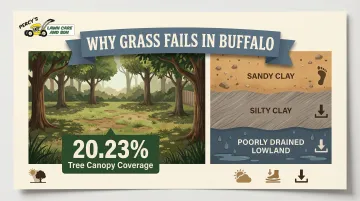
That's a real advantage in Buffalo. The city's tree canopy averages 20.23%, creating widespread shaded microclimates where grass struggles. Erie County's fine-textured soils — sandy clay, silty clay, and poorly drained lowland areas — are ideal for moss rhizoids but suffocate deep-rooting turfgrass.
Conditions where moss consistently outperforms turf:
- Densely shaded areas under mature trees
- Sloped ground prone to runoff and erosion
- Low-lying spots with standing water or poor drainage
- Compacted soil where grass seed won't germinate
Supports Local Biodiversity
Those same soil conditions that make moss so resilient also make it a better habitat. A moss lawn creates microhabitats for ground-active invertebrates like beetles, earthworms, mites, and springtails. Mosses form the dominant component of a complex detrital food web, supporting organisms that standard turf simply doesn't.
Birds also use moss as nesting material in spring. In the Northeast, species such as Baltimore Orioles and Bushtits use mosses to weave and insulate their nests. For homeowners trying to attract wildlife, a moss lawn does more ecological work than a conventional grass yard ever will.
Lush, Year-Round Greenery and Curb Appeal
Moss stays visually green even in cold-weather dormancy and creates an elegant, carpet-like appearance that enhances the look of shady, woodland-style properties. Unlike turf that browns in winter and during dry spells, moss maintains its soft, vibrant aesthetic throughout the year in Buffalo's climate.
The Cons of a Moss Lawn
Limited Sun Tolerance
Most moss species prefer shade or partial shade, meaning moss lawns are not ideal for open, south-facing yards with full sun exposure. Sun-tolerant species like Bryum moss exist but may not create the uniform carpet look many homeowners expect. If your yard receives more than 4-5 hours of direct sunlight daily, moss may struggle or require more intensive care.
More Delicate Than Turfgrass Under Heavy Use
While moss handles light-to-moderate foot traffic, consistent heavy use—kids playing, pet activity, regular pathways—can damage its structure. Use stepping stones or mulched paths in high-traffic zones to protect the moss mat. Recovery from repeated compression or tearing is slow compared to turfgrass.
Debris Management Is Ongoing
Moss cannot photosynthesize under a layer of fallen leaves and organic matter, so keeping it clean—especially in fall—is a recurring task. Leaf blowers or hand-picking are preferred over raking, which can damage the moss mat.
For Buffalo homeowners with large deciduous trees nearby, expect to do light clearing several times throughout autumn.
How to Grow a Moss Lawn: Step-by-Step
Step 1 — Test and Adjust Your Soil pH
Most mosses prefer acidic soil with a pH between 5.0 and 5.5. Start by purchasing a basic soil test kit from a garden center or extension service. If your soil pH is above 6.0 (alkaline), you'll need to lower it.
The majority of urban agricultural and residential soils in New York State exhibit a pH between 7.1 and 8.1, often due to historical fill and concrete leaching. To lower pH, apply elemental sulfur or a soil acidifier. Soil microbes oxidize the elemental sulfur to produce sulfuric acid, which slowly lowers the pH. This is a biological process requiring warm, moist soils, so plan ahead—it often takes months to see permanent pH change.
Buffalo's naturally acidic soils in many neighborhoods may already be close to the ideal range, but testing is essential before proceeding.
Step 2 — Choose the Right Site and Moss Species
Identify microclimates in your yard before selecting a species. Walk your property and note sun exposure, moisture levels, and shade sources at different times of day.
Beginner-Friendly Species for Western New York:
- Sheet Moss (Hypnum imponens): Shade tolerant, prefers moist decaying logs, rock, or soil. Forms creeping, regularly pinnate mats. Height: 3–10 cm. Native to North America.
- Haircap Moss (Polytrichum commune): Tolerates partial shade to open habitats; prefers moist organic soil or peat. Stiffly erect, forming loose or dense tall tufts. Height: 5–10 cm. Native to North America.
- Silvergreen Bryum Moss (Bryum argenteum): Sun tolerant; thrives in drier, anthropogenic habitats (cracks, poor soil). Low cylindrical shoots forming compact tufts. Height: 0.2–1 cm. Cosmopolitan urban species.
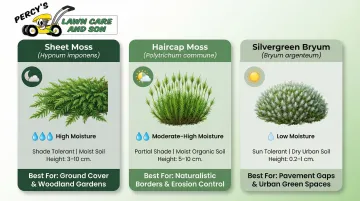
Use Bryum for sunny, dry patches, and Hypnum or Polytrichum for shaded, moist zones.
Step 3 — Prepare the Area
Clear existing grass, weeds, and debris. Lightly till and level the soil, then rake it to create a slightly textured surface for the moss to anchor to. Avoid over-smoothing—moss rhizoids need some texture to grip.
For larger yards, Percy's Lawn Care and Son offers spring cleanup and site prep services across Buffalo neighborhoods like Linwood Historic District and Seneca-Cazenovia—with over 25 years of local experience handling exactly this kind of ground-level prep work.
Step 4 — Plant the Moss
Moss is not planted in the soil but pressed firmly onto its surface. Transplant large sheets or plugs, securing with landscaping pins if needed, and press down to ensure good contact between moss and soil.
The "moss milkshake" method—blending moss fragments with buttermilk or yogurt and spreading the slurry over bare soil—is sometimes suggested for large areas. In practice, peer-reviewed evaluations show highly variable success rates, and the slurry requires weeks to months of constant misting to survive. Physical transplanting of plugs or sheets is more reliable.
Step 5 — Water Consistently During Establishment
Newly planted moss needs daily misting or watering for the first 6–12 weeks until its rhizoids anchor to the soil. Water gently to avoid dislodging the moss.
Signs of healthy establishment:
- Vibrant green color
- Moss doesn't lift easily from the surface when gently tugged
Signs of stress:
- Browning or yellowing
- Moss lifts easily or appears dry and brittle
How to Care for and Maintain Your Moss Lawn
Keep It Clear of Debris Year-Round
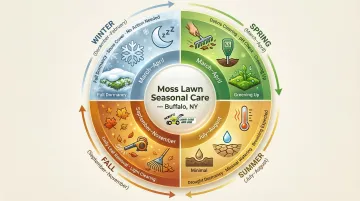
Fallen leaves are the single biggest threat to an established moss lawn. Accumulated leaves block photosynthesis and promote disease. Build a routine of light hand-clearing or blowing leaves in fall, and remove sticks and organic matter weekly during shedding seasons.
This is especially important for Buffalo homeowners with large deciduous trees on or near their property. Percy's Lawn Care and Son offers comprehensive fall cleanup services across Buffalo neighborhoods, including leaf removal and debris clearing, all of which directly support moss lawn health through the season.
Watering Guidelines for Established Moss
Once established, moss is more drought-tolerant than most people expect. Mosses can withstand drying to water contents of 5–10% of their dry weight, entering a state where metabolism ceases. Upon rehydration from rain, photosynthetic activity resumes within minutes to hours.
Only water during extended dry spells in summer, using clean or filtered water. Skip watering entirely during Buffalo's winters. Buffalo has the sunniest and driest summers of any major city in the Northeast, so expect moss to brown and go dormant during July and August dry spells. It will rebound when rain returns.
Weed and Mold Management
Moss's dense growth naturally crowds out weeds, but hand-pulling is essential if any break through. Never use herbicides, as moss is highly sensitive to chemicals.
Mold (white cottony patches) can occur near water sources. Trim affected areas, reduce watering frequency, and improve air circulation by thinning overhead branches if needed.
Repairing Patchy or Worn Areas
Bare or thinning patches can be fixed by pressing loose moss fragments from healthy areas over the bare spots and misting to keep them moist. Gently press down to ensure contact with the soil.
Recheck patchy areas after rain — moss that has good soil contact typically fills in within a few weeks without further intervention.
Frequently Asked Questions
How do you maintain a moss lawn?
Maintenance involves removing debris (especially leaves), occasional hand-weeding, and light supplemental watering during hot, dry periods. No mowing, fertilizing, or chemicals are needed once the moss is established.
What is the best way to treat moss in a lawn?
If keeping the moss, encourage it by removing competing grass and adjusting soil pH to 5.0–5.5. If removing it, use iron-based moss control products during active growth periods (fall or early spring) and correct underlying conditions like shade and compaction.
When is the best time to apply moss-control products to a lawn?
Moss-control products are most effective during the moss's active growing season—typically fall rains, mild winter rains, and early spring—when moisture is high and moss is actively growing.
When should you do spring cleanup for a moss lawn?
Spring cleanup for a moss lawn typically begins in late March–April in Buffalo, once temperatures stay consistently above freezing. Clear debris, rake dead organic matter, and check soil conditions before the moss fully greens back up.
Can a moss lawn survive a Buffalo winter?
Yes, moss lawns are well-suited to cold climates like Buffalo's. Moss goes dormant under snow, turns brown or pale, and reliably greens back up in spring once temperatures warm and moisture returns.