

Introduction
If you own a home in Buffalo with a sloped front yard, you know the challenge: water rushing toward your foundation during spring thaw, patchy grass that refuses to establish, and a front entry that feels unwelcoming instead of inviting. These frustrations are common across Western New York, where freeze-thaw cycles, heavy snowmelt, and clay-heavy soils create unique obstacles for sloped properties.
That slope you've been fighting? It's actually one of your yard's strongest design assets. With the right approach, a sloped front yard can boost curb appeal, control erosion effectively, and add genuine character that flat lawns down the street simply can't match.
This guide covers how to assess your slope's grade and drainage patterns, which landscaping solutions deliver lasting results, how to select plants that thrive in Buffalo's climate, and design principles that transform a challenging slope into a standout feature.
Key Takeaways
- Sloped front yards create erosion, drainage, and maintenance challenges—but strategic design transforms them into high-impact curb appeal features
- Assess slope grade, soil type, and drainage patterns before choosing a design approach
- Retaining walls, terracing, groundcovers, natural stone steps, and boulders provide structural stability and visual appeal
- Plant selection matters: drought-tolerant varieties handle the dry upper slope, while moisture-loving species thrive at the base
- For steep or complex slopes, a local landscaping professional helps avoid erosion failure and drainage problems
Know Your Slope: What to Assess Before You Start
Measure Your Slope Grade
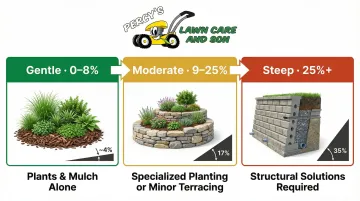
Slope grade determines which solutions will work. Calculate it using the rise-over-run method: divide elevation change by horizontal distance, then multiply by 100 for percentage. According to USGS standards, this measurement directly dictates your landscaping strategy.
Slope classifications:
- 0–8% (gentle): Manageable with plants and mulch alone
- 9–25% (moderate): Requires specialized planting or minor terracing
- 25%+ (steep): Demands structural solutions like retaining walls or full terracing
In Buffalo, slopes above 33% become especially hazardous in winter when freeze-thaw cycles create ice buildup that poses serious safety risks for residents and visitors.
Read Your Drainage Patterns
Walk your property during a heavy rain or spring snowmelt. Watch where water flows and pools. Critical checkpoints:
- Does runoff funnel toward your foundation, driveway, or sidewalk?
- Are there channels forming where soil is washing away?
- Does water collect at the base of the slope?
Unaddressed drainage problems damage your foundation over time, so fixing them is as much about structural protection as it is about landscaping success.
Understand Your Soil Type
Erie County soils frequently include the Erie series—silt loams with a dense fragipan layer that restricts water movement and creates poor drainage. Knowing your soil type shapes how you approach stabilization:
- Sandy/silty soils: Erode faster; need structural reinforcement sooner
- Clay-heavy soils (common in WNY): Hold together better but become waterlogged and can heave retaining walls if drainage isn't planned correctly
Check Access and Safety
Can you navigate the slope safely for maintenance? Is it a tripping hazard for visitors approaching your front door?
Before any construction, check local codes: Buffalo restricts front yard walls to a maximum height of 4 feet, and New York State requires engineering approval for retaining walls supporting more than 48 inches of fill.
For complex slopes or unclear drainage, a professional assessment prevents costly rework down the line. Percy's Lawn Care and Son has spent over 25 years helping Buffalo-area homeowners evaluate challenging front yards and plan solutions that hold up through Western New York winters.
Top Sloped Front Yard Landscaping Ideas
Not every solution works for every slope — match the approach to your grade, budget, and home's architectural style.
Retaining Walls
Retaining walls are the primary solution for moderate to steep slopes because they hold soil in place, prevent erosion, and create usable flat zones for planting or pathways.
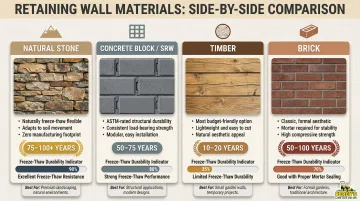
Material options:
- Natural stone: Complements older Buffalo bungalow and craftsman-style homes; dry-laid stone can shift slightly during freeze-thaw without structural failure
- Concrete block (SRW): Suits contemporary looks; manufactured to ASTM C1372 standards for freeze-thaw durability
- Timber: Budget-friendly but lasts only 10-20 years due to rot and freeze-thaw degradation
- Brick: Formal appearance; requires proper mortar and drainage
Critical drainage requirement: Buffalo's freeze-thaw climate makes drainage behind the wall non-negotiable. Water trapped behind a wall freezes, expands, and causes cracking or collapse. Best practice requires a minimum 12-inch column of clean gravel with a 4-inch perforated drain pipe at the base.
Terracing
Terracing creates a series of flat "steps" cut into the hillside, each supported by a small retaining wall. It's ideal for medium slopes and transforms unusable terrain into tiered garden beds, seating areas, or structured plantings.
When to terrace: The New York State Standards for Erosion Control recommend terracing for slopes steeper than 3:1 (33%) to reduce runoff velocity and increase water infiltration. Terracing also adds visual depth, making your property feel larger and more intentional.
Groundcover and Slope Planting
Planting dense, deep-rooted groundcovers is a cost-effective way to stabilize gentle to moderate slopes while adding year-round beauty.
Key principle: Plants at the top of the slope need drought tolerance (drier soil), while the base can support moisture-loving varieties. This approach works especially well as a complement to structural solutions like low retaining walls or stone edging.
Natural Stone Steps and Pathways
Adding a clear pathway from the street or driveway to your front door solves both safety and curb appeal problems.
Options:
- Natural stone slabs: Custom-cut slabs deliver a high-end, one-of-a-kind appearance that suits craftsman and colonial-style homes
- Pavers: Consistent sizing and color options make pavers a practical choice for formal or contemporary front entries
- Switchback pathways: Reduce effective walking grade on steep slopes
Stone steps also anchor the slope and reduce surface runoff channeling, preventing erosion along heavily trafficked routes.
Boulders and Rock Features
Boulders anchor soil with zero maintenance once placed, while doubling as natural design elements that suit Western New York's landscape character.
How to use boulders effectively:
- Cluster in odd numbers (3, 5, 7) for natural visual flow
- Sink one-third to one-half into the ground so they look settled rather than dropped in place
- Intersperse with groundcovers and low shrubs for layered depth
Tiered Garden Beds
Tiered garden beds offer a softer, less structural alternative to full terracing. Use low walls of stone, brick, or timber to create raised planting areas at different levels of the slope.
Benefits:
- Replaces struggling slope lawn with low-maintenance, attractive planted displays
- Channels water more gradually down the slope
- Creates distinct planting zones for sun, shade, and moisture variations
Best Plants for a Sloped Front Yard
Core Selection Principle
Choose varieties with deep, fibrous root systems that bind soil. Group plants with similar water needs — drought-tolerant at the top, moisture-tolerant at the bottom. Native plants are the strongest performers on Buffalo-area slopes: they're built for local freeze-thaw cycles and need far less upkeep than ornamentals.
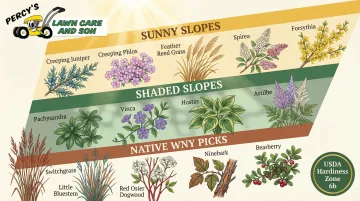
Recommended Plants for Zone 6b
Sunny slopes:
- Creeping Juniper (Juniperus horizontalis): Shallow, spreading roots form dense mats 4-10 feet wide
- Creeping Phlox (Phlox subulata): Vigorous, mat-forming habit spreads up to 24 inches
- Feather Reed Grass (Calamagrostis 'Karl Foerster'): Deep fibrous roots; tolerates heavy clay
- Spirea (Spiraea spp.): Multi-stemmed shrub that forms colonies
- Border Forsythia (Forsythia × intermedia): Upright-arching shrub; some cultivars spread by suckering
Shaded slopes:
- Pachysandra (Pachysandra terminalis): Spreads by rhizomes to form dense carpet (Zone 5-9)
- Vinca/Periwinkle (Vinca minor): Trailing stems root at nodes for quick coverage (Zone 4-8)
- Hostas: Clumping perennials with fibrous roots; excellent for moisture-retentive bases
- Astilbe: Feathery blooms; thrives in moist, shaded conditions
Native alternatives for WNY: Cornell Cooperative Extension recommends Switchgrass (Panicum virgatum), Little Bluestem (Schizachyrium scoparium), Red Osier Dogwood (Cornus sericea), Ninebark (Physocarpus opulifolius), and Bearberry (Arctostaphylos uva-ursi) as fast-establishing soil binders.
Avoid Turf Grass on Steep Slopes
Once you've chosen the right ground covers or shrubs, one more decision becomes clear: skip the grass. On slopes steeper than 15 degrees, riding mowers carry a severe tip-over risk. Push mowers are safer, but must be operated across the slope — never up and down — to keep the operator from slipping under the deck.
Beyond safety, establishing grass on erosion-prone grades is frustrating and usually unsuccessful. Reserve turf for gentle slopes where mowing is both safe and practical.
Design Tips to Boost Curb Appeal on a Sloped Front Yard
Design for Visual Flow
A sloped front yard should guide the eye naturally from the street to the front door. Create visual movement using:
- Clear pathways that define circulation
- Plant height variation (groundcovers, mid-height shrubs, taller anchor plants)
- Focal points such as distinctive boulder groupings or ornamental trees
Match Materials to Architecture
Choose hardscape materials and plantings that complement your home's style and neighborhood character:
- Bungalows, craftsman homes, and colonials pair well with natural stone and cottage-style plantings
- Modern homes suit clean-line concrete or brick retaining walls with structured plantings
Apply the Rule of 3
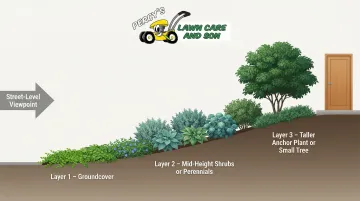
The Rule of 3 in landscaping creates natural, visually balanced compositions. Group plants in odd numbers (3, 5, 7) and use three distinct plant layers:
- Groundcover
- Mid-height shrubs or perennials
- Taller anchor plant or small tree
This structure adds depth across every level of the slope — from street view to front door.
Consider Core Design Principles
Two principles especially relevant to sloped front yards:
- Proportion — Boulder size should match the slope's scale. Oversized rocks on a small slope look out of place; undersized ones on a large slope simply vanish.
- Focalization — A clearly defined front entry path improves both usability and aesthetics, anchoring the entire composition and making your home more inviting.
How to Keep Your Sloped Front Yard Looking Great Year-Round
Mulch Strategically
Mulching is one of the most important maintenance habits for sloped yards. A 2-3 inch layer of shredded bark mulch reduces erosion, retains moisture, and suppresses weeds.
For steep slopes: Use jute netting or biodegradable erosion control blankets as a base to keep mulch from washing downhill. Buffalo's heavy spring rains make this especially important on steep grades. Gorilla hair mulch (shredded redwood or cedar) has a fibrous, interlocking texture that holds together well on steep grades.
Seasonal Maintenance for Buffalo's Climate
After winter (March-April):
- Check retaining walls and stone edging for shifting or cracking from freeze-thaw cycles
- Clear debris from drainage channels before spring snowmelt
- Inspect plantings for winter damage or heaving
Fall preparation (October-November):
- Clear fallen leaves and debris from drainage channels before snow arrives
- Cut back perennials to prevent them from trapping moisture against slope plantings over winter
- Apply fresh mulch layer if previous year's has decomposed or washed away
Water Efficiently with Drip Irrigation
Drip irrigation delivers water slowly and directly to root zones, reducing runoff and erosion while keeping plants healthier. Overhead sprinklers apply water faster than clay-heavy soils can absorb, leading to surface runoff that defeats the purpose.
Compared to overhead sprinklers, drip systems offer clear advantages on slopes:
- Deliver water at a rate clay soils can actually absorb
- Reduce surface runoff that strips topsoil and mulch
- Keep foliage dry, lowering disease risk on dense plantings
- Cut water waste on steep grades where pooling and runoff are common

Keeping up with all of this across seasons takes real effort. Percy's Lawn Care and Son offers seasonal cleanups and mulching services tailored to Buffalo properties — so your sloped yard stays healthy without the guesswork.
Frequently Asked Questions
What do landscapers typically charge per hour?
Professional landscaping crews typically charge between $50 and $100 per hour, with rates varying by region, project complexity, and skill level required. For larger sloped yard projects involving grading or structural work, get multiple quotes to compare scope and pricing.
How much to landscape a 20x20 yard?
Basic landscaping installation generally costs between $4 and $12 per square foot. For a 400 sq. ft. yard (20x20), expect $1,600 to $4,800. Sloped yards typically cost more due to grading, erosion control, and potential structural work like retaining walls.
What is the rule of 3 in landscaping?
The Rule of 3 means grouping plants in odd numbers — especially threes — to create a more natural, visually balanced appearance. Even numbers read as rigid and symmetrical, while odd groupings guide the eye naturally across a sloped front yard.
What are the six rules of landscape design?
The six principles are balance, focalization (focal point), simplicity, rhythm and line, proportion, and unity. On a sloped yard, proportion guides boulder or plant sizing, while focalization helps direct attention to a clear front entry path.
What is the cheapest way to landscape a sloped front yard?
Mulching plus deep-rooted groundcovers is the most budget-friendly approach for gentle to moderate slopes. DIYing natural stone steps or small timber retaining walls can reduce costs on steeper grades — just confirm local permit requirements before breaking ground.
What plants work best for a sloped front yard?
Deep-rooted, low-maintenance groundcovers and native shrubs perform best. For Buffalo's USDA Zone 6b climate, consider Creeping Juniper, Creeping Phlox, Feather Reed Grass, and Spirea for sunny slopes; Pachysandra, Vinca, and Hostas for shade. Native options like Switchgrass and Red Osier Dogwood offer excellent erosion control.