

Introduction
You're standing in your Buffalo driveway on a humid June morning, staring at your lawn. Was it just four days ago that you mowed? The grass already looks shaggy, edging past your driveway in unruly tufts. You wonder: should you mow again this week, or can you stretch it another few days?
For Buffalo homeowners, that call matters more than you'd think. The region's compressed growing season (roughly May through October), cool-season grasses that surge inches per week in spring, and clay-heavy soils that hold moisture and fuel rapid growth all make timing genuinely consequential.
Choose the wrong frequency and you risk scalping your turf, inviting weeds, or paying for cuts your lawn didn't actually need.
Key Takeaways
- Weekly mowing maintains consistent grass height and is essential during Buffalo's May–June growth surge
- Bi-weekly cuts save money and work well during slower July–August growth or for shade-tolerant lawns
- Buffalo's climate demands flexible scheduling—one approach rarely works across the entire season
- The one-third rule—never remove more than one-third of the blade—should guide every mowing decision, not the calendar
Weekly vs. Bi-Weekly Lawn Care: Quick Comparison
| Factor | Weekly Mowing | Bi-Weekly Mowing |
|---|---|---|
| Cost (Buffalo area) | $30–$50/visit; $120–$200/month | $40–$85/visit; $80–$170/month |
| Lawn Health | Minimal stress; clippings decompose as natural fertilizer | Risk of violating the one-third rule; heavy clumps can smother turf |
| Best Season | May–June (peak growth); September (fall flush) | Mid-July–August (heat slowdown); October (taper-off) |
| Curb Appeal | Consistent, manicured look week to week | Noticeable height variation; potential "shaggy" periods |
Bi-weekly visits often cost more per cut than weekly rates. Two weeks of growth means longer mow times, heavier clippings, and harder cleanup — which is why most providers charge 50% to 80% above their weekly baseline per visit.
The right schedule shifts with the season. In Buffalo's peak spring growth (May–June), weekly mowing protects lawn health. By mid-summer, bi-weekly is often enough — and cheaper overall.
What is Weekly Lawn Care?
Weekly lawn care means professional or DIY mowing performed every seven days, typically including cutting, edging, trimming, and cleanup. This cadence aligns with the natural growth cycle of Buffalo's dominant cool-season grasses—Kentucky bluegrass, perennial ryegrass, and tall fescue—during their peak growing periods.
The Lawn Health Science Behind Weekly Mowing
Cool-season grasses can grow 2 to 4 inches per week during Buffalo's May and June conditions. Weekly mowing keeps grass within the agronomic one-third rule: never remove more than one-third of the blade height in a single cut.
Violating this rule shocks the turf, halting root growth for up to 14 days while the plant diverts energy to repair leaf tissue. Research shows Kentucky bluegrass clipped too aggressively developed 76% less root mass than properly maintained controls.
Weekly cuts produce smaller clippings that filter into the canopy and decompose quickly, releasing nitrogen back into the soil as natural fertilizer. Larger clippings from bi-weekly cuts clump on the surface, blocking sunlight and creating humid micro-environments where fungal diseases like snow mold and brown patch thrive.
Curb Appeal and Practical Benefits
- Consistent grass height with no "shaggy" appearance between cuts
- Clean, sharp edges along driveways and walkways
- Reduced pest and mold risk in Buffalo's humid summers
- No unsightly clipping clumps left behind
Who Weekly Mowing Is Best For
- Homeowners with fast-growing turf during peak season
- Properties in neighborhoods with HOA standards or high curb-appeal expectations
- Commercial properties where appearance matters daily
- Anyone prioritizing lawn health over short-term cost savings
Percy's Lawn Care and Son handles weekly mowing in Buffalo with commercial-grade equipment, complete clipping removal, and precise edging—so your lawn stays healthy and presentable every week, not just after a visit.
Use Cases of Weekly Lawn Care
Weekly mowing is essential during Buffalo's May–June growth surge, when temperatures hover in the optimal 60°F–75°F range and cool-season grasses can grow several inches in seven days. Skip a week during this period and you'll violate the one-third rule—stressing the turf and leaving behind heavy clumps.
Weekly schedules are also essential for:
- Newly seeded or overseeded lawns where consistent maintenance promotes healthy establishment
- Properties where skipping even one week causes visible, embarrassing overgrowth
- Lawns recovering from damage or disease, where regular cutting encourages consistent growth
What is Bi-Weekly Lawn Care?
Bi-weekly lawn care means mowing every 14 days (not twice a week—a common source of confusion). This schedule is popular in mid-summer and early fall in Buffalo when grass growth naturally slows due to heat stress or drier conditions.
When grass grows at a normal or slower pace, bi-weekly mowing can still respect the one-third rule. But if there's heavy rainfall or a late-spring cool spell during your 14-day gap, you may end up cutting off too much at once, stressing the turf and leaving clumps of clippings that block sunlight and create disease-friendly conditions.
Buffalo's clay-heavy soils (dominated by Niagara silt loam and Canandaigua silty clay loam) hold moisture well, which can fuel unexpected growth spurts even in summer. These soils are also prone to compaction when wet, so bi-weekly schedules must account for soil conditions and avoid mowing after heavy rains.
Bi-weekly service typically costs $80–$170 per month versus $120–$200 for weekly plans. Per-visit pricing is often higher ($40–$85 compared to $30–$50 weekly), though, because overgrown grass takes longer to cut, strains equipment, and requires more cleanup effort.
Bi-weekly mowing tends to work best for:
- Homeowners with drought-resistant or shade-tolerant grass varieties that grow more slowly
- Larger lots where weekly service becomes cost-prohibitive
- Lawns in partial shade or with poor soil that naturally limit growth
- Budget-conscious property owners during Buffalo's mid-summer slowdown
Use Cases of Bi-Weekly Lawn Care
The seasonal sweet spot for bi-weekly mowing in Buffalo is mid-July through September, when average daily highs reach 79°F–80°F. Cool-season grasses enter semi-dormancy at these temperatures, slowing vertical growth. During this window, bi-weekly cuts align with actual growth rates without overworking the turf.
Beyond the summer slowdown, bi-weekly schedules also make sense for:
- The October taper-off period as the growing season winds down and frost approaches
- Commercial or rental properties where budget is the priority over pristine weekly presentation
- Homeowners willing to monitor growth and switch to weekly if conditions change
Weekly vs. Bi-Weekly: Which Mowing Schedule is Right for You?
Rather than defaulting to one frequency year-round, Buffalo homeowners should ask four key questions:
- What type of grass do I have? Fast-growing Kentucky bluegrass demands more frequent cutting than shade-tolerant fine fescue.
- What season is it? May growth isn't comparable to August growth.
- What's my budget? Weekly service costs more monthly, but bi-weekly surcharges can offset savings.
- What are my lawn goals? Health, appearance, or cost savings?
Your answers will point toward a seasonal pattern. Here's how that looks across Buffalo's growing calendar.
Seasonal Recommendation Framework for Buffalo
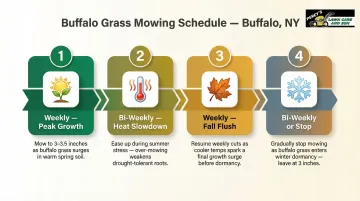
May through mid-June: Choose weekly mowing. Soil temperatures surpass 50°F, triggering active spring green-up and rapid vertical growth. This is when perennial ryegrass can grow 2–4 inches per week. Bi-weekly cuts will force you to scalp the lawn.
Mid-July through August: Consider bi-weekly mowing. Average highs of 80°F push cool-season grasses into energy deficit and semi-dormancy, naturally slowing growth. Bi-weekly cuts can maintain the one-third rule during this window. Raise your mower deck to 3+ inches to shade soil and preserve moisture.
September: Return to weekly or monitor closely. Temperatures drop back into the 60s and 70s, prompting a secondary fall growth flush. Resume weekly mowing as needed.
October: Wind down to bi-weekly or stop. As frost approaches and growth ceases, reduce frequency until the season ends.
The Lawn Health Angle
If you've been mowing bi-weekly and notice:
- Stressed, yellow-tipped grass after cuts
- Heavy clumps of clippings left behind
- Weeds gaining a foothold
These are signals to switch to weekly. Weekly mowing prevents weed establishment better than bi-weekly because weeds are removed before they can produce seeds.
Two Clear Reader Scenarios
Scenario A: You own a quarter-acre lot in Amherst with Kentucky bluegrass, an HOA with appearance standards, and a goal of maintaining strong curb appeal. Recommendation: Weekly mowing from May through mid-June and again in September; bi-weekly during the July–August slowdown.
Scenario B: You have a shaded backyard in Cheektowaga with mixed grass, no HOA pressure, and a tight budget. Recommendation: Bi-weekly mowing during summer months (mid-July through August) with close monitoring; switch to weekly if growth accelerates after heavy rains.
Percy's Lawn Care and Son builds schedules around each lawn's actual growth rate—not a fixed calendar. Whether you need weekly cuts through spring or a shift to bi-weekly in July, the team adjusts as the season changes across Buffalo, Amherst, Cheektowaga, and surrounding areas.
Conclusion
No single mowing frequency works year-round for every lawn. The right schedule depends on your grass type, growth rate, the season, and what you want your yard to look like. In Buffalo's climate, most homeowners do best by adjusting frequency throughout the year rather than locking into one routine from April through October.
A few signals worth watching:
- Grass growing faster than an inch per week — move to weekly cuts
- Growth slowing in July heat or late fall — bi-weekly is likely enough
- After heavy rain or fertilizing — mow sooner, regardless of schedule
- Heading into winter — drop to bi-weekly or stop once growth stalls
A well-timed mowing plan means healthier roots, better curb appeal, fewer weeds, and a lawn that holds up through Buffalo's unpredictable weather—whether that calls for weekly cuts in May or bi-weekly visits in August. Let your grass growth rate, not the calendar, be your guide. If you'd rather leave the scheduling to someone with 25 years of local experience, Percy's Lawn Care and Son has been managing Buffalo-area lawns since 1999.
Frequently Asked Questions
How much is lawn care per week?
Weekly lawn care in Buffalo typically costs $30–$50 per visit for a standard quarter-acre lot, or $120–$200 per month. Pricing varies by yard size, services included (edging, trimming, clipping removal), and whether you're working with a solo operator or an established company with commercial equipment.
Should you still water your lawn in October?
In Buffalo, October is when cool-season grasses prepare for dormancy. Shift to deep but infrequent watering rather than regular irrigation, and stop entirely before the first hard frost (historically late October). This prevents waterlogged soils and freezing damage as the turf transitions into dormancy.
Is bi-weekly mowing bad for your lawn?
Bi-weekly mowing isn't inherently harmful, but it can damage lawn health if grass grows more than one-third of its height between cuts. During Buffalo's May–June growth surge, bi-weekly mowing will violate this rule, stressing turf and inviting disease. During the July–August slowdown, bi-weekly cuts work fine.
How often should I mow my lawn in Buffalo, NY?
Buffalo's cool-season grasses typically require weekly mowing from May through mid-June, can shift to bi-weekly from mid-July through August, and then taper off in September and October as the season ends. Let growth rate, not a fixed schedule, guide your decision.
Can I switch between weekly and bi-weekly mowing throughout the year?
Absolutely. Flexible scheduling is recommended for Buffalo homeowners, since growth rates shift significantly across the season. Percy's Lawn Care and Son adjusts mowing frequency based on actual grass growth, so you're not locked into a one-size-fits-all plan year-round.
What happens if I let my lawn go too long between mows?
Skipping too many cycles forces you to cut more than one-third of the grass blade at once, which shocks the turf and can reduce root mass by up to 76%. It also leaves unsightly clumps of clippings that block sunlight and create openings for weeds and fungal diseases to take hold.