TLDR:
- Agricultural lime (calcium carbonate) is safe and non-caustic when used correctly
- Buffalo's clay soils and heavy rainfall naturally drive pH down, making lime essential
- Over-application or using hydrated lime (not agricultural lime) can cause real damage
- Soil testing is the only way to confirm lime needs before applying
- Fall is optimal for lime application in our region due to freeze-thaw cycles
Does Lime Actually Burn or Kill Grass?
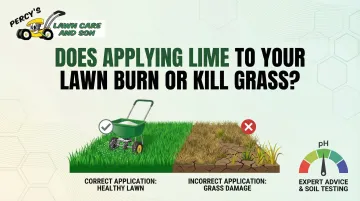
Under normal conditions, lime does not burn or kill grass. Agricultural lime — the calcium carbonate product used for lawns — won't scorch plant tissue the way chemical fertilizers or herbicides can.
What homeowners often mistake for "lime burn" is usually one of two things:
- Pre-existing lawn stress that becomes visible after disturbance (thinning, yellowing, or weak turf that was already struggling from acidic soil)
- Actual over-application that pushes soil pH too high (above 7.5), preventing nutrient uptake and causing grass to decline
The Rare True-Damage Scenario
Hydrated lime (calcium hydroxide) IS caustic and CAN burn grass. This is a completely different product from agricultural lime. Penn State Extension explicitly warns against using hydrated lime or burned lime on established turfgrass, as both can cause severe burning. Safety data sheets classify calcium hydroxide as corrosive, causing severe skin irritation, eye damage, and chemical burns.
Before buying, confirm you're using pelletized or agricultural lime (calcium carbonate) — not hydrated lime — and read the product label carefully.
Why Buffalo Lawns Are Particularly Prone to Confusion
Buffalo-area lawns face conditions that naturally drive soil acidity. Two factors push that process faster here than in most regions:
- Heavy annual rainfall (averaging 40.68 inches per year) leaches basic ions like calcium and magnesium from the soil, replacing them with acidic hydrogen and aluminum ions
- Clay-heavy soil composition slows drainage and concentrates that acidic buildup over time
This ongoing acidification means Buffalo homeowners often need lime more frequently — and are more likely to misapply it.
When you use the right type of lime, apply the correct amount based on a soil test, and follow proper timing, lime will help grass thrive, not hurt it.
What Lime Does for Your Lawn and Soil
Lime is a soil amendment made from ground limestone rock, primarily calcium carbonate (calcitic lime) or calcium and magnesium carbonate (dolomitic lime). It's not a fertilizer or pesticide — it's a pH adjuster.
How Acidic Soil Hurts Grass
When soil pH drops below 6.0, essential nutrients like nitrogen, phosphorus, and potassium become chemically "locked" in the soil and unavailable to grass roots. According to UMass Extension, in strongly acidic soils (pH below 5.2), the availability of calcium, magnesium, nitrogen, and phosphorus is significantly reduced. Fertilizer applications go to waste and grass starves even in nutrient-rich soil.
Toxic elements like aluminum and manganese also become highly soluble in acidic conditions, damaging root systems before grass has a chance to recover.
What Lime Actually Does When Applied Correctly
Lime raises soil pH back into the optimal range — typically 6.0 to 7.0 for most lawn grasses — unlocking those nutrients and allowing grass to absorb them. Grass that once looked pale, thin, or unresponsive to fertilizer can begin greening up as pH improves.
| Grass Type | Optimal pH Range |
|---|---|
| Kentucky Bluegrass | 6.5–7.2 |
| Tall Fescue | 5.5–6.5 |
| Perennial Ryegrass | 6.0–7.0 |
| Fine Fescues | 5.5–6.5 |
Kentucky bluegrass requires a slightly higher and narrower pH range, making it more sensitive to acidic soil conditions common in Buffalo.
Secondary Benefits of Liming
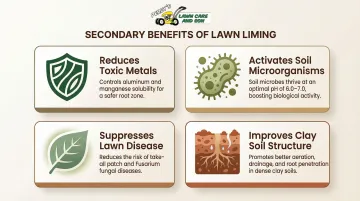
Beyond pH adjustment, lime provides several bonus benefits:
- Lowers solubility of aluminum and manganese, keeping toxic levels in check
- Activates beneficial soil microorganisms that break down thatch and organic matter (they thrive at pH 6.0–7.0)
- Suppresses turfgrass diseases like take-all patch and Fusarium patch by optimizing soil conditions
- Improves aeration and water infiltration in clay-heavy soils
How to Tell If Your Lawn Needs Lime
Visible Signs Your Lawn May Need Lime
Common indicators of acidic soil stress include:
- Yellowing or pale grass despite regular fertilizing
- Thin or patchy turf with bare spots that won't fill in
- Moss growing in shaded or damp areas
- Increase in broadleaf weeds like clover, plantain, or red sorrel
- Fertilizer applications producing no noticeable improvement
Penn State Extension notes that moss is most commonly associated with low soil pH, along with poor soil fertility, heavy shade, and excessive moisture. Broadleaf plantain, red sorrel, and prostrate knotweed are reliable indicator weeds for acidic soils.
Soil Testing: The Only Reliable Confirmation
Visual indicators are helpful, but a soil test is the only accurate way to confirm a lime need. A pH meter or basic test kit can give you a ballpark reading, but a full soil test reveals:
- Exact pH level
- Nutrient deficiencies
- Soil type
- Precise amount of lime needed
In the Buffalo area, Cornell Cooperative Extension (Erie County) offers pH testing services and facilitates comprehensive soil nutrient analysis. This prevents both under- and over-application.
Why Soil Type Matters
Clay soils — common throughout Erie County — require significantly more lime to achieve the same pH shift as sandy soils. Buffalo's predominant soil series (Erie, Niagara, and Wiscoy) are fine-loamy or fine-silty with high clay content.
These soils have a high natural buffering capacity, meaning they actively resist pH changes — so higher lime volumes are often needed to move the needle.
Contrasting Lime Deficiency vs. Over-Liming Symptoms
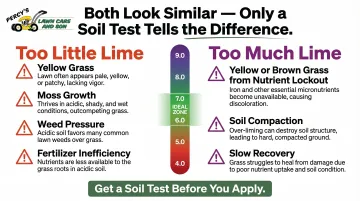
Too little lime:
- Yellow grass
- Moss growth
- Weed pressure
- Fertilizer inefficiency
Too much lime:
- Grass turns yellow or brown from nutrient lockout (especially iron and manganese deficiency)
- Soil becomes compacted
- Recovery is slow
Because deficiency and excess produce nearly identical symptoms, a soil test is the only way to know which problem you're actually dealing with — and how much lime, if any, to apply.
Situations Where Lime Can Harm Your Grass
Over-Application Without Soil Testing
Applying lime when your soil pH is already ideal or alkaline pushes pH too high. At a pH above 7.5, grass struggles to absorb iron and manganese. Purdue Extension reports that iron availability is lowest between pH 7.5 and 8.5.
The most noticeable symptom is interveinal chlorosis — yellow leaves with dark green veins — which eventually causes plant cells to die and turn brown. Unlike fertilizer burn, which typically appears as scorched tips, this yellowing follows the leaf veins and spreads inward.
Using the Wrong Product
Hydrated lime is not for lawns. It's caustic enough to burn grass and damage soil biology on contact. For residential turf, stick to agricultural lime or pelletized lime — and check the product label before buying to confirm which type you have.
Applying Lime During Drought or Heat Stress
Lime applied to dry, stressed grass can sit on leaf blades and cause surface irritation. Ohio State Extension advises against applying lime to wilted or drought-stressed turf. Water lime in immediately after application, and time your spreading for periods when grass isn't already struggling from heat or lack of rain.
How to Apply Lime Safely to Your Lawn
Step-by-Step Application Guidance
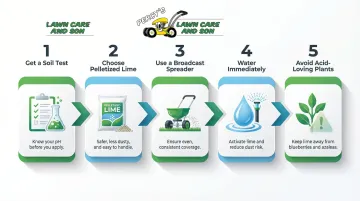
- Get a soil test first - Confirm your pH and determine the exact lime requirement
- Choose pelletized lime - Easier to spread, creates less dust, and acts faster than powdered lime
- Use a broadcast spreader - Apply in two perpendicular passes for even coverage
- Water immediately - Helps lime penetrate soil and prevents foliar irritation
- Avoid acid-loving plants - Don't apply near azaleas, rhododendrons, or blueberries
Dosage Guidelines
Follow soil test recommendations closely. Typical rates are around 50 lbs per 1,000 sq. ft., though exact needs vary by lawn.
| Source | Maximum Single Application | Split Application Guidance |
|---|---|---|
| Cornell University | 50 lbs per 1,000 sq. ft. | If more than 50 lbs needed, split between fall and spring (3-6 months apart) |
| Penn State University | 100 lbs per 1,000 sq. ft. | If more than 100 lbs needed, use semiannual applications |
For Buffalo homeowners: Buffalo's clay soils often require higher lime rates. Adhering to Cornell's conservative 50 lbs per 1,000 sq. ft. guideline minimizes risk of surface residue and turf stress.
Professional Application Option
Percy's Lawn Care and Son has over 25 years of experience working with Buffalo-area lawns and understands the local soil conditions that make lime application both more necessary and nuanced in this region. If your soil test shows a pH below 5.5, you've applied lime before without improvement, or you're unsure how to read your results, professional application takes the uncertainty out of the process. Getting the product, rate, and timing right matters — especially when Buffalo clay soils don't respond the same way as typical loam.
When Not to Apply Lime to Your Lawn
Conditions to Avoid
Do NOT apply lime when:
- Ground is frozen or waterlogged
- During extreme heat or drought
- Immediately after seeding (lime can interfere with germination)
- Soil test shows pH is already at or above ideal range
- Heavy rain is forecast within 24–48 hours (risk of runoff)
Best Timing Windows
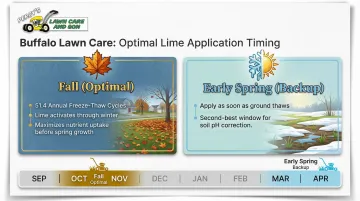
Two windows work best for lime applications in Buffalo:
- Fall (optimal): Cool-season grasses respond well, and lime has all winter to break down before the spring growing season. Penn State Extension notes that fall applications allow rain, snow, and freeze-thaw cycles to help work limestone into the soil. Buffalo averages 51.4 freeze-thaw cycles annually, making fall applications especially effective here.
- Early spring: A solid backup if you miss the fall window — apply as soon as the ground thaws.
How Long Does Lime Take to Work?
Lime does not produce instant results. Even pelletized fast-acting lime typically needs 3–6 months before soil pH shifts noticeably — so patience is part of the process.
Frequently Asked Questions
Does lime kill grass?
Agricultural lime does not kill grass under normal conditions. It's a pH-correcting soil amendment that helps grass thrive. Over-application or using the wrong product (hydrated lime) can cause damage, but correct use of pelletized or agricultural lime is safe.
How long does it take for lime to turn grass green?
Expect several weeks to a few months before soil pH shifts noticeably. Pelletized lime generally acts faster than traditional powdered lime, and how much greening you see depends on how low the pH was to begin with.
How do you tell if your lawn needs lime?
Visual signs include yellow or pale grass despite fertilizing, moss growth, broadleaf weeds like plantain or red sorrel, and patchy turf. That said, a soil test is the only accurate way to confirm you actually need lime before applying.
When should you not put lime on your lawn?
Avoid applying lime to frozen or waterlogged ground, during extreme heat or drought, when pH is already adequate or alkaline, or when heavy rain is imminent. Fall and early spring are the ideal windows for Buffalo-area lawns.
Can I apply lime and fertilizer at the same time?
Apply lime first and wait 2–3 weeks before fertilizing. Lime needs time to shift soil pH before fertilizer can work at full effectiveness — applying both at once isn't harmful, but you'll get less out of each.
How much lime is too much for a lawn?
Applying more lime than your soil test recommends — or applying lime to soil that doesn't need it — can push pH above 7.5, triggering nutrient lockout (especially for iron and manganese) and causing grass to yellow and thin. Always follow soil test recommendations.