
According to the Bureau of Labor Statistics, Americans spend an average of 73 hours annually on lawn and garden care—that's nearly two full work weeks every year. For Buffalo-area homeowners, the challenge is even steeper: our harsh winters, heavy snowfall (averaging 95.4 inches annually), and Zone 6a-6b climate mean plant selection matters more than anywhere else. Choose the wrong plants, and you're signing up for extra work. Choose regionally hardy, climate-appropriate options, and nature does most of the heavy lifting.
The 7 ideas below are practical, proven strategies that genuinely reduce ongoing effort—not temporary fixes, but foundational design choices that save you hours every season.
Key Takeaways
- Replacing lawn with mulched beds cuts mowing time and suppresses weeds naturally
- Native perennials and evergreen shrubs return year after year with zero replanting
- Hardscaping permanently removes lawn sections from your to-do list
- Ground covers solve problem areas like shade and slopes where grass fails
- Grouping plants by water and sun needs upfront eliminates years of repetitive maintenance
What "Low Maintenance" Really Means for a Front Garden
Low maintenance isn't zero effort—it's fewer repetitive tasks. A well-designed front garden still needs a few hours of attention per season, but you're not trapped in an endless cycle of mowing, watering, deadheading, and replanting.
The two biggest time drains in most front yards:
- Maintaining a large grass lawn — weekly mowing, watering, fertilizing, and fighting weeds
- Replanting annual flowers every year — buying new plants each spring, pulling out dead ones each fall
The ideas below specifically target these time sinks. They shift the work from ongoing repetition to thoughtful, one-time setup. Getting that setup right, though, starts with choosing the right plants for Buffalo's specific conditions.
Why Buffalo's climate makes plant selection extra important:
Buffalo sits in USDA Hardiness Zone 6a-6b, with winter lows reaching -10°F to 0°F and an average annual snowfall of 95.4 inches. Plants that aren't adapted to these conditions need extra watering, winter protection, pest control, or frequent replacement.
Regionally hardy plants are already accustomed to local soil, rainfall patterns, and temperature swings. Once established, they largely look after themselves—which is exactly the goal.
7 Low Maintenance Front Garden Ideas That Actually Work
Idea 1: Replace Some (or All) of Your Lawn With Mulched Garden Beds
Reducing lawn area is the single highest-impact change you can make. Every square foot of mulched bed is a square foot that never needs mowing again.
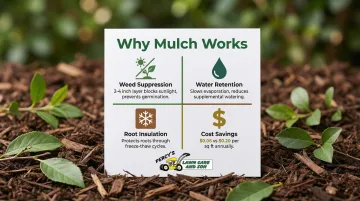
Why mulch works:
- A 2-4 inch layer of mulch blocks sunlight, preventing weed seeds from germinating
- Slows evaporation, reducing the need for supplemental watering during dry spells
- Insulates plant roots through Buffalo's harsh freeze-thaw cycles
- Cuts costs: maintaining a natural planting area runs approximately $0.06 per square foot annually, versus $0.20 per square foot for weed-free turf
What a well-designed mulched bed looks like in practice:
- Clearly edged borders to separate bed from lawn and prevent grass creep
- A mix of low and mid-height plants so the bed fills in naturally and chokes out weeds
- Bark or hardwood mulch refreshed with a 1-2 inch top-up once per year to maintain optimal depth
Getting it right the first time:
Professional landscaping setup ensures proper bed edging, soil preparation, and mulch depth—a one-time investment that pays off in years of easier upkeep. Percy's Lawn Care and Son has been serving Buffalo-area homeowners for over 25 years, with deep knowledge of Western New York's soil and climate conditions.
Idea 2: Choose Native Perennials Over Annual Flowers
The key difference:
Annuals die every year and must be replanted. Perennials come back on their own—and in Buffalo's climate, they return stronger each year.
Reliable hardy perennials for Zone 6a:
- Black-eyed Susans (Rudbeckia hirta) — bright yellow blooms, hardy zones 3-7
- Purple Coneflowers (Echinacea purpurea) — drought-tolerant once established, hardy zones 3-8
- Catmint (Nepeta) — fragrant foliage, minimal care, hardy zones 3-7
- Russian Sage (Perovskia atriplicifolia) — silvery leaves, lavender blooms, hardy zones 5-9
- Daylilies (Hemerocallis) — diverse colors, nearly indestructible, hardy zones 3-9
Once established, native and regionally adapted perennials rarely need fertilizing, extra watering, or pesticide treatment.
They're already adapted to Buffalo's soil, rainfall patterns, and local pest pressures. Native plants can survive on natural rainfall alone once they've settled in.
Idea 3: Plant Evergreen Shrubs for Year-Round Structure
Evergreen shrubs give a front garden structure and color in every season—including winter when everything else dies back. Most need pruning only once or twice a year at most.
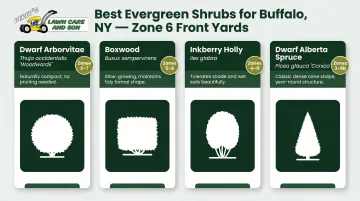
Top evergreen shrubs for Buffalo front yards:
- Dwarf Arborvitae (Thuja spp.) — hardy zones 2-7, naturally compact
- Boxwood (Buxus spp.) — hardy zones 5-8, slow-growing dwarf cultivars rarely need pruning
- Inkberry Holly (Ilex glabra) — hardy zones 4a-11b, tolerates shade and wet soil
- Dwarf Alberta Spruce (Picea laxa 'Conica') — hardy zones 3a-6b, classic cone shape
Why slow-growing dwarf varieties are ideal:
Fast-growing shrubs outgrow their space quickly, blocking windows and requiring frequent heavy pruning. Dwarf varieties maintain their compact form naturally, eliminating the need for constant trimming.
Preventing winter burn in Western NY:
Winter burn (desiccation) happens when frozen ground prevents root water uptake while winter sun and wind continue to draw moisture from evergreen foliage. Plant evergreens on the north or northeast side of buildings to protect them from winter wind and sun, and avoid late-summer pruning, which stimulates vulnerable new growth.
Idea 4: Use Ground Cover Plants in Problem Areas
Ground covers shine in spots where grass fails and requires constant intervention:
- Shady areas under trees where grass won't grow
- Steep slopes that are dangerous to mow
- Narrow strips between walkways and the house
Once established, ground covers spread to fill the area and block out weeds on their own.
Reliable low-maintenance ground covers for Buffalo:
| Plant | Best For | Hardiness Zone |
|---|---|---|
| Creeping Phlox (Phlox subulata) | Full sun, well-drained soil | Zone 6 |
| Pachysandra (Pachysandra terminalis) | Shade, competes well with tree roots | Zones 5-9 |
| Hostas (Hosta spp.) | Shade, slightly moist soil | Zones 3-8 |
| Creeping Thyme (Thymus serpyllum) | Full sun, dry/sandy soils, walk-adjacent areas | Zones 4-8 |
Ground covers like creeping phlox strongly suppress weed growth by preventing new weed seedlings from establishing through dense foliage coverage.
Idea 5: Add Hardscaping to Permanently Reduce Lawn Area
Every element of hardscaping—stone walkway, gravel area, paver border, stepping stone path—permanently removes a section of lawn from the maintenance equation. No mowing, no watering, no weeding that area again.
Practical hardscaping ideas for different budgets:
- Pea gravel border around existing beds — $30-$35 per cubic yard, excellent drainage, easy DIY installation
- Wider front walkway that replaces a weedy strip along the path
- Small paver seating area near the front porch for functional curb appeal
Best materials for Buffalo's freeze-thaw climate:
- Interlocking concrete pavers — top-rated for freeze-thaw climates because they distribute stress across multiple joints rather than concentrating it in single crack lines
- Decomposed granite — flexes with freeze-thaw cycles and can be easily repaired by adding more material, watering, and compacting
Idea 6: Plant Ornamental Grasses for Texture and Easy Interest
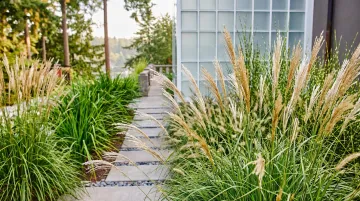
Ornamental grasses are a low-maintenance win:
- Clump-forming (not invasive spreaders)
- Drought-tolerant once established
- One annual haircut in late winter before new growth
- Four seasons of interest from summer plumes to winter structure
Top ornamental grasses for Buffalo:
- Karl Foerster Feather Reed Grass (Calamagrostis × acutiflora 'Karl Foerster') — hardy zones 5-9, narrow-vertical habit, sterile (won't self-seed)
- Blue Oat Grass (Helictotrichon sempervirens) — hardy zones 3-8, steel-blue foliage
- Little Bluestem (Schizachyrium scoparium) — hardy zones 3-9, native option, high drought tolerance
The one annual cut:
Cut back stems and old foliage to about 6 inches in late winter or very early spring before new growth begins. That's it.
Idea 7: Plant One Low-Maintenance Specimen Tree as a Focal Point
The right tree adds four seasons of interest to a front yard with virtually no annual maintenance beyond occasional cleanup.
The key is choosing the right size and species:
A tree that's too large for the space creates gutter-clogging debris and root problems. The right tree simply grows and looks beautiful.
Reliable low-maintenance trees for Buffalo front yards:
| Tree | Hardiness Zone | Mature Size | Key Feature |
|---|---|---|---|
| Serviceberry (Amelanchier spp.) | Zone 3b+ | 6-25' tall, 10-20' spread | Multi-season interest, small size |
| Eastern Redbud (Cercis canadensis) | Zone 5b+ | 20-35' tall and wide | Spring color, heart-shaped leaves |
| Kousa Dogwood (Cornus kousa) | Zone 5a+ | 20-30' tall and wide | Disease-resistant, fall berries |
The root flare rule:
Trees must be planted so the root flare is visible at or just above the soil line. Planting too deep deprives roots of oxygen and can lead to girdling roots that eventually strangle the plant. Proper initial placement and planting depth are the most important factors for a trouble-free tree.
General Tips to Keep Any Front Garden Low-Effort Year-Round
A few simple habits at the start of the season pay off all year long. These three principles do most of the heavy lifting:
- Fill in bare soil with dense planting — fewer open patches means fewer weeds. Space plants so they close gaps within a season or two, cutting down on hand-weeding significantly.
- Prep soil before you plant — loosen it to depth and mix in compost so roots establish faster. Strong, established plants need less supplemental watering and feeding over time.
- Top up mulch once each spring — a 1-2 inch refresh restores the 3-inch depth needed to suppress weeds and hold moisture, while keeping beds looking neat with almost no ongoing effort.
Conclusion
The best low-maintenance front garden starts with the right design decisions — not just the right products. Every idea above works because it removes the source of recurring work, whether that's compacted soil that kills grass, bare beds that invite weeds, or plants that can't survive a Western New York winter.
Homeowners in the Buffalo area who want help putting these ideas into practice can reach out to Percy's Lawn Care and Son. The team offers landscape design and installation services across Amherst, Cheektowaga, West Seneca, and surrounding areas.
With over 25 years working in Western New York, Percy's knows which plants hold up through harsh winters and which setups actually cut down on weekly upkeep — not just on paper, but in practice.
Frequently Asked Questions
Frequently Asked Questions
What low maintenance plants to put in front of a house?
The best categories for easy front-yard care are evergreen shrubs for structure, native perennials like coneflowers and daylilies for color, and ornamental grasses for texture. Matching plants to your local hardiness zone — Zone 6a–6b for Buffalo — is the single most important factor for truly hands-off results.
How do I reduce lawn maintenance in my front yard?
The most effective approach is to reduce the size of the lawn itself. Replacing sections with mulched planting beds, ground cover, or hardscaping like gravel and pavers permanently removes those areas from the mowing and watering rotation.
What is the easiest front garden to maintain?
The easiest front gardens combine evergreen shrubs, native perennials, and mulched beds. This combination requires only a mulch refresh in spring, one annual pruning, and minimal watering once plants are established.
Do native plants need to be watered after they are established?
Once established (typically after one full growing season), most native and regionally adapted plants can survive on natural rainfall alone in climates like Buffalo's. Plan on supplemental watering during the first summer and any extended dry spells after that.
How often should mulch be replaced in garden beds?
Mulch typically needs a top-up of 1–2 inches once per year, usually in spring, to maintain the 3-inch depth needed to suppress weeds and retain moisture. Every few years, replace the full layer to prevent compaction and organic buildup.